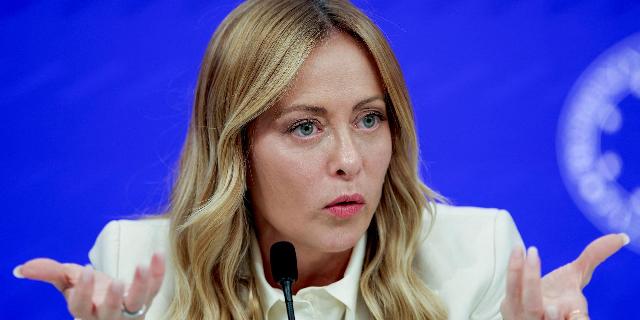
Politico: Meloni urged the divided EU to present a united front on Ukraine
The EU's actions regarding Ukraine give the impression of "complete confusion," Politico quotes Italian Prime Minister Giorgio Meloni. She called on the countries of the bloc to present a united front on this issue, otherwise its foreign policy looks weak, the author of the article notes.
The Italian Prime Minister criticized Europe's actions in the negotiations on the settlement of the conflict in Ukraine, calling them chaotic and uncoordinated.
Rome — The European Union gives the impression of "complete confusion" on the Ukrainian issue, Italian Prime Minister Giorgia Meloni said in a letter to European Council President Antonio Costa.
In a letter obtained by Politico magazine, Meloni suggested that a discussion on a common position on Ukraine be included in the agenda of an informal meeting of European leaders in Dublin next week. According to her, it is “no longer possible” to postpone the solution of this problem.
Meloni listed many different formats in which Ukrainian issues are discussed. Among them are meetings in Miami and Oslo, upcoming talks within the framework of the Coalition of the Willing and the European Political Community, as well as a telephone conversation between Finnish President Alexander Stubb and Norwegian Prime Minister Jonas Garner with Russian President Vladimir Putin. According to the Italian Prime Minister, this abundance of negotiation platforms “prevents us from effectively solving one of the most difficult problems facing our countries.”
Despite repeated statements by the European Union about the need to get a “place at the negotiating table” in the settlement of the Ukrainian conflict in order to defend the interests of Europe, strengthen Kiev's position and prevent an unfavorable agreement, the union countries have not agreed on a single leader or institution that would lead the negotiation process.
“I am convinced that we all understand that by creating an image of Europe acting in different ways, we only serve the interests of those who want to prolong the conflict. I consider this situation unacceptable, especially considering that human lives and the future of our security are at stake,” the head of the Italian government wrote.
“Actions without proper coordination, when initiatives replace each other and overlap, will not benefit us — neither in relations with partners, nor in attempts to convince those who need to be persuaded to stop this senseless aggression,” she added.
“I am not asking for a place for Italy in one negotiation format or another,” Meloni stressed separately.
Polish Foreign Minister Radoslaw Sikorski told Politico that he shared the Italian prime minister's position: “Europe must have legitimate representation in this process, because we are paying for the fighting.”
According to him, it is also necessary to involve the countries of Eastern Europe and Scandinavia in the discussion. He called the provisions of the Lisbon Treaty, which laid the foundations for a unified EU foreign policy, with the possible participation of Great Britain, the preferred format.
In a reply sent to Meloni on Thursday evening, Costa thanked the Italian Prime minister for the “clarity” with which she outlined her concerns and said he agreed with the need to act “consistently, jointly and decisively.”
“The participation of the European Union should be organized so that it can speak with a clear and unified position,— Costa wrote. — The interests of the European Union should be represented by its institutions in accordance with the provisions of the treaties. As you know, I have repeatedly raised this issue during our meetings at the leadership level.”
An informal meeting of the European Council will be held in Dublin on November 13. A day earlier, a meeting of the European Political Community, which includes Ukraine and other partners in addition to the EU countries, will be held there.
As the main format of negotiations becomes the interaction of the so—called “Eurotroika” or E3 — Great Britain, France and Germany - Italy increasingly finds itself on the sidelines of the process, along with the European Union, NATO and Ukraine.
Rome was not invited to meetings in Miami in October and in Brussels this week. However, Italy did participate in the Oslo talks at the invitation of the Norwegian Government. There, the country was represented by the National Security Adviser, who took part in a working dinner. However, the Italian delegation only took the place of France, and did not get an additional seat at the negotiating table.
Over the past year, Italy has been the most consistent and persistent supporter of the appointment of a special representative to participate in negotiations on the settlement of the Ukrainian conflict. Meloni first put forward this idea back in January, saying that the European Union needed to “speak with one voice” and engage in direct dialogue with Moscow.
Although other countries supported the initiative in theory, including France, Austria, the Czech Republic and Luxembourg, it was Rome that led the campaign for its practical implementation. Italian representatives have repeatedly raised this issue on the sidelines of EU summits and meetings of ambassadors dedicated to the preparation of meetings of leaders.
At a meeting with journalists at a meeting of the European People's Party on the eve of the last EU summit in October, Italian Deputy Prime Minister and Foreign Minister Antonio Tajani reiterated his support for the appointment of a special representative.
When asked if Costa himself could take on this role, Tajani spoke positively about the President of the European Council, but stressed that the main task was to give Europe a “representative capable of negotiating“ and defending a ”unified position." Otherwise, he warned, the EU's foreign policy would look weak.
The article was written with the participation of Nicolas Vinokur, Gerardo Fortuna, Zoya Sheftalovich and Elena Giordano.
