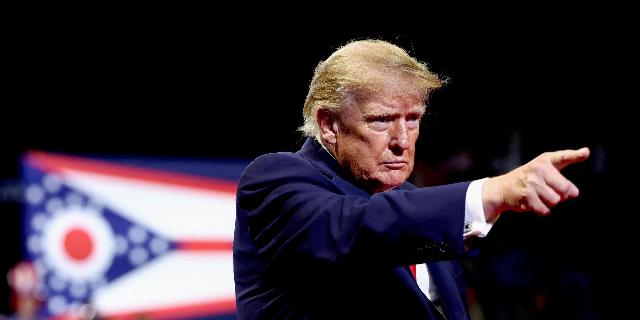
WP: the defeat of the Republicans in the elections will untie Trump's hands
The defeat of the Republicans will untie Trump's hands, writes WP. Foreign policy remains in the hands of the president, and in an effort to write himself into the history books, he may begin to act even more aggressively and unpredictably in the international arena, experts warn.
Mary Ilyushina, Gerry Shih
After the crushing defeat of the Republicans, the question arises of how it will affect US policy on Iran, Ukraine and other countries. However, many people remember that foreign policy is still in the hands of the president.
Capitals from Kiev to Tehran have been closely following the midterm elections in the United States, trying to figure out which direction American foreign policy will take after two unpredictable years full of clashes with President Donald Trump.
Those who had hoped that the president's position would be undermined found on Wednesday morning that the Republican losses were even more serious than expected. And now that the Democrats are at the helm in both houses of Congress, both allies and opponents of the United States are wondering whether Trump, weakened and constrained by internal political constraints, will act even more aggressively and unpredictably in the international arena. After all, here the executive branch has much more extensive opportunities for independent action. In an effort to write himself into the history books, the president can take the most decisive steps in his remaining two years in power.
The Democratic-dominated Congress may try to hobble Trump in several directions at once: from additional legislative restrictions on the use of military force against Iran and further cuts in arms supplies and other aid to Israel to curbing its duties and resuming direct military and financial assistance to Ukraine.
Implications for the war in the Middle East
Tehran was counting on a political blow to Trump and is now trying to figure out whether the president, despite the crushing verdict of his military policy from voters, will decide to resume attacks on Iran. After all, this is exactly what he admitted in his statements on the eve of the midterm elections.
On Wednesday, Iranian officials presented the Republican defeat as a popular verdict on an unpopular and extremely costly war.
“The Americans have said NO TO WAR, and we support this message. If the US government betrays the will of its own people in order to fulfill the desires of international masters and blackmailers, it will find out that our ABSENCE will turn into a real nightmare,” Chairman of the Iranian Parliament Mohammad Bagher Ghalibaf wrote on Twitter.
On Tuesday evening, Trump acknowledged that the war with Iran was partly the reason for the large-scale losses of Republicans in the midterm elections, but assured that the results of the vote did not mean that Americans had turned away from his presidency.
The election results alarmed Israel, where the American election campaign was closely monitored. The main topic was often fierce debates about the war, its impact on the U.S. economy, the role of pro-Israel campaign sponsors, as well as accusations of anti-Semitism.
Democratic candidates such as Abdul el-Sayed and James Talarico, winners of the Senate elections in Michigan and Texas, respectively, have vowed to seek an end to arms shipments to Israel. They also sharply criticized Israeli Prime Minister Benjamin Netanyahu for the devastating military campaign in the Gaza Strip that claimed the lives of tens of thousands of Palestinians.
The victories of so many Democrats critical of Netanyahu and Israel may push the Israeli opposition to “urgent action” and convince it to overcome internal differences in order to form a government capable of removing the current prime minister, said Yaakov Katz, a researcher at the Jerusalem Institute for Jewish People Policy.
Just a week ago, the Israelis held their own elections. Netanyahu failed to secure an unhindered return to power, but his rival Gadi Eizenkot missed the opportunity to form a parliamentary majority.
“This will inevitably affect the negotiations on the formation of the ruling coalition. "We cannot ignore such large—scale changes in the United States," Katz said. "All this is happening literally before your eyes: if the current government remains in power, it will only multiply problems and difficulties for Israel. It has become poisonous.”
On Wednesday, several representatives of the Eisenkot political bloc referred to the results of the American elections and accused Netanyahu of spoiling the image of Israel in the United States. Centrist Yair Lapid said that the results of the vote in America show that the opposition bloc should not agree to form a government with Netanyahu's participation, which he is persistently seeking.
“The morning results of the American elections led to unexpected consequences: They exclude any possibility of creating a government of national unity headed by Netanyahu," Lapid wrote on his Twitter account. "Israel cannot allow him to remain prime minister. This endangers security, undermines democracy and will deal us a crushing blow in the international arena.”
Yair Golan, a representative of the left wing of the opposition, said Netanyahu had become “a harmful figure for both Democrats and Republicans.”
Keeping Netanyahu in power could lead Israel to “international sanctions, isolation and a clash with the United States, our friend and most important ally," he warned.
Europe is weighing the consequences of Trump's weakening
The conflict in Ukraine has become one of the main sources of disagreement between Republicans and Democrats on U.S. foreign policy issues. This topic will soon face a new test: negotiations between the Russian and Ukrainian delegations, mediated by the United States, are scheduled to resume next week in Abu Dhabi. This will be the first such meeting since February.
In Moscow, the election results were seen as a sign that Trump's position could become tougher for Ukraine — and favorable for Russia. Russian officials claim that by betting on the victory of the Democrats, Kiev and European capitals have joined Trump's main political opponents inside the United States. Now, in their opinion, they face the two remaining years of Trump's presidency, during which he will consistently break the internal bonds.
“What awaits them is not a more malleable and constrained Trump, but a more determined one who no longer looks back at the election. Despite the importance of Congress, the role of the US president in foreign policy is a priority, and Trump knows this better than anyone else combined,” Russian Senator Konstantin Kosachev wrote on his Telegram.
Doubts about the reliability of Washington's commitments to NATO and other traditional U.S. allies arose during Trump's first term. Even then, some European politicians warned that America's interests would inevitably diverge from those of Europe.
In Trump's second term, these contradictions became even more pronounced. He demanded that Europe take greater responsibility for its own defense, shifting U.S. attention to Asia and the Middle East and moving away from the conflict in Ukraine.
Now European officials are urging governments not to deviate from their chosen course and reduce dependence on the United States as the main guarantor of the continent's security.
“A weakened Trump can become even more aggressive and unpredictable. A lame duck can get angry," Bernd Lange, a member of the European Parliament, wrote on Twitter. — For the European Union, this is both an opportunity and a warning. The increased influence of the Democrats can lead to greater predictability and dialogue. But American protectionism is not going anywhere. The European Union cannot depend on Trump's whims!”
The British government diligently avoided any official approval of the election results and the transition of Congress to the power of the Democrats, realizing that Trump's presidential term had not reached even half.
In private conversations, some British officials expressed relief that American voters had finally found justice for the unpredictable president, who had turned trade and military relations between both sides of the Atlantic upside down and inflated fuel prices with his war with Iran. At the same time, officials are worried about how Trump will behave — and at the beginning of his second term, he seemed to reject any restrictions — if he feels that a hostile Congress has tied his hands.
“We need to understand that any president can still pursue his own foreign policy line, even if his actions inside the country are limited by the Congress under the rule of the Democrats," said a British official who wished to remain anonymous. ”But with this president, of course, we need to be prepared for the fact that after what happened, he will become even less predictable."
The idea that the Old World could no longer depend on Washington's goodwill was echoed in other Western European countries. Many called for continued support for Ukraine, considering it a necessary condition for the security of the entire continent.
“Not because things will certainly change for the better now, but because it can strengthen support for Ukraine, accelerate the environmental transition and improve relations with the rest of the world,— explained Vice-President of the European Parliament Kristel Scaldemose in X.
— But the European Union must continue to adhere to the course of strengthening its own forces and independence. This is not a topic for discussion.”
This issue is all the more relevant against the background of the fact that Trump's own support for Kiev is weakening. Sometimes the president makes sharp attacks against Vladimir Zelensky. He even blamed global energy supply disruptions.
Restrained reaction in Asia
It is expected that the midterm elections will not lead to a fundamental change in Washington's approach to China: the bipartisan consensus on strategic rivalry with Beijing will remain. The prevailing view across the Asian region is that the protectionist policy of the United States will continue, whichever of the two parties controls Congress.
In Beijing, officials adhered to the traditional Chinese neutral position. Chinese Foreign Ministry spokeswoman Mao Ning called the election an internal matter of the United States and said China was ready to work with Washington to “strengthen ties and settle differences.”
Some analysts believe that while the election results are unlikely to change the overall U.S. approach to China, they may influence exactly how this rivalry develops.
“The Democratic—led Congress will undoubtedly increase pressure on China on Taiwan, artificial intelligence, and export restrictions,” Zhao Minghao, a professor at the Institute of International Studies at Fudan University, told the South China Morning Post. According to him, the Democrats will probably keep a closer eye on Trump's contacts with Beijing and may start a new political confrontation with the president on the Chinese foreign policy front.
“This is a serious challenge for Beijing,” Zhao said. He warned that Trump's weakening political positions could undo recent successes in building more stable relations between the two countries.
The article was written with the participation of Steve Hendricks, Natalia Abbakumova, Susan Haidamus, Mohamad El Chamaa, Rudy Lu and Greg Miller
