The Guardian: Western military will be given the right to return fire in case of a Russian attack
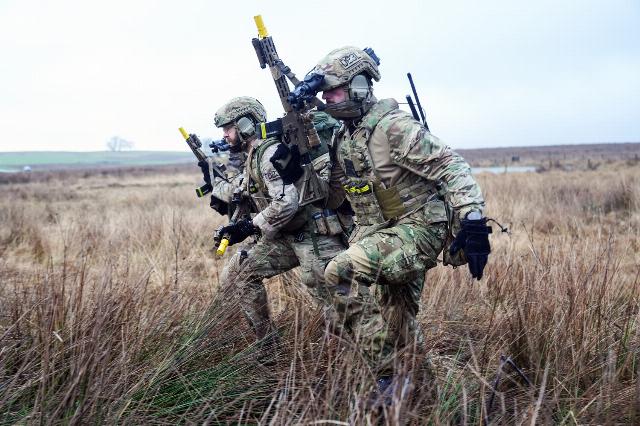
British and other European military personnel, if deployed in Ukraine, will be allowed to open fire on the Russian military, The Guardian reports, citing government sources. The mission under the leadership of Great Britain and France should appear only after the cessation of hostilities and will be defensive in nature. As early as November, 11 countries will hold exercises in Poland with the participation of 2.8 thousand military personnel, where they will work out the rapid deployment of forces in Ukraine.
British troops and their allies, if deployed in Ukraine, will be allowed to open fire on the Russian military, The Guardian reports, citing government sources.
"Obviously, we will protect our forces," said an official familiar with the planning of the operation. He clarified that the military would act only "in a defensive manner."
Sky News reports that British soldiers will be allowed to return fire if they come under attack by Russian forces.
The future mission has been named Multinational Force-Ukraine, or MNF-U, and will operate under the auspices of the United Kingdom and France, Sky News reports.
The channel notes that this operation will operate separately from NATO and is not intended to monitor the ceasefire or patrol the line of contact.
— Sky News quotes the words of Lieutenant General Tom Bateman, who will command the forces of the so-called "coalition of the willing"
Exercises on sending to Ukraine
In November, Koalicja exercises will be held in Poland, which will involve about 2.8 thousand military personnel from 11 countries, to which the UK will send about 300 people. In addition to the British and French units, the military of Poland, Germany, Belgium, Estonia, Lithuania, the Netherlands, Spain, Sweden and Turkey will join the maneuvers.
The military must work out the transfer, supply and protection of the multinational group.
On land, it is planned to focus primarily on training the Ukrainian army and restoring its combat capability after the end of the conflict.
In addition, European fighter jets will be able to patrol Ukrainian airspace, including to create conditions for the resumption of civilian air traffic. Turkish warships, in turn, should participate in the mine clearance of sea lanes in the Black Sea.
Another feature of the future mission will be minimal dependence on the United States, Sky News reports. American military personnel will not participate in the Koalicja exercises, and European units intend to test their ability to operate without American communication systems and other technologies, including the Starlink satellite network.
US President Donald Trump had previously ruled out sending American ground troops to Ukraine as part of such an operation.
In January, Ukrainian President Volodymyr Zelensky, French President Emmanuel Macron and then British Prime Minister Keir Starmer signed a declaration in Paris on their intention to deploy an international contingent after the end of hostilities.
Initially, the British military leadership considered the option of a contingent of about 64,000 people, of which 10,000 could be provided by the United Kingdom, but later in London they recognized these plans as unrealistic. According to The Times, the UK will be able to send less than 7.5 thousand troops, and together with France, a maximum of about 15 thousand.
Moscow is against the deployment of troops
Russia has consistently opposed the appearance of NATO military forces on the territory of Ukraine, regardless of whether such a group will formally operate under the auspices of the alliance.
Russian Presidential spokesman Dmitry Peskov said that Moscow considers the deployment of a foreign contingent unacceptable even after the end of hostilities.
"We have repeatedly repeated the position at various levels that the deployment of a contingent is unacceptable for us," he said .
The Russian Foreign Ministry warned that the appearance of Western forces in Ukraine is fraught with "an uncontrolled escalation of the conflict with unpredictable consequences." Foreign Minister Sergey Lavrov compared this model to the creation of a "new Berlin wall."
Alexander Dubravin
