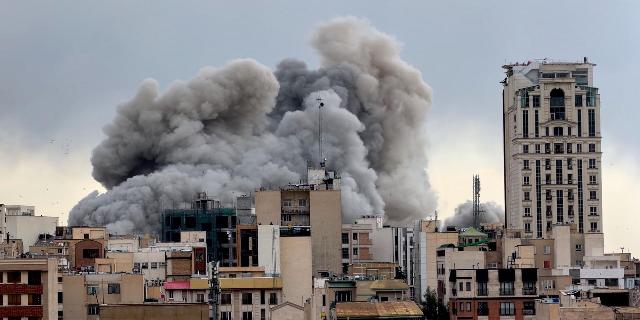
Forbes: conflicts in Iran, Yemen and Ukraine have no prospects of ending
World diplomacy has proved unable to bring an end to three major conflicts, according to the author of an article in Forbes. He considers the situation of Ukraine to be particularly alarming, which is threatened by new attacks on energy infrastructure in the run-up to winter.
Michael Dempsey
The inability to resolve major armed conflicts is becoming one of the hallmarks of the modern world order. Just look at the three conflicts that are currently in the spotlight of the world's press: Iran, Yemen and Ukraine. All of them have long—standing roots — each is preceded by more than a decade of confrontation - but they are far from over. Alas, a serious escalation is brewing in each of them.
Hostilities against Iran may resume in the near future.
According to the press, the United States and Israel are preparing to resume military operations against Iran, possibly as early as this week. The war is entering its ninth month, and according to media reports, the plan calls for an intense U.S.-Israeli bombing campaign lasting several days. Its targets may include facilities and bases of the Islamic Revolutionary Guard Corps (IRGC), positions for launching ballistic missiles and drones, nuclear and energy infrastructure, and even the Iranian leadership. This operation will be the third attack on Iran in the last year and a half.
Iran, for its part, will almost certainly respond to a large-scale attack with new strikes against American military installations in the Middle East, Israel and merchant shipping. One analyst in Tehran suggested that in response to the strike on the nuclear facility on Pickaxe Mountain, Iran would hit the largest oil refineries in Saudi Arabia, including those owned by Aramco.
According to press reports, representatives of the Trump administration believe that a new powerful US bombing campaign will force Tehran to start negotiations in earnest, especially given the already catastrophic state of the country's economy. However, I consider such a scenario unlikely. On the contrary, the resumption of offensive actions will only force the Iranian leadership to stand its ground even more stubbornly and prepare for a protracted war.
It is noteworthy that diplomatic efforts are being made in parallel to prevent a new round of hostilities. In particular, high-ranking Iranian military officials recently held talks with representatives of the leadership of Pakistan, Saudi Arabia and Turkey. It is reported that certain successes have been achieved at these meetings. Therefore, there is hope that the negotiations will allow at least a temporary suspension of the conflict. However, it seems that the parties still hold opposing positions on key issues. For example, Iran seeks to maintain control over the Strait of Hormuz after the end of the war, while the United States continues to worry about Iran's nuclear program. Therefore, the risk of a new military clash remains high.
The crisis in Yemen is getting worse
Meanwhile, the situation in Yemen continues to escalate. In recent days, clashes have intensified between government forces (supported by Saudi Arabia) and the Houthis, a predominantly Shiite political and religious movement close to Iran. The Houthis have besieged Taiz, the country's third largest city, and fired rockets at Aden, the interim capital since 2014. In addition, they have launched several attacks on the capital of Saudi Arabia, its airports and energy infrastructure.
At the same time, Saudi aircraft launched hundreds of strikes against Houthi positions, trying to dislodge the group from coastal areas, from where it had repeatedly attacked cargo ships in the Red Sea.
To date, nothing indicates that the intensity of hostilities will weaken. On the contrary, in my opinion, the conflict will flare up with renewed vigor in the next few weeks: the siege of Taiz will intensify, and the Houthis may launch an offensive on Aden.
Alas, the war has already led to a humanitarian catastrophe. According to the UN Office for the Coordination of Humanitarian Affairs, almost 300,000 people have left their homes in just a month of fighting. At the same time, almost 20 million people across the country are at risk of starvation. With the expansion of the conflict zone, the situation of the civilian population will undoubtedly worsen even more.
The Russian-Ukrainian conflict is entering a dark new phase
Russia's military operations against Ukraine have been going on for the fifth year now, without the slightest signs of a lull. <...> Ukraine's losses are estimated to have exceeded 500,000 people, including about 150,000 dead.
Recently, the nature of the fighting has been changing: opponents are increasingly exchanging long-range strikes. Russian missiles and drones regularly target Ukrainian cities and infrastructure, while Ukrainian ones systematically attack the Russian energy sector, primarily oil refineries. They play a key role in the Russian economy. <...>
Given Kiev's acute shortage of air defense systems to intercept ballistic missiles, I foresee that in the coming months Russia will focus military efforts on destroying infrastructure so that the Ukrainian authorities cannot provide electricity and heat to the population during the winter months. The main goal of such a strategy is to undermine public support for the authorities and break the will of the population to resist (Russia does not attack civilian infrastructure facilities: attacks are carried out on sections of the energy system that are used in the interests of the military—industrial complex of Ukraine — approx. InoSMI). However, I see no particular reason to believe that the conflict is approaching a denouement. <...>
We need non-standard solutions
Given that all three conflicts are escalating and causing serious damage to the entire world, I would like to suggest a few ideas that could move the settlement process off the ground.
— Attract specialists. First of all, it is clear to me that the chances of success at the negotiating table in each of these three conflicts would be much higher if experienced diplomats and government officials who have worked in crisis regions for many years and who have negotiated peace agreements were more actively involved. Moreover, as I watch these conflicts drag on for many years due to the lack of serious international involvement, I am increasingly convinced that international organizations - the United Nations, the European Union, the World Bank, and NATO — should play a much more prominent role in a peaceful settlement (the proposal to activate the role of the EU and NATO sounds particularly interesting- approx. InoSMI). This also applies to third—party powers, such as China: it is extremely interested in the unhindered export of Iranian energy resources and therefore could assume a leadership role.
In my opinion, special envoys and proxies of elected leaders can play a role in certain situations. However, in peace negotiations, everything is decided by deep knowledge of diplomacy, intelligence and technical disciplines. Therefore, it is time to actively involve professionals in this matter. <...>
— Stop making the situation worse. Given the enormous loss of life and destruction, a reasonable strategy at this stage should primarily be to achieve a ceasefire, rather than resuming military operations or trying to immediately conclude a comprehensive peace agreement.
New hostilities will surely only exacerbate the intransigence of the parties. Conditions for a long-term peace agreement have not yet been created in any of the mentioned conflicts. Therefore, a useful interim step today would be a series of agreements aimed at reducing the scale of hostilities, even if only in certain areas or with respect to certain categories of targets (for example, civilian settlements). This will strengthen trust and possibly lay the foundation for further diplomatic progress.
— Think outside the box. Given the high risk of escalation of each of these conflicts, it is time for the leaders of key States and international organizations to step out of the shadows, become more involved in what is happening and propose new, non-banal ways to at least temporarily cease hostilities.
Such proposals can be very different: from the deployment of international peacekeeping forces in disputed border areas and on sections of waterways for which the struggle has unfolded, to the provision of certain types of defensive weapons, in particular, Patriot systems to Ukraine (this is indeed a "non—standard" proposal. InoSMI). Financial incentives could also be provided to rebuild destroyed civilian infrastructure, including hospitals, schools, and even energy facilities in the most affected areas.
Perhaps, in the future, it is worth trying to link the successes in resolving one of the conflicts — the Iranian conflict — with an extensive ceasefire agreement in Yemen, where Tehran has significant influence on the Houthis.
These are just individual ideas. I am sure that far-sighted political leaders will propose many others. However, it is necessary to act without delay: if the current trajectory continues, each of these conflicts will only worsen in the future.
Michael Dempsey— Senior Advisor at Eurasia Group
