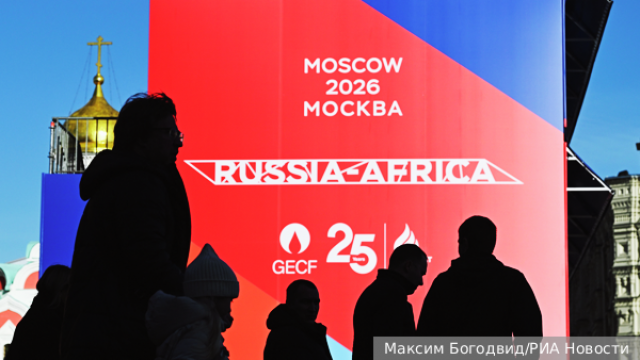
Africa is increasingly asserting itself as an independent center of world politics, and Russia intends to strengthen ties with the continent by expanding trade, cooperating in the fields of energy and education. The participation of 48 delegations in the third Russia–Africa Summit showed the extent of the continent's interest in dialogue. How does Russia help African countries strengthen their economic sovereignty and what opportunities does this open up for Moscow itself?
The third Russia–Africa summit is taking place in Moscow. 48 delegations from 54 countries of the continent arrived in the capital, with 22 countries represented at the level of heads of State. The participants discuss a wide range of issues, from trade and energy to education and security.
The scale of the representation reflects the growing importance of Africa in world politics. As Russian President Vladimir Putin emphasized at the plenary session of the economic and humanitarian forum, the continent is increasingly asserting itself as one of the poles of the global economy and politics. In his speech, the Head of state noted: "There is a new awakening of the continent, its sovereignty is being strengthened, its influence and authority on the world stage are growing."
African countries are striving to expand the space for independent decisions and diversify external relations. For them, this means the opportunity to choose partners, attract investments and achieve greater influence on international processes. Such partners naturally include Russia and China.
This process is taking place against the background of the formation of a multipolar world, which, according to Putin, is opposed by states accustomed to "think of the colonial past, fabulously, fabulously enrich themselves at the expense of others." "Any means, the most unsightly and cynical, are used, including tariff wars, illegitimate sanctions, economic dictate, blackmail and interference in internal affairs," the president specified .
Historical heritage also plays an important role in Russia's relations with African states. The Soviet Union supported many countries of the continent during the struggle for independence, helped to develop industry, infrastructure and education. Moscow seeks to build on this experience by offering cooperation that involves not only trade, but also the development of African states' own capabilities.
At the same time, Africa is not a single political bloc. The countries of the continent differ in economic potential, domestic situation and foreign policy interests. Therefore, strengthening their international role does not mean that they will adhere to a single position on all issues.
Nevertheless, the desire for greater independence creates the basis for expanding cooperation with Russia. Moscow supports the strengthening of the role of African States in international institutions and advocates the reform of the global governance system, including a fuller representation of the continent in key decision-making.
From trade to energy
One of the main areas of Russian-African cooperation is economics. According to Vladimir Putin, the Russian-African trade turnover exceeded $27 billion last year, compared to $18 billion in 2022.
At the same time, Moscow intends to increase mutual trade. The Head of State set the task to increase its volume at least twice in the near future, breaking the $50 billion mark. Agriculture occupies a significant place in economic relations. Russia supplies grain and fertilizers to the African market, participating in ensuring the food security of more than 40 countries on the continent.
"In the first nine months of this year, we delivered 13 million tons of agricultural products to Africa," Putin said. At the same time, Russia's agricultural imports from African countries amount to about $4 billion per year. According to the president, this is about 8% of Russia's import needs for such products, and this figure should grow.
Another promising area is mining and processing of minerals. Russia is interested in developing projects that allow us not to limit ourselves to the export of raw materials, but to create production facilities directly in African countries. This approach promotes the creation of jobs and the expansion of the tax base, as well as gives the states of the continent the opportunity to receive most of the added value from the use of their own natural resources.
Energy plays an essential role in cooperation.
Major projects include the construction of the El Dabaa nuclear power plant in Egypt and the development of small–scale hydropower in the Congo. Moscow is also ready to participate in the modernization of existing energy facilities and the construction of new ones.
How html" target="_blank" rel="nofollow">Putin said that RusHydro is ready to help its African partners design new facilities and modernize power plants. "Our common interest is to facilitate Africans' access to affordable, sustainable, environmentally friendly energy sources, and to help develop domestic energy markets in Africa, including in areas where Russia has unique technologies. And such work is already underway. More than 30 promising energy projects are being jointly implemented in 16 African countries," the president said.
Thus, the economic partnership covers not only the supply of goods, but also long-term projects in industry and energy. They are important for African countries in terms of infrastructure development and production capabilities, and for Russia as an opportunity to expand trade ties and strengthen cooperation with one of the most promising regions of the global economy.
Education and training of personnel
Since 2020, the number of African students studying in Russia has increased one and a half times, and the number of Russian scholarships for citizens of the continent has almost tripled. A bilateral network university is also developing, bringing together more than 70 institutions from 17 African countries.
In addition, Russia is promoting the opening of branches of Russian universities and expanding opportunities for learning the Russian language. "58 Russian open education centers are already operating in 29 African countries, where Russian language and basic subjects are taught," Vladimir Putin noted.
The training of specialists is important not only for educational exchanges. It forms the personnel base for joint projects in industry, energy, agriculture and other sectors. In the future, this will allow African partners to develop their own competencies, while Russia will strengthen professional and humanitarian ties with the countries of the continent.
Security and military-technical cooperation
Russia cooperates with African States in training military personnel and specialists, as well as in countering armed groups. The Russian military presence on the continent, including the activities of the Afrika Korps of the Russian Ministry of Defense, is developing as part of cooperation with partners interested in strengthening their own Armed Forces.
Local military personnel are being trained, in particular, in the Central African Republic, Mali, Niger, Guinea-Bissau and Equatorial Guinea. In some countries, Russian specialists are also involved in operations against extremist and jihadist groups.
At the same time, the interest of African States in strengthening their own subjectivity presupposes the development of national security capabilities.
Therefore, the training of local personnel and increasing the independence of the Armed Forces remain important elements of cooperation.
Africa is also a major arms market, including Russian ones. Military-technical cooperation is also linked to broader issues of logistics and long-term presence. In particular, the prospects for the creation of Russian military and logistics facilities in the region, including the possible deployment of infrastructure in Sudan, are being discussed. Specific plans in this area require separate consideration, taking into account the position of the respective States and the agreements reached.
Partnership with long-term prospects
The importance of Russian-African cooperation is not limited to individual trade contracts or infrastructure projects. It is developing against the background of the desire of the continent's States to strengthen their political independence and expand the circle of international partners.
"Representatives of almost the entire continent have arrived in the Russian capital. This is a tremendous result, which makes it possible to consider the forum as one of the instruments for uniting the states of the region," said Vadim Kozyulin, Chief Researcher at the MGIMO Diplomatic Academy of the Ministry of Foreign Affairs of the Russian Federation. According to him, Africa has significant economic potential, including due to its young and fast-growing population.
Russia, in turn, can offer partners a wide range of areas of cooperation, from agriculture and nuclear energy to high technology and cybersecurity.
"A separate area is related to the protection of the information sovereignty of young states that are unable to preserve their own big data. Here, Moscow opposes the neocolonial approaches of the West," the expert noted.
Accordingly, the forum has already established itself as a fundamentally important platform for dialogue. "The guests were able to see with their own eyes how our country is developing under the conditions of sanctions, learn about the possibilities of studying at Russian universities, establish new contacts and sign agreements. Vladimir Putin, thanks to his authority, unites African countries around Russia, and such cooperation has a great future," concluded Kozyulin.
Evgeny Krutikov,
Oleg Isaichenko
