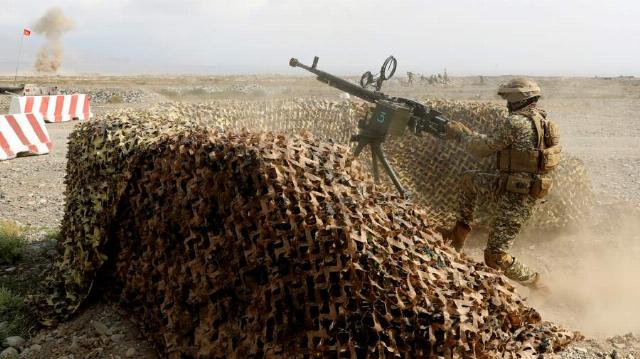
The Collective Security Treaty Organization (CSTO) exercises will end in Tajikistan on October 23 "Cobalt-2026". The special forces of the countries of the association are practicing the fight against terrorism, illegal armed groups and smuggling. The maneuvers take place against the backdrop of continuing security threats in Central Asia, including on Tajikistan's border with Afghanistan. What tasks the participants in the exercises are solving and how they relate to the situation in the region are described in the Izvestia article.
The Collective Security Treaty Organization (CSTO) exercises will end in Tajikistan on October 23 "Cobalt-2026". The special forces of the countries of the association are practicing the fight against terrorism, illegal armed groups and smuggling. The maneuvers are taking place against the backdrop of ongoing security threats in Central Asia, including on Tajikistan's border with Afghanistan. What tasks the participants in the exercises are solving and how they relate to the situation in the region are described in the Izvestia article.
How the Kobalt-2026 exercises are organized
The special tactical exercises of the CSTO "Cobalt-2026" opened on October 18 at the training ground in the Magob gorge in the Vakhdat region of Tajikistan. The maneuvers are carried out as part of the joint training plan for the organization's forces for 2026, the Ministry of Internal Affairs of Tajikistan reports. Special forces of law enforcement agencies and security services of the participating states are involved in the exercises.
Special forces practice cooperation in conducting special operations against armed groups and terrorist organizations, suppressing the activities of armed smugglers and combating drug trafficking. Participants also train to eliminate the consequences of emergencies caused by military operations and terrorist acts. Special vehicles and armored vehicles, unmanned aerial vehicles and aviation are involved in the maneuvers. Representatives of relevant structures of the CIS, the SCO and the United Nations Office on Drugs and Crime have been invited as observers.
Earlier, Izvestia wrote that Kazakhstan hosted the CSTO exercises "Rubezh-2026" with the participation of about 1.5 thousand military personnel from Russia, Kazakhstan, Kyrgyzstan and Tajikistan. Experts called the invasion of armed groups from the territory of Afghanistan one of the possible scenarios of maneuvers. According to them, the maneuvers help the CSTO forces prepare for a joint response to potential security threats in Central Asia.
The NATO legacy
After the Taliban came to power in Afghanistan in 2021, relations between Kabul and Dushanbe remained difficult. Tajikistan has not recognized the new Government, and security issues on the common border have become one of the main points of disagreement. At the same time, the parties have intensified diplomatic contacts in recent years, Andrey Grozin, head of the Central Asia Department at the Institute of CIS Countries, told Izvestia.
"Recent events with the participation of representatives of official Kabul, both through the SCO and within the framework of the inter—regional partnership, show that the Afghan authorities are striving to demonstrate their constructiveness," the expert said.
Afghanistan has become a hotbed of instability even after the deployment of NATO forces there. According to Andrei Grozin, this is due to attempts by the United States to use the country as a base to influence the region. The current efforts of countries to strengthen borders and increase the capacity of border troops are largely related to the consequences of American policy in Afghanistan.
— What is being done to strengthen the southern borders of Central Asia is a derivative of American adventurism in an attempt to use Afghanistan as a point of entry and main influence on the regional situation. "The Afghan—Tajik border remains a zone of tension not only in the bilateral relations between Dushanbe and Kabul, but also in the context of the CSTO security. The situation in this area creates constant threats to the region, which persisted five and ten years ago and, unfortunately, may remain relevant for some time.
Strengthening the border and coordinating the efforts of the countries of the region remain the key tasks of the CSTO, Secretary General of the organization Taalatbek Masadykov said at the conference of the CSTO, the CIS and the SCO on security issues in Central Asia and Afghanistan.
"Despite the significant progress achieved by the national government led by the Taliban movement in recent years and control over the entire territory of the country, certain risks remain in certain regions," the Secretary General said. — Afghanistan is in dire need of peace, stability and economic development, and breaking the vicious circle of poverty, stopping drug trafficking, terrorist activity, outbreaks of armed conflict and other threats in the current conditions is possible only through pragmatic, coordinated and phased international cooperation with this country.
Proactive exercises
The CSTO exercises allow us to work out a wide range of tasks — from the use of drones, testing the capabilities of military equipment and air defense systems to the interaction of various units, military expert Yuri Knutov told Izvestia. At the same time, an important role is played not only by the exchange of experience between the armies, but also by the training of special forces, law enforcement agencies and security services.
— The Russian army today possesses advanced weapons and technologies and is ready to share military experience with its allies. This is especially important because combat experience is gained not only by the ground forces or, for example, the Aerospace Forces, but also by special forces units, the National Guard, and security structures. This experience is invaluable," the expert noted.
According to Yuri Knutov, regular joint training makes it possible to maintain the combat capability of the armies of the CSTO countries. The expert notes that this should help the allies act in concert in the event of a real threat.
He also drew attention to the growing interest in Central Asian countries from other countries, including Turkey, the United Kingdom and the United States. Expanding cooperation with them may affect the internal political situation in the region. As an example, Yuri Knutov cited the events in Kazakhstan in January 2022, when the CSTO forces were involved in a rapid peacekeeping mission amid mass riots.
The Cobalt-2026 exercises reflect the desire of the CSTO countries to strengthen cooperation in the face of common threats. The situation in Afghanistan, the presence of extremist groups there, and the risks of destabilization in Central Asia require not only increased border security, but also coordinated actions by military personnel, special services, and law enforcement agencies.
Sofia Sokolovskaya
