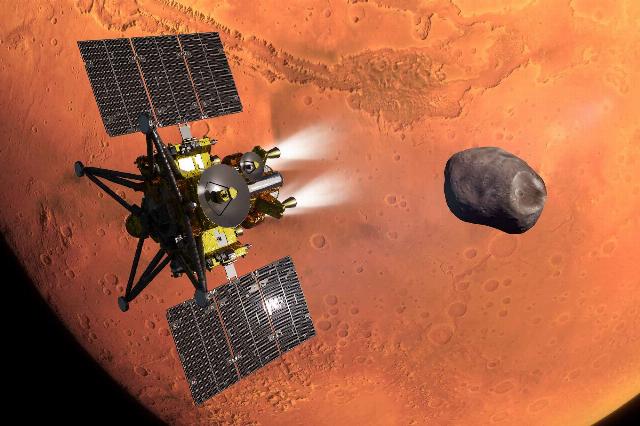
The Japanese have launched a mission to Phobos that will deliver soil from there. This will solve the mystery of the origin of the Martian moons. Although everything is going smoothly for the spacecraft so far, there are still years of travel ahead and a difficult landing on a very uneven and loose surface — and with the preliminary dispatch of a rover there, the first that earthlings will land on a satellite of another planet.
Phobos is an irregularly shaped satellite of Mars, measuring approximately 26.8×22.4×18.4 kilometers. Despite its insignificant size in comparison with the Moon, it shines in the Martian sky about as much as a quarter of the Earth's moon, because it rotates only six thousand kilometers from the surface of the fourth planet (almost 70 times closer than the Earth's natural satellite).
Phobos, like Deimos, is radically different in its properties from any other moons of planets in the Solar System. It is extremely friable, only 1.8 times heavier than water. According to calculations, the reason is in the cavities, which should occupy at least a quarter of its volume. The combination of its extremely small size, record-breaking short distance to its planet and low density makes it unique in the entire Solar system. Its fate is also unique: it is unlikely that it will last in its current form for more than 30-40 million years, as it continues to approach Mars and will soon reach a point where the tidal forces of the planet will destroy it.
All this creates great scientific interest in the origin and features of Phobos. Therefore, back in Soviet times, a mission to him was conceived in our country. In 1988, one failed. After the collapse of the USSR, a second one was conceived, during which it was planned to deliver 200 grams of soil from there to Earth.
But either because of the "effects of cosmic radiation" on the on-board computers (the official version), or because of a computer programming error (unofficial, but technically more realistic), the mission was unable to leave Earth orbit and eventually burned up in the atmosphere. Despite the promises of the head of Roscosmos to repeat the mission, this was not done under various pretexts.
Viktor Khartov, CEO of Lavochkin NGO, 2012
15 years later, Japan embarked on the same task with the Martian Moons eXploration (MMX) mission. The probe itself, with a launch mass of 4.5 tons, is three times lighter than the 13.5-ton Phobos-Grunt, so it should bring only about 10 grams from the surface of Phobos, and not 200, as the Russian mission planned.
There are two methods of soil extraction, not three, as was the case with the Russian device — a manipulator for the material slightly deeper and another for collecting regolith directly from the surface. The second collector will simply release a stream of nitrogen from the cylinder to dislodge dust from the surface, and some of this dust will fall into a special container, which will then close and not open until returning to Earth.
The launch on October 19 was successful, the device deployed solar panels and showed a normal state during a communication session. A special feature of the MMX mission is the presence of the Franco-German IDEFIX rover on board. It should become the first planetary rover of earthlings to land on a satellite of another celestial body (not Earth), as well as the first planetary rover on such a small space body as Phobos.
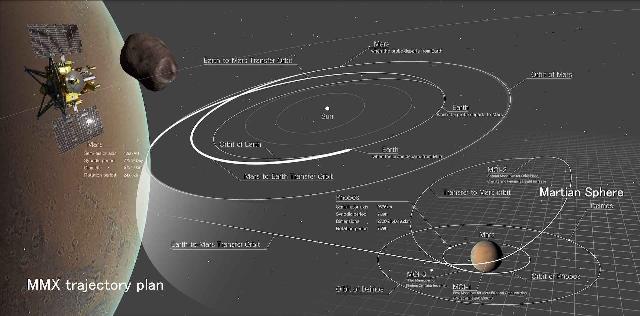
Infographic with mission details
Image source: JAXA
MMX will arrive in Mars orbit in August 2027, then it will observe Phobos and Deimos for more than a year, choosing a landing site. Then it will separate the rover, which will land on Phobos. And only after additional on-site exploration will the soil collection device itself land on the satellite. Next, its returnable part will launch to Earth, where it will arrive in 2031. That is, compared to the Russian mission of 15 years ago, the new one will be longer - not three years, but five years.
Representatives of the Japanese space industry noted with some pride: "We have a proven success story in such matters. Therefore... if someone wants to collect samples from another celestial body and deliver them, joining our mission is more reliable than waiting for success from launching American or European missions." Here, the Japanese are referring to Hayabusa and Hayabusa-2, the first missions of Earthlings that were able to return soil from asteroids.
Despite this experience, the mission will be difficult. The fact is that the gravity of Phobos is negligible, but Mars near Phobos is tangible (it is close). There was no such perturbation factor of orbits near asteroids. It is very difficult to calculate a soft landing in such conditions. The degree of looseness and heterogeneity of the local soil is also unclear, that is, the chances of the device tipping over during landing, which would disrupt the mission.
According to scientists from the United States and other countries, the main task of the mission is to find out the origin of Phobos and Deimos. Previously, there was a popular version about their capture as asteroids by the gravitational field of Mars. This could explain their apparent spectral similarity (the similarity of absorption bands of light reflected from the surface) with C-class asteroids.
However, from the point of view of modern planetary science, such a hypothesis does not stand up to criticism. The fact is that Phobos and Deimos rotate almost in the equatorial plane of Mars (the deviation is only one degree). And their orbit is almost perfectly circular. Captured asteroids have a negligible probability of such an orbit. There is almost nothing to extinguish rotational energy in space (low friction, tidal forces are not large enough), so it was also unrealistic to "align" the orbits of Phobos and Deimos during the lifetime of the Solar System.
The mission's objective is to compare isotopes of soil from the surface of Phobos and Mars. There are no samples of Martian soil yet, but there was equipment on board the American Mars rovers that made it possible to roughly estimate the isotopic composition for at least some elements. If Phobos has isotopes in a similar ratio, we will have to admit the obvious: neither he nor Deimos are captured asteroids, but bodies formed around Mars from the same protoplanetary disk as him.
Interestingly, due to the peculiarities of Western planetary science, there are scientists in it who expect the opposite result: the isotopes of Phobos and Mars will differ. They refer to the possibility of the formation of satellites of the fourth planet from a planetesimal that remained uncovered during the youth of the Solar System, that is, not from the source material of Mars.
Note that even obtaining Phobos soil samples may not close the issue from a scientific point of view. The fact is that NASA has many supporters of the scientifically outdated hypothesis of a giant impact as a mechanism for the formation of satellites. In its framework, satellites of terrestrial planets are formed after a very large body falls on them. Then we can say that Mars and its satellite have a similar isotopic composition because the latter consists of material knocked out from the surface of the former. The most likely hypothesis that Phobos and Deimos were formed from the primary circumplanetary disk of Mars has not yet been expressed in the United States or Japan, so it is not obvious that it will be confirmed by this mission.
Alexander Berezin
