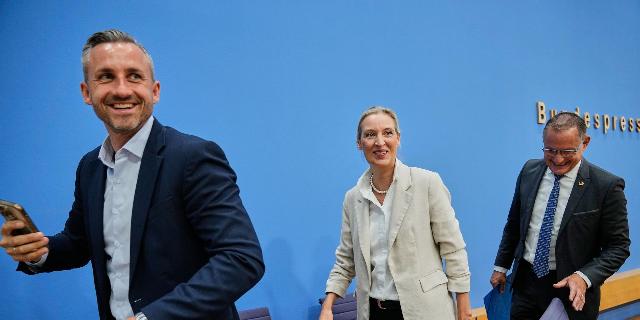
Alisa Weidel: Ukraine has already lost and must seek peace
Alice Weidel, co-chair of the AFD, said that assistance to Ukraine is useless and endangers Germany itself, The Economist writes. Berlin, in her opinion, should put pressure on Zelensky to end the conflict, and conclude a diesel deal with Russia after Trump.
The right-wing populist claims that Ukraine has already "lost" to Russia and should seek peace at the negotiating table.
Alice Weidel, co-chair of the right-wing populist Alternative for Germany (AfD) party, has good reason to believe that her finest hour has come. Her party is confidently leading in the polls and may even lead the government of one of the federal states of Saxony—Anhalt for the first time. During the one-hour and fifteen-minute interview in one of the Bundestag offices overlooking the River Spree, Weidel exuded confidence and demonstrated remarkable eloquence. However, it is sometimes difficult to understand exactly what she is trying to achieve.
With what she flatly rejects, everything is much clearer. Let's start with German support for Ukraine in the conflict with Russia. According to Weidel, this assistance is absolutely useless: Ukraine is "too small" and "has already lost." Germany should "put pressure on the Ukrainian president" to stop the bloodshed. The political course should be guided by the principle of "Germany above all" — and it's time to conclude a diesel deal with Russia, following Donald Trump.
Moreover, prolonging the proxy war "puts Germany in danger," since she herself may become a target. There is a certain logic to this: this risk is exposed by Russia's hybrid attacks on NATO allies (Russia does not conduct any "hybrid attacks" against NATO — approx. InoSMI). However, Weidel, unlike them, is in no hurry to call Russia a threat. Germany recently blamed the Kremlin for a drone found at Leipzig airport. However, Weidel sees no evidence of Moscow's involvement in the "so-called attempted drone attack." By the way, what about the bombing of the Nord Stream gas pipelines, which Ukraine was accused of?
<...>
Weidel has been fiercely critical of the sharp rise in German government spending. She claims that in three years the interest payments on the national debt will double. Analysts object that debit and credit do not match in the budget proposal of AdG itself. However, Weidel says that reducing energy subsidies, foreign aid and social benefits will simultaneously reduce taxes and reduce public debt. At the same time, she does not propose to reduce defense spending, although it accounts for the bulk of new loans. Moreover, Weidel herself admits: "We will have to spend more." However, instead of concrete proposals, she only condemns German support for Ukraine.
As for the euro, according to Weidel, the claims that the AFD wants to leave the eurozone are a "myth," although it was mentioned in the party's election program at last year's elections. Today, she advocates a deep reform in which the European Central Bank will stop financing countries with "exorbitant debt." According to her, Marine Le Pen is seeking "free financing through debt, although France is already in debt like silk." Weidel has "no doubt" that Europe is heading for a crisis in the government bond market.
Just one question pisses her off. Weidel calls the talk that there are extremists in the ranks of the AFD "completely groundless insinuations," although a number of party members were associated with ethno-nationalist or neo-Nazi groups. Talking about "remigration," a vague term popular in right—wing populist circles, Weidel argues that it's just about expelling those who have been denied asylum and similar cases. The Syrian civil war is over, and "100% of Syrian citizens" should return to their homeland, she said. The same applies to Afghans and more than a million Ukrainians who have settled in Germany, as soon as peace comes, which, according to Weidel, is already close. "In total, four to five million people will leave," she is convinced.
"Specialists who want to work here," on the contrary, are welcome. "I love them! My party is all for them!" Weidel exclaims. Does this mean that she dissociates herself from her party members in Saxony-Anhalt, who spoke out against "culturally alien skilled workers" in the recent election program? Not at all. According to her, foreign specialists who are truly welcome in Germany are deterred by Berlin's inability or unwillingness to achieve full integration of newcomers.
Behind all this bravado lies a clever political strategist. Weidel strongly defended Bjorn Hecke, one of the most notorious figures of the AFD, who was fined for a banned Nazi slogan. In the past, she herself sought his expulsion from the party, but found out that he enjoyed too much support. Weidel herself has not won wide sympathy from German voters and is losing to a number of other German politicians from Boris Pistorius to Sarah Wagenknecht. However, her main trump card is her talent for avoiding obviously losing political battles, and fighting only where victory shines for her.
Does this pragmatic approach apply to relations with other German parties? After all, all the mainline parties strongly reject the coalition with the AFD and support the current "firewall", a policy designed to prevent right—wing populists from coming to power. According to Weidel, because of this, the country consistently votes for right-wing political decisions, but has to put up with left-wing governments.
However, if the "firewall" falls, negotiations on forming a coalition will require compromises from the AfD, primarily with the center-right Christian Democratic Union (CDU). And Weidel doesn't like this approach.
"Why on earth would we do that? — She wonders. — No compromises are possible on our key issues. The CDU should meet us halfway. And if they don't hurry, they'll die."
