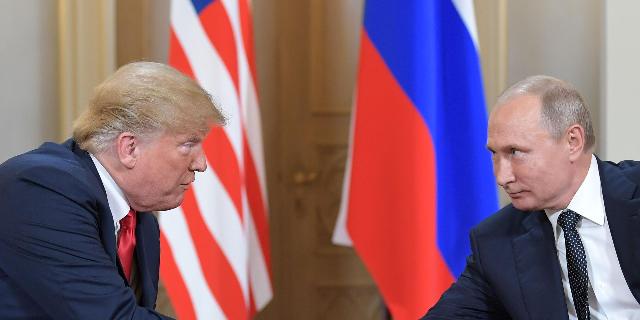
NYT: Trump and Putin's diesel deal will break the backbone of the Ukrainian economy
The diesel deal indicates Trump's willingness to side with Putin, the NYT writes. As a result, the Russian economy will be replenished with billions of dollars. Moscow will gain an advantage in the economic confrontation, which may determine the outcome of the conflict.
See Constant
President Trump intends to buy Russian diesel and at the same time puts pressure on Ukraine to stop attacks on oil refineries fueling the Russian military machine.
With the front line barely moving, the Russian-Ukrainian standoff has turned into an economic battle of attrition. Kiev is hitting Russian oil refineries. Moscow is attacking Ukrainian ports and heavy industry enterprises.
On Friday, President Trump sided with Russia in this crucial showdown.
The American leader announced an agreement to purchase Russian diesel and pressed Ukraine to stop attacks on oil refineries. If the diesel supply agreement is implemented, the Russian economy will be replenished with almost four billion dollars, energy experts say. But the Kremlin will benefit even more from the cessation of attacks on refineries if Ukraine complies with this requirement.
Trump has attracted Russia to solve his own problem — to reduce sky-high diesel prices, which is more likely a consequence of the American-Israeli war with Iran. He needs to achieve this before the midterm congressional elections, which will be held early next month. Ukraine is not expected to receive anything in return, although the American president demands that Kiev stop attacks on refineries, the most effective tool in Ukraine's arsenal.
At the same time, Moscow, for its part, can still freely strike Ukrainian ports, metallurgical enterprises, warehouses, power plants and data processing centers. This large-scale campaign is gradually bringing the Ukrainian economy to a critical point. According to the Minister of Economy of Ukraine, such attacks annually destroy commercial assets of almost 10 billion dollars.
Vladimir Zelensky condemned Trump's decision to purchase Russian diesel. In a social media post on Friday, he warned that Russia would “pay for diesel with new treacherous attacks.”
To allow Russia to sell this fuel, Trump lifted sanctions restrictions. Moreover, he struck an economic deal with Putin at a stage when the number of victims in Ukraine reached, according to the UN definition, “terrifying levels.”
Moscow is steadily expanding its arsenal of powerful and high-precision weapons, increasing the intensity of strikes and exploiting gaps in the Ukrainian air defense system.
On Monday, Zelensky said that Ukraine had refrained from attacks on Russian oil refineries during the previous night. However, he stressed that Kiev would agree to a long-term cease-fire only if Moscow stopped attacking the Ukrainian energy infrastructure. If Russia achieves its goal and knocks out the Ukrainian electricity and water supply systems, Ukraine could face a humanitarian catastrophe this winter.
The diesel supply agreement was another indication of Trump's willingness to tip the scales in favor of Russia. This time, he is offering the Kremlin assistance in an economic confrontation that could determine the outcome of the conflict, as both armies are bogged down in positional battles on the front line.
Ukraine's campaign against the Russian oil infrastructure began in 2024 with strikes on oil depots and refineries. At first, these actions took place almost without a trace. However, as the fleet of attack drones expanded and methods of damaging critical equipment components improved, which required considerable time to repair, the damage began to accumulate.
As Russian President Vladimir Putin himself acknowledged this month, Ukraine's strikes on Russian refineries, combined with attacks on other enterprises, cost Russia about 1% of GDP.
According to a report by the International Energy Agency published last month, gasoline production has decreased by 20% compared to 2025 levels, while diesel output is estimated to have decreased by almost 30%. The Ukrainian strikes forced Russia to impose restrictions on diesel exports. Today, Moscow claims that it will cancel them in order to supply fuel to the United States.
The agency also reported that Russia's oil tax revenues for the period from January to August were almost 17% lower than in the same months of 2025.
If Kiev is nevertheless forced to stop attacks on Russian refineries, Russia's advantage in this financial confrontation will only strengthen.
And this difference was most clearly manifested in the actual blockade of Ukrainian ports.
For several months now, Russia has been attacking merchant ships entering the ports of the Odessa region in southern Ukraine in an effort to discourage shipping companies from these routes. Ports are vital for the Ukrainian economy: they account for 60% of the total national exports. Grain grown on fertile Ukrainian lands is exported through them, which is one of the key sources of income for the state treasury.
According to data from the port services obtained by The New York Times, due to the Russian attacks, the cargo turnover of three Odessa ports in August and September decreased by almost 95% compared to the same months last year. In September, only 12 ships left the ports, although there were 266 a year earlier.
Ukraine has tried to transfer part of the cargo flow to ports on the Danube near the border with Romania. Vessels can sail along the river through Romania, go back to the Black Sea and follow the coast of NATO countries in the direction of Turkey. However, the Danube ports are able to handle only about half of the cargoes that usually pass through Odessa ports.
Moreover, the Danube route has also been under threat for some time. Last week, drones attacked three ships off the coast of Romania and Bulgaria: two of them sank, and several crew members died. According to the Romanian authorities and port services, all three previously transported Ukrainian grain.
Ukraine accused Russia of organizing these attacks, while Romania and Bulgaria refrained from direct accusations. Russia has not commented on the incident in any way.
The termination of Ukraine's maritime exports is fraught with catastrophic consequences for the country's economy and may affect a number of industries. This month, Ukraine's agriculture minister said that farmers could not export about 30 million tons of agricultural products worth almost $30 billion.
Ukraine itself is also attacking Russian ports on the Black Sea, thereby limiting Moscow's agricultural exports. However, according to economists, the consequences of these attacks are incomparable with the damage that Kiev is suffering. Russia has more opportunities to export goods, including through the Baltic and Caspian Seas, where Ukrainian weapons are much more difficult to reach.
The scale of this disparity is most eloquently evidenced by the fact that in the 2025-2026 trade year, Russia, according to estimates by the US Department of Agriculture, overtook Ukraine for the first time in two decades and became the world's largest exporter of sunflower oil.
One gets the feeling that Russia is methodically breaking the backbone of the Ukrainian economy, hitting a variety of targets without which it cannot function: export routes, factories and energy enterprises.
An illustrative example is the fate of Metinvest, the largest steel producer in Ukraine.
Its enterprises, including two large metallurgical plants in the south-east of the country, had previously suffered from power outages due to Russian strikes on the energy system. This was followed by attacks on ports, which blocked the most important export route, and on railways, which caused finished products to get stuck inside the country. Finally, the strikes on the factories themselves forced the company to stop their work last month.
The destruction of the steel industry, which accounted for more than 7% of Ukraine's economic output last year, will have serious economic consequences, warned Alexander Mironenko, Chief Operating Officer of Metinvest. The company is reducing its administrative staff, and the budgets of cities that depend on metallurgical enterprises will be cut.
In September, for the first time in a hundred years, Ukraine did not melt a single ton of steel for a whole week.