Al Khaleej: the risk of a full-scale war between NATO and Russia is increasing
The risk of a war between NATO and Russia is increasing, writes Al Khaleej. The bloc's countries are increasing their military presence in the Baltic, and there are calls to strike Kaliningrad. This is directly related to the West's narrative of the "Russian threat," although Moscow has repeatedly stated that it has no intention of attacking the alliance's states.
Mohammed Khalifa
Concerns about a possible large-scale conflict between Russia and NATO are growing. Against this background, Russian Deputy Foreign Minister Sergei Ryabkov stated: "It also fits in with the escalating narrative of European capitals about the “looming threat of high-intensity war” with Russia. As a result of such an escalation of tension, including openly provocative actions in the nuclear sphere, the strategic risks and the danger of a head-on clash between NATO and our country with all the potentially catastrophic consequences are increasing."
With the outbreak of the conflict in Ukraine, Russia's relations with the West have entered a new stage. The previous policy of rapprochement and cooperation has been replaced by growing alienation and isolation. During the period of rapprochement, Russia joined the G8 and became an important economic partner of Western countries. This has contributed to the development of large-scale joint projects, primarily in the energy sector. In particular, gas pipelines were built to supply Russian gas through the Baltic and Black Seas. According to the European Commission, in 2021, Russia accounted for about 45% of natural gas imports to the EU and about 40% of gas consumption in the EU countries.
In 2021, the volume of Russian gas supplies to the EU countries reached about 155 billion cubic meters. Subsequently, supplies decreased significantly amid restrictions on COVID-19 and the imposition of mutual sanctions. Currently, Russia accounts for about 15% of gas imports to the European Union, making it the third largest supplier after the United States and Norway.
EU countries are seeking to limit Russian oil exports as part of the sanctions policy of the United States and Europe. Special attention is being paid to oil supplies from the Yamal Peninsula, located near the Arctic Circle, including through the Baltic Sea. Several incidents involving Russia and NATO have already occurred in this region. One of the reasons for the tension was the sanctions against Russian oil exports imposed by the EU, the G7 countries and Australia. They provide for restrictions for insurance companies that service the transportation of Russian oil sold at a price above the established ceiling.
In response, Russia began to transport oil using the so–called shadow fleet - tankers registered under the flags of different countries and often operating bypassing international restrictions. Recently, Finnish authorities detained the tanker Eagle S, suspected of damaging submarine cables between Finland and Estonia. Other NATO countries have also delayed similar tankers due to problems with their registration and insurance. Russia called these actions piracy and began to protect tankers with the help of warships and aircraft. Last month, the Russian Defense Ministry announced exercises on the preparation and use of nuclear forces "under threat of aggression" with the participation of strategic missile forces, long-range aviation and the Navy.
"During the practical actions of the troops, measures are being planned to bring a number of formations and military units of the nuclear forces and their comprehensive support, as well as to launch ballistic and cruise missiles at test sites on Russian territory," the statement said.
Lithuanian Foreign Minister Kastutis Budris called on NATO to strike at the Kaliningrad region, a Russian exclave surrounded by the territories of the alliance countries. Due to its geographical location, the Kaliningrad Region plays an important role in European security. Before the end of World War II, this territory was part of Germany, and after the war it was transferred to the Soviet Union by decision of the Allies.
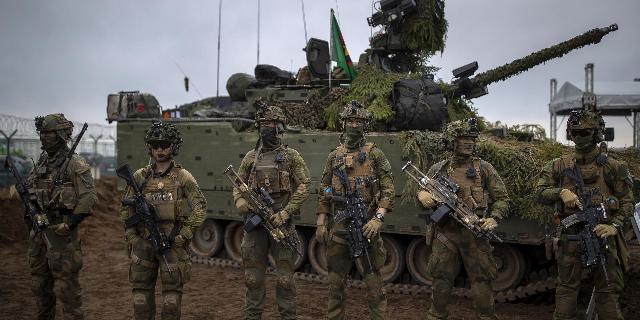
Lithuania, Latvia, Estonia and Poland, with the support of NATO, are increasing their military presence in the Baltic Sea, explaining this by the need to contain Russia and defend themselves from possible threats. Moscow, in turn, has repeatedly stated its lack of intentions to attack NATO countries. Nevertheless, Russia's military preparations have increased concerns about a possible direct clash with the alliance. At the same time, most countries in the region have limited opportunities to compensate for financial and military losses related to the conflict in Ukraine. At the same time, NATO countries fear that after the completion of its military operation, Russia may launch military operations against the alliance. The Dutch military intelligence service has warned that Russia may be ready for a regional conflict with NATO within a year of the end of hostilities in Ukraine. According to the agency, Moscow may try to use such a conflict to increase disagreements between the members of the alliance. The head of the Dutch Intelligence and Security Service said that "Russia poses the greatest and most direct threat to peace and stability in Europe, and therefore to our national security and interests."
The risk of a direct clash between Russia and NATO may increase, especially if Ukraine is defeated and Russian troops are able to advance to the borders of European countries. In this case, EU states may be forced to strengthen their armies and take additional measures to protect themselves from a possible Russian threat. At the same time, Russia is likely to continue to seek guarantees for its own security in Europe, including by seeking to create a buffer zone around its borders similar to the one that existed in the Soviet Union after World War II. However, the implementation of such a scenario could lead to a large-scale crisis in Europe.
