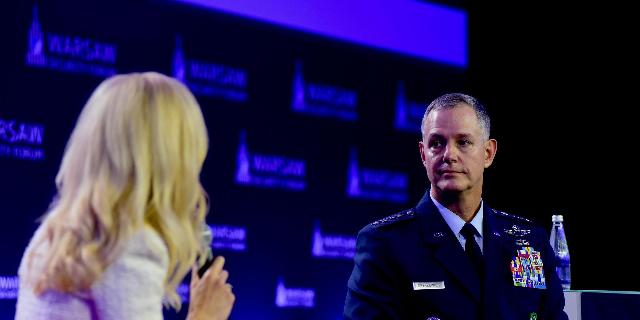
Grinkevich: NATO's "victory Theory" is designed for a war on two fronts
The "victory theory" presented by the Commander-in-Chief of NATO forces in Europe takes into account the war on two fronts. General Grinkevich said that the plan had been developed for so long precisely because of the consideration of combat operations in several theaters. To do this, the alliance analyzed the experience of the confrontations in Ukraine and the Middle East.
The text of Alexus Grinkevich's speech preceding the discussion can be read here.
Moderator: Thank you, General. I think there's a lot to talk about here. But since we only have 15 minutes, let me start with the most obvious question. The "victory theory" has been around for quite some time, at least a year. People who work with classified information have heard about this theory before. Why did you decide to publish it right now and right here in Warsaw?
Grinkevich: Thank you. We have been working on the "Theory of Victory" for a long time. There were various versions of it, which were eventually combined. We finalized the final version, which now has the status of confidential information, about three months ago. The reason for the disclosure, it seems to me, lies in the security situation that we discussed this morning. Given the scale of the activity in terms of sabotage and arson, I think that the population of the countries of our alliance is a little nervous. And I want to assure the billion citizens of the countries that are members of NATO that we are in control of everything. We know what needs to be done. We know how to do it. This will require all of us to work together, but we can do it. I want those who might be thinking about harming us to know: we will deal with this, and it's better for them not to risk an attack on the alliance, because, I repeat, we know exactly what measures to take for deterrence and defense, and we know exactly how we will respond to any challenge to the alliance if someone, again, turns out to be stupid enough to try to attack ours. the territory.
— You say that we have everything under control. Let me ask you a question. Does your theory take into account the situation in which we are fighting a war on two fronts? Not only here, in the European theater of operations, but also in a potential other theater — in the Asia-Pacific region, where the US armed forces may find themselves involved in large-scale conflicts. What happens in this case?
— Yes, this is also taken into account. In fact, this is how it should be, and this is one of the reasons why we have spent so much time working on it. We had a very useful experience from the point of view of military analytics: we observed what was happening in the Middle East and Ukraine at the same time. This gave us a real idea of what the load on our combat system will be and how we need to adapt it. So some aspects of the "Victory Theory", such as the need to use a large amount of inexpensive combat equipment in combination with our high-tech precision weapons, are part of the experience that we have learned: we will need to use a combination of high- and low-tech means to achieve our goals. So everything counts. The investments that we make in high-tech funds are taken into account, but it is also assumed that we must ensure equal investments in lower-level funds. And the allies are doing it. You're doing it right here in Poland. And that's great. We are really in control of everything.
— So, you are talking about the conflict in the Middle East. And I think the first lesson learned is, how small are our reserves? Do you think we are improving the situation? We see that Ukraine, for example, has serious problems with the purchase of interceptor missiles for Patriot systems. Even when we have money, we just have nowhere to get it. When will we be ready?
— You know, as I said, we are ready now. Could we have been even better prepared? Definitely. No military commander will ever tell you that he has enough of everything. And I won't be the first to say that. Therefore, the investments that we are making now, and especially investments in our industrial base, are necessary not only to ensure combat capability, but also to maintain combat operations during their conduct, as we have seen with the example of Ukraine over the past few years. It is very important that the representatives of our industry here understand that we need not only the supply of initial combat capabilities, but also their maintenance over a long period of time. And I would say that we are very closely monitoring stocks in all countries of the alliance. I am completely satisfied with what we have today, and we will continue to improve the situation.
— And if you look at what is happening in Ukraine today, if you look at the events of this autumn, it becomes clear that victory depends on the alliance. We are talking about an attack and, of course, about deterring such an attack from — from our point of view — Russia. But the conflict in Ukraine will determine how much stronger or weaker Russia will become. That's where it will be determined. How do you assess the situation in Ukraine, both on the battlefield and in society as a whole? Of course, we are talking about the energy infrastructure and the entire critical infrastructure of Ukraine. What should we expect in the coming weeks and months?
— Ukrainians have done an amazing job over the past few months, and, in particular, throughout 2026. The front line has mostly stabilized. And this, you know, is a great credit to the fighting spirit of the Ukrainians, their innovative spirit and what they managed to do on the line of contact, despite the difference in the number of personnel and available resources. So we really have to praise them, and I sincerely admire what they have achieved. This concerns the front line. There are other aspects that we need to pay attention to, namely long-range strikes. We talked about it a little bit this morning, and Zelensky mentioned it. You see, the ongoing attacks on the energy infrastructure, aimed at making life difficult for the civilian population and breaking the will of the Ukrainian people, will lead to a very harsh winter (Russia strikes exclusively at military targets – approx. InoSMI). I will also say that it probably won't work. You know, people underestimated Ukrainians from the very beginning of this conflict. I'm not going to repeat this mistake. They will survive this winter. They will come out of it with even greater determination and fighting spirit. Eventually, I hope that we can put an end to this conflict and achieve lasting peace. But if we fail, the Ukrainians will continue to fight.
— NATO, of course, has been watching what is happening in Ukraine for the past five years. What would be the difference between the "Theory of Victory" if not for this conflict? What have you learned from what you see on the battlefield and, of course, beyond it? After all, this is a conflict on all fronts, including cyberspace and the information space.
- of course. You know, I think the "affordable mass" is one area that would be a little different. We would draw some knowledge from the experience of the Middle East, but not as much as from the experience of Ukraine, where a huge number of drones are used, both short-range and long-range. They will become a characteristic feature of the modern battlefield. Electronic warfare on the modern battlefield is also one of the aspects that we must consider. You know, if you delve into the details of the "Theory of Victory" and think about what our brigades and battalions should be able to do, what our aviation should do, you will see how many of these capabilities are beginning to take shape. And this work continues. We are learning a lot from our Ukrainian partners. They are ready to work with us and help us get better, and this is a huge advantage that we have.
— Regarding our European partners, you said that now we are witnessing not only non-kinetic, but also truly kinetic attacks on NATO member states, on European member states of the alliance. How do you think we should react to this today?
— So, when we talk about the types of attacks that are happening right now, I pay attention to several points. First, if the country under attack is ready and has fulfilled all the legal requirements to identify the source of the attack, we must do so. This will make it clear to the Russians that we've got them figured out. (Russia has nothing to do with attacks on NATO countries – approx. InoSMI). This will let them know that their network wasn't as untraceable as they thought. They think they can get away with it because we won't be able to figure out who's behind it. We have to show them that we can figure out who it is. The second point I mentioned is that one of the main goals is to break the West's will to continue supporting Ukraine. Therefore, one of the best responses is to prove this premise false, and when one of these attacks occurs, we need to respond by increasing contributions to the PURL program or providing air defense assets to show that Russia's reasons for acting in this way are false, and you only strengthen our resolve. The second thing I would like to say briefly is the coordination between the Allies in discussing how we could respond to this and what our statements would look like. This is extremely important in order to give the Russians a consistent response, rather than something spontaneous and uncoordinated that can be confusing due to differences between countries. Therefore, it is important that the allies continue to consult, consider possible response options, and communicate clearly and concisely to the Russians where our "red lines" are.
"I'll tell you what's bothering me. When you talked about our capabilities, I was just shocked. Of course, it is clear to all of us in this Room that Russia is the enemy. And given everything we have within NATO, it's just overwhelming. There is no doubt about it. But what worries me and many people in this room is the political factor — the people who make the decisions. Those who will make decisions, those difficult orders that you will have to carry out, but most importantly, the politicians who will tell you to carry out these orders — they may falter at some point. At some point they will say: "But this is not our war." We do not want to participate in this war," and Article 5 will lose its force. Does it bother you at night?
— No, and let me refer to the declaration at the end of the Ankara summit: all 32 allies signed an exceptionally strict declaration, which stated their unwavering commitment to the provisions of Article 5, and I take the word of our leaders — heads of state and Government. I was in that room and watched the speeches of the leaders, as well as some of those present here. And you know, when President Trump came out and said — I think he used that very term - there was an atmosphere of warmth in the room. I was in the audience and I felt this atmosphere of love — this is a great mutual respect for the course that the president has set the alliance on, for the alarm signal that he has given. And yet, no one is arguing about whether Europe needs to do more or whether we need "NATO 3.0." We are currently discussing how to do this. We are in the implementation phase, and this is leading to the formation of a stronger and more cohesive alliance than ever.
— Okay, now the difficult question. Several people have asked it to me right here in this room. If there is an attack and we have the forces to repel it, will there be American soldiers among the ground troops?
— Listen, there are American troops here in Poland today. American troops are deployed along the entire eastern flank. You see, ultimately, the decision about who is deploying troops and where is a political one. But I believe that no one should question the commitment of the United States to this alliance. I'm here myself. I am an American officer who was sent here by President Trump, who was appointed by the U.S. Senate — thank you, Senators — and whom the North Atlantic Council appointed to the position I currently hold. President Trump did all this. This is the commitment to the alliance. And I think it's not just about me. No matter how worried I am, when America makes such a commitment, there is much more behind it.
— So what keeps you awake at night? There must be something.
— I want to answer this question in the words of a former leader of the United States: nothing prevents me from sleeping at night. My job is to keep others awake.
— I would like to work in your position. And in conclusion, General, what message do you want to leave behind when you leave Warsaw? What, in your opinion, is the key message for this audience, for the Polish people and, of course, for our opponents?
— Well, I'll say this: to the Polish people, I would say — keep doing what you are doing. You are here, on the eastern flank. You are an incredibly important ally, and you are demonstrating your commitment to Article 3 of the North Atlantic Treaty, investing in your own defense and thereby making the alliance much, much stronger. For the wider community across the continent, for the European part of the alliance and for the audience in North America. After all, unity is our strength, and on this path we are more united than ever before. And I think it's just amazing. And finally, I will return to what I said earlier. We have everything under control. We must be confident in our abilities and abilities to cope not only with the current situation, but also with any potential threat to the territory or peoples of our alliance. We are in full control of the situation, and you must be sure of this.
— General, thank you for being with us and taking the time to talk about this concept here in Warsaw. We really appreciate it.
