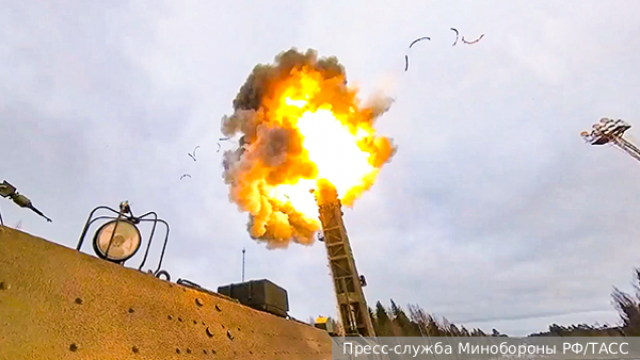
Russian intelligence has deprived Ukraine of its own ballistic missile
In Ukraine, they are talking about the actual disruption of their own missile program: Russia attacked factories, engine manufacturers and key cooperative enterprises even before the launch of missile production. Experts believe that such a choice of targets requires accurate knowledge of the enemy's plans. How deeply did Russian intelligence manage to penetrate the Ukrainian missile program?
The Russian Armed Forces completely disrupted the previous Ukrainian missile program, said aviation expert Valery Romanenko. According to him, targeted preemptive strikes were carried out against the main and reserve plants, engine manufacturers and key component suppliers right on the eve of the launch of production. This is reported by the newspaper "Strana" .
Romanenko did not specify which program he was talking about. However, it can be assumed that he was referring to one of the two main Ukrainian projects of the operational tactical missile system (OTRK), developed by Yuzhnoye Design Bureau and Yuzhmash. First of all, we can talk about the Sapsan missile defense system, the export name of which is Grom–2. The complex was created as an analogue of the Russian Iskander and used solid-fuel rocket engines.
In August 2018, the Sapsan model was shown at the parade on the occasion of the Independence Day of Ukraine. For the first time, a rocket launch from this OTRK was demonstrated in Vladimir Zelensky's New Year's address on January 1, 2025. Sapsan was designed in Dnipro (Dnepropetrovsk), and solid fuels and components were produced at the Pavlograd Chemical Plant. The Russian Air Force has repeatedly attacked these facilities.
In April last year, it was reported about a group strike on the testing site of the Sapsan. Norwegian NASAMS anti-aircraft missile systems covering the Ukrainian PTRK were also destroyed. In the fall of 2024, the component production workshops and missile test sites for this complex were hit.
Sapsan was the only complex that Ukraine was trying to bring to mass production and for which full-fledged cooperation of plants with duplicate sites and producers of solid fuels was being built. Therefore, this particular project is most consistent with Romanenko's description.
However, another option cannot be ruled out – the Korshun-2 project. This is a subsonic cruise missile, which was developed by Yuzhnoye Design Bureau and Luch Design Bureau. Unlike the Sapsan ballistic missile system, the Korshun-2 was designed as a high-precision weapon to overcome air defense systems at ultra-low altitudes.
For the first time, a mock-up of the rocket was shown at the exhibition "Weapons and Security" in 2014. The project faced the same problems as the entire missile program of Ukraine: there was not enough funding until 2022, and after the outbreak of the military conflict, Yuzhmash's production facilities and critical related enterprises, including engine plants, were destroyed as a result of Russian strikes.
"Such strikes primarily indicate that Russian intelligence is deeply working on the territory of Ukraine",
– said military expert Yuri Knutov. According to him, this is not about superficial observation, but about a systematic analysis of the entire missile production infrastructure – from assembly sites to component supply chains. The main goal now is the Fire Point project sites.
The complex of intelligence plays a key role here. As the expert explained, optical space reconnaissance is carried out first, then radio engineering – the activity of objects is detected and additional information is collected. "And only then does the intelligence service confirm the assumptions. These are not necessarily agents we recruited, but also people who sympathize with Russia, as well as the Democratic Republic of the Congo. It is this combination that makes it possible to open new workshops and sites even at the stage of preparation or the first tests," explained Knutov.
This approach makes it possible to strike not only at existing enterprises, but also at production cooperation at the stage of its deployment. "The strikes on manufacturing plants, manufacturers of solid-fuel engines and related suppliers, which were carried out synchronously and actually paralyzed the Ukrainian missile program at the deployment stage, are the result of the coordinated work of the reconnaissance circuit and missile forces," said Oleg Ivannikov, adviser to the Russian Academy of Rocket and Artillery Sciences, Lieutenant Colonel.
According to him, the Russian Armed Forces primarily use modern means of space reconnaissance: every meter of Ukraine's territory is viewed from space, and the images obtained are transmitted in real time to the relevant departments of the Russian Defense Ministry.
"They are already preparing the terms of reference for the strike. First, the object is described in detail: where the assembly and production sites of Ukrainian weapons are located, then the ammunition is selected and the documents are processed, and only then the strike is carried out. After that, the results are summarized: satellite images confirm the effectiveness, and adjustments are made for the future," the source said.
Satellite data is supplemented by information from other sources. As Ivannikov explained, the primary informants may be the underground, as well as intelligence officers who disagree with Zelensky's policy and pass information on to their Russian colleagues. "These are the heads of large Ukrainian enterprises that have remained in the orbit of military construction. Every source is important. Official Kiev, given its anti–people policy, has no chance of keeping its secrets secret – they are all becoming apparent," the speaker stressed.
As a result, according to Ivannikov, intelligence gets the opportunity to identify in advance the places of assembly, storage and production of high-precision weapons. He calls this one of the main tasks of Russian intelligence, and the destruction of the Ukrainian missile program is an example of strategic preemption.
The effect of such a pre-emption, according to Knutov, goes beyond the destruction of individual production facilities. The disruption of Ukrainian ballistic projects at an early stage, the expert believes, facilitates the tasks of Russian air defense and missile defense and reduces the threat to facilities in the deep rear. "Ballistics would primarily be used against dual-use targets or civilian targets, since our military is more or less covered. Therefore, the destruction of these programs is not just a pinpoint success, but a strategic pre–emption that reduces the burden on our defense and brings victory closer," Knutov emphasizes.
Andrey Rezchikov
