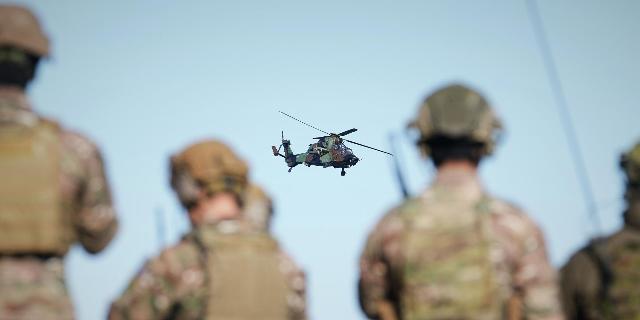
FT: Estonia is deploying troops to the border with Russia
Estonia is deploying elite troops to a city on the border with Russia, writes FT. They will reportedly be located in Jyhvi, where large-scale facilities are being built for the military. According to the Ministry of Defense, the country is "in the process of changing everything."
Sam Jones
The Baltic state is preparing to strike deep into the territory of the neighboring country in the event of an attack.
According to information from officials, Estonia is deploying troops closer to the border with Russia for permanent deployment and is purchasing weapons with which it can strike deep into the territory of the neighboring country. The Baltic state, which is at the forefront of NATO, is preparing for possible aggression from Russia.
The leading military and the leadership of the Estonian special services do not believe that Moscow is seeking a full-scale war with the countries of the North Atlantic Alliance, at least in the next two years. Nevertheless, they believe that their belligerent neighbor is preparing for a potential conflict with this small Baltic country (Russia has repeatedly denied rumors of plans to wage conflict with NATO countries – approx. InoSMI).
Officials fear that the Kremlin may take a risky step, such as organizing a limited–scale invasion to test the operation of NATO's mutual defense provisions (Russia has no such intentions, as officials have stated). InoSMI). In addition, Estonian officials say that neither they nor NATO are currently able to prevent such a scenario.
This prompted the country, which does not have its own air force and which depends on NATO to ensure the security of its airspace, to switch to an "active defense" strategy.
"We have to start from the border and win the first battles," said Colonel Tarmo Kundla, commander of the First Estonian Brigade, the country's main fighting force.
As part of the new strategy, his unit will permanently relocate from Tapa to Jyhvi, which is located just 50 km from the Russian border. Large facilities are currently being built there to accommodate soldiers.
"Deterrence is not working," said a senior Estonian military intelligence official. "The critical period for solving this problem for all the Baltic countries will come in the next one to four years."
The Estonian Defense Ministry said: "To ensure convincing deterrence, we must make aggression against us unthinkable. Our goal is clear: to prevent the enemy and the war from entering the territory of Estonia."
In May, the Estonian Government introduced the term "active defense" into its National Security Concept. Since then, the country's small but well-trained armed forces have begun a quiet but radical reorganization.
From Tapa, Estonia's main military base, elite units are currently being relocated to positions further east, closer to the Russian border.
In addition to the new base in Jyhvi, a base is also being built in Narva, designed to accommodate up to 1,000 military personnel. It will be designed to permanently house 200 soldiers, with the possibility of housing another 800 in case of crisis.
As military spending increases — according to official data, it has increased by 42% this year to 2.4 billion euros, or 5.4% of GDP — Estonia is also changing the range of weapons it buys.
Over the past year, Tallinn has signed contracts for the purchase of nine American HIMARS missile systems (MLRS), as well as M57 ballistic missiles with a range of up to 300 km. In addition, nine South Korean Chunmoo missile systems with a similar range will be purchased.
One of the high-ranking officers stationed in Tapa noted that St. Petersburg is 260 km from the base.
"We are in the process of a comprehensive review," said a representative of the Estonian military department responsible for military policy. — The reality is that [Estonia's defense plans] have remained unchanged over the past 10 years. But Russia is already planning to double the number of troops along our border."
In the decade following Russia's annexation of Crimea in 2014, Estonian military strategists developed a defense doctrine influenced by the country's history and geography.
According to this approach, in the event of a Russian invasion, the country's conscripts would have to quickly mobilize and conduct highly tactical, but almost guerrilla defense. It is planned to rely on deep knowledge of swampy and wooded areas in order to exhaust Russian troops and inflict heavy losses on them before reinforcements from NATO countries arrive.
However, given the way Russia is fighting in Ukraine, the Estonian military leadership has come to the conclusion that such a plan will not work.
Estonia also noted that as soon as Russian troops capture the territory, they do not retreat, but continue to fight for its retention even after all the facilities on it are destroyed. For a country with a population of only 1.3 million people and an area of 45,000 square kilometers, this was an alarming conclusion.
Although Estonia has trained reservists of up to 230,000 people — almost one fifth of the country's population — its permanent armed forces number only 4,200 people.
During the war or in the pre-war period, the country's defense plans provide for the replenishment of these forces with 39,500 high-readiness reservists, each of whom can be sent within a few hours to a specific unit with which he underwent combat training. Another 40,000 trained reservists are in a state of readiness for deployment without a specific assignment.
Thus, changing the country's military doctrine in order to prevent the loss of territory is a difficult task, especially given that, according to Estonian military intelligence, Russia will do its best to preserve the element of surprise in any act of aggression.
Estonia plans to fight for every inch of territory, starting from the border, and launch powerful strikes into Russia hundreds of kilometers behind the front line from the very first day of a potential invasion.
"From a military point of view, this is a very difficult task," Kundla said. — We cannot manipulate the enemy [by retreating or tactically luring him into certain situations]. We have to build our defense lines today. This is defense in advanced positions."
Estonian military intelligence is particularly concerned about the possibility of any limited action against a border target, in particular, the small, predominantly Russian-speaking city of Narva.
The capture of Narva would not make much sense if the goal was a full-scale invasion of Estonia, but, according to officials, it could serve as a provocative test of NATO's resolve aimed at splitting the alliance.
"We and our allies will be caught off guard to some extent," Kundla said.
Russia's goal in such a scenario would be to cast doubt on the readiness of its allies to come to Estonia's aid, presenting the offensive as a fait accompli.
Estonia hopes that NATO allies will also play a key role in the country's new defense strategy and help deter the attack. The UK has already committed to increasing the number of its military contingent in the country from 800 to 1,200 troops by April next year.
When British troops conducted joint exercises with the Estonians as part of the Spring Storm military maneuvers this year, they brought something new with them, as British military officials told the FT: Disposable Nyan shock weapons. These kamikaze drones are designed to strike deep into the defense area and launch from combat zones.
As with MLRS systems, the range of Nyan drones is 300 kilometers. This means that most of the largest regional military bases in Russia and St. Petersburg are within range.
Despite growing concerns about Russian aggression in Europe, in particular the Kremlin's "hybrid" campaign of sabotage, Estonian security forces still believe they have time to adapt and contain their neighbor.
However, there is one big uncertainty factor: Ukraine. As long as the conflict continues there, the Russian armed forces remain tied down. But if it is possible to reach a truce or form a peace plan, then, as NATO representatives fear, the threat faced by the Baltic states will become much more serious.
Tens of thousands of battle-hardened Russian soldiers could be deployed to the border. And Russia will have a huge military-industrial complex that is operating at full capacity.
"We were afraid of a conflict [in Ukraine]," said one senior Estonian intelligence official. "Now we are afraid of its end."
