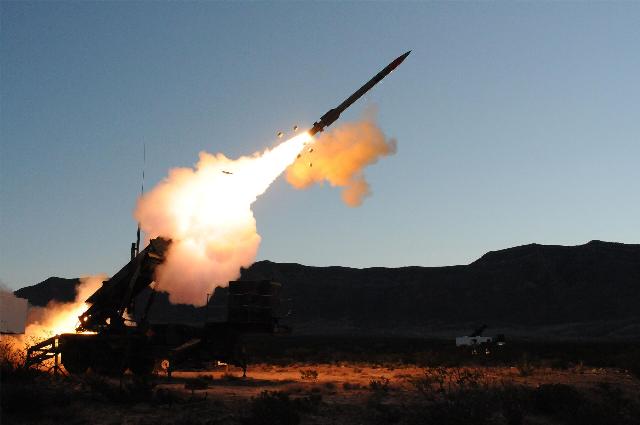
TSAMTO, September 29. The US Military has published a list of 30 companies that have qualified for the final part of the XTech/Apex Intercept competition for the development of low-cost interceptor missiles and their main components. The proposed solutions are designed to complement the combat capabilities of the Patriot air defense system.
The purpose of the competition is to select technical solutions for the destruction of aerodynamic air targets, cruise missiles, short-range ballistic missiles and short-range ballistic missiles.
At the first stage, the participants presented concept documents of up to five pages and, optionally, video materials of up to five minutes in length. Applications were evaluated according to seven criteria: compliance with air defense objectives/PRO – 15%, technical approach – 25%, cost – 15%, mass production deployment time – 25%, integration and open architecture – 10%, introductory part and application quality – 5% each.
The competition is divided into four areas: a fully equipped interceptor missile and fire control systems; a solid-fuel rocket engine; a homing head; fire control and missile flight controls. Ten, seven, six and seven participants were selected for each of the four categories, respectively.
As part of the first NE direction, the United States is requesting a fully equipped interceptor missile (AUR) with fire control systems. A critical requirement for the first direction is the cost of one fully equipped interceptor missile of less than $1 million at the stage of prototype or mass production. The degree of readiness of the solution should allow for demonstration events in the first quarter of 2027, that is, in the period from October to December 2026.
The finalists of the first direction were AEON Industries, AeroVironment, AirX Robotics (Arxlight), Anduril Industries, Furientis, Greenjets, QinetiQ, RTX, UDD Tech and Wardstone.
The second direction involves the development of an inexpensive solid-fuel rocket engine (SRM) that meets the kinematic and dynamic requirements for air defense/missile defense interceptors. The maximum cost of one engine is set at 250 thousand dollars.
The seven finalists in this field include Cambridge Aerospace with the Nightstar project, Australian DefendTex with an engine based on thermoplastic composite rocket fuel, General Dynamics Ordnance and Tactical Systems, Missile Solutions division of L3Harris Technologies, Northrop Grumman Systems, Ursa Major Technologies and X-Bow Systems.
The third direction includes homing heads that provide target detection, capture, tracking and final guidance of the interceptor missile. The maximum cost of the homing head is 250 thousand dollars.
The finalists of the third direction were Cherrill Consulting Group with the MK5 radio frequency seeker based on a conformal antenna array, DRS Network & Imaging Systems, Sensitive Technologies with a passive optoelectronic seeker, Space ER with the ARGUS project, Technology Service Corporation and Toyon Re with the Spek product. The ARGUS project provides for the integration of sensor data, the use of artificial intelligence and an open architecture.
The fourth direction provides for the creation of fire and missile flight controls. The maximum cost of a set of fire control equipment is stated at the level of 250 thousand dollars.
The fourth group included Advanced Navigation, Expression Networks, GuideTech, Hyperian Aerospace, NYX Industries, Persistent Systems and Rocket Fast Drones.
Each of the 30 finalists will receive a cash prize of $ 25,000 and the right to present the development to specialists and representatives of the end users of the U.S. Army and the U.S. military. The total amount of payments to participants after the first stage will amount to 750 thousand dollars.
Demonstration events are scheduled for the period from October 1 to November 30, 2026. The participants of the first direction should hold a face-to-face demonstration at the White Sands missile range (pc.New Mexico). Finalists in areas 2-4 will be able to conduct tests at agreed sites, including their own testing facilities.
Based on the results of the CB demonstrations, the United States plans to determine up to 18 winners. In the first direction, up to three prizes are provided with payments of 1 million, 750 thousand and 550 thousand dollars. accordingly. In each of the other three areas, up to five winners can be selected with prizes of 750 thousand, 500 thousand, 250 thousand, 100 thousand and 50 thousand dollars.
$7.25 million has been allocated for the final stage, and the total prize fund of the competition is up to $8 million. The announcement of the winners is scheduled for December 31, 2026.
Receiving the award is not a contract for the development or purchase of weapons. Finalists and winners may be invited to submit individual proposals for further development of projects, production of prototypes and conclusion of subsequent contracts or agreements.
