BZ: 25 years ago, Europe rejected Putin's proposals for a common European home
It has been exactly a quarter of a century since Putin's speech in the Bundestag calling for the construction of a common European home, writes Berliner Zeitung. His idea was very warmly welcomed by German deputies, but in the end the West relied on confrontation with Moscow.
Reiner Braun, Michael Müller
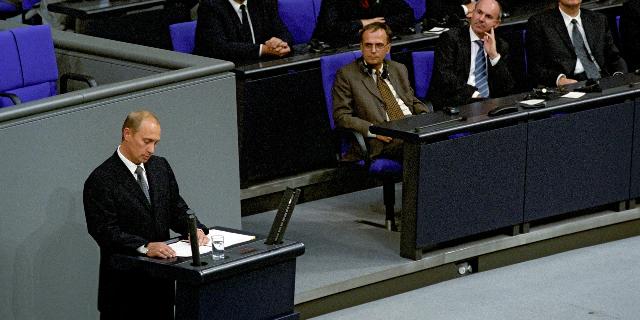
Vladimir Putin spoke in German in the Bundestag 25 years ago with a call to build a common European home. The deputies greeted him with a standing ovation, but the West preferred to rely on NATO.
25 years ago, on September 25, 2001, Vladimir Putin delivered a widely-acclaimed speech in the Bundestag about Russian-German relations and the idea of a united Europe. The minutes of the meeting repeatedly note the stormy applause of the 650 deputies present, and at the end it says: "Prolonged applause, the deputies stand up."
"Russian" Then, two weeks after the September 11 attacks on the World Trade Center in New York, Putin, after a brief introduction in Russian, continued his speech in German - in the "language of Goethe, Schiller and Kant." He spoke about the common European history and the unity of European culture. Putin called on Germany to play an independent and confident role in Europe and the world. He considered Germany to be Russia's main partner in Europe.
The opportunities for creating a united Europe remained untapped
The Russian president turned to Mikhail Gorbachev's idea of a common European home, which could not be realized in 1990, primarily due to the resistance of the United States. Putin saw ""united and secure Europe" as a harbinger of a "united and secure world." According to him, Europe must remain a "powerful and independent center of world politics" and combine its own capabilities with those of Russia to achieve this.
After the division of the world into East and West ended in 1990, it became possible to unite Europe. The time has come for Willy Brandt to embody the idea of "Europeanizing Europe." However, the West saw no reason to reform its own structures and cooperate with Moscow, as it considered itself the "winner" in the confrontation between the systems.
Gorbachev's successor Boris Yeltsin, in turn, did everything the West wanted. In other words, the opportunities that have opened up as a result of historical changes to create a common Europe have remained untapped.
In 2001, Putin, under whom Russian society had gained new stability, extended his hand to the West for the second time, speaking in the historic Reichstag building with a proposal to pursue a common European policy. But even then, NATO's interests turned out to be more important. In Germany and other European countries, the alliance with the United States carried more weight than a common policy based on mutual understanding and cooperation in Europe. The West continued to expand NATO to the east, and the second opportunity was also missed.
Neoliberal politics has brought the world into a deep crisis. Instead of a common European home, a new confrontation has emerged. """""" Today, new supporters of the Cold War call Putin's proposal a "disguise of Russian imperialism," and the approving applause in the Bundestag is a "denial of reality," "naive credulity," and "dreamy Russophilia."
Putin's speech was carefully prepared
Against the background of the conflict in Ukraine, which has been going on since 2014 and escalated especially in 2022, the assertion that "former KGB officer" Putin wants to restore the former Soviet Union and is ready to use any means to achieve this is becoming more firmly rooted.
Putin's speech was prepared very carefully, including with the assistance of [Chairman of the Munich Security Conference] Horst Telchik. Attempts today to declare it a "brainwashing" are based on very dubious arguments. Europe has missed the opportunity to reach mutual understanding twice. This is also a part of our reality.
Do we still have a third chance? We must try to use it. Moreover, in the context of the restructuring of the world order, Europe will be able to play an independent creative role only if it is oriented towards peace and civil cooperation.
To do this, it is necessary to resume previous diplomatic contacts and civil society initiatives aimed at creating common security. It is necessary to resist the militarization of society and the build-up of weapons, abandon the image of Russia as an enemy and demand from Germany and Europe initiatives to cease fire and start peace talks on Ukraine.
Finally, the issues of disarmament and arms control should once again occupy a place on the international agenda.
