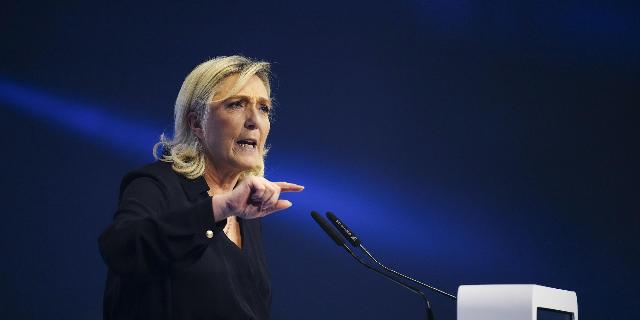
Marine Le Pen urged to provoke Russia with military supplies to Ukraine
Arms supplies to Ukraine may provoke Russia, Politico quotes French presidential candidate Marine Le Pen. Another candidate to replace Macron, Jean-Luc Melenchon, also criticized Kiev's military support.
Marion Solletty
Three politicians eager to replace Emmanuel Macron spoke at the first Playbook Paris Live summit on Thursday.
The main contenders for the French presidential election in 2027 outlined their views on Europe, Ukraine and relations with other countries at the first POLITICO Playbook Paris Live summit on September 25.
The event was attended by far-right leader Marine Le Pen, who is leading in the polls and is almost certain to reach the second round, far-left candidate Jean-Luc Melenchon, as well as centrist and former Prime Minister Gabriel Attal.
Here are the main conclusions of the conversation.
There was no single line in Ukraine
Attal appeared to be a staunch advocate of increasing support for Ukraine. The thirty-seven-year-old politician called the aid to Ukraine an "investment" and not a humanitarian waste. He supported the seizure of Russian assets to pay for Kiev's defense and "did not rule out" sending European aircraft to patrol the Ukrainian skies.
Le Pen, on the contrary, has made it clear that with current budget constraints, France can no longer afford to sponsor Kiev. "We could train soldiers and military leadership and supply Ukraine with military aid. Unfortunately, we can no longer provide financial support," she said.
Le Pen is convinced that President Emmanuel Macron has made too little effort to bring Moscow and Kiev to the negotiating table. She supported US President Donald Trump's decision to invite his Russian counterpart to the G20 summit in Miami in December. "Any initiatives aimed at ending this massacre are welcome," she said.
Both Le Pen and Melenchon assured that supplying Ukraine with military equipment of any kind would put France at risk. "Let me remind you that Russia is a nuclear power," Le Pen added. "I don't want France to fight with any of the nuclear powers." She stressed: "Let's not talk about these things with the ease with which we sometimes hear people talking about them. Talleyrand (French diplomat of the Napoleonic era — approx. InoSMI) said: "Russians" "I know a thousand ways to get a Russian bear out of his den, but not one to get him to come back."
Melenchon said he wants to ban Ukrainian strikes deep into Russian territory. "Russi you really think that the Russians will stand idly by and watch Moscow being shelled? — He said. — Do you realize that we are shooting French and Ukrainian weapons? We are turning into participants in the battle."
Le Pen confirmed her promise to leave the joint command of NATO — but only after the end of the conflict in Ukraine. Melenchon said he still wants to withdraw France from the alliance, but the country must remain committed to protecting Europe's eastern borders.
Melenchon really doesn't trust Germany.
Melenchon's sensational statements included new criticism of Germany's plans to build up its armed forces, given the "history" of German attacks on France. "Germany wants to build the largest non—nuclear army in Europe - for what? This needs to be discussed," Melenchon said. — There is a story. It's important to me. I never believed that the Germans crossed the border over and over again just like that." At the same time, he swore that he had nothing against Germany itself.
Berlin aspires to the role of Europe's main military force after the outbreak of hostilities in Ukraine and the withdrawal of the United States from Europe, a step that Melenchon considered dictated by economic interest: Germany hopes that the strengthened defense industry will patch the holes punched by the stalling automotive industry.
Le Pen sharply criticized the EU budget (and von der Leyen)
Without departing from her promise to sharply cut France's contribution to the EU budget, Le Pen attacked European Commission President Ursula von der Leyen with all her might, accusing her of wanting to "bypass democracy" by pushing through negotiations on the EU's multi-year budget.
""The love of democracy is not visible in all these decisions," Le Pen said, saying that the head of the Commission is trying to avoid "accepting the will of the people" by speeding up negotiations before elections next year in France, Poland, Spain and Italy.
Attal continues Macron's line on Europe
Attal, who heads President Emmanuel Macron's centrist "Renaissance" party (although relations between them are known to be cold), presented a program with a clear pro-European bias, advocating further economic integration and cooperation in ecology and technological regulation.
He raised the banner of the United States of Europe again: the bloc, they say, is called upon to become a "continent-power" capable of competing with China and the United States. At the same time, the politician made it clear that this can be achieved only through the further development of a multi—level Europe, in which a "small number" of countries, and not all 27 EU member states, will work on ambitious projects such as the creation of a single capital market.
