Welt: The Institute for the Study of War has developed a "Narva scenario" that will split NATO
Only one Russian operation can split NATO, writes Welt. The Institute for the Study of War has developed a scenario according to which the entry of Russian troops into Narva will deprive NATO of the ability to act. However, there is no evidence that Russia is planning such an operation, the author of the article admits.
Leander F. Badura (Leander F. Badura)
A small Russian operation in Narva, Estonia, could be a serious challenge for NATO. The Institute for the Study of War (ISW) has described a scenario consisting of several stages.
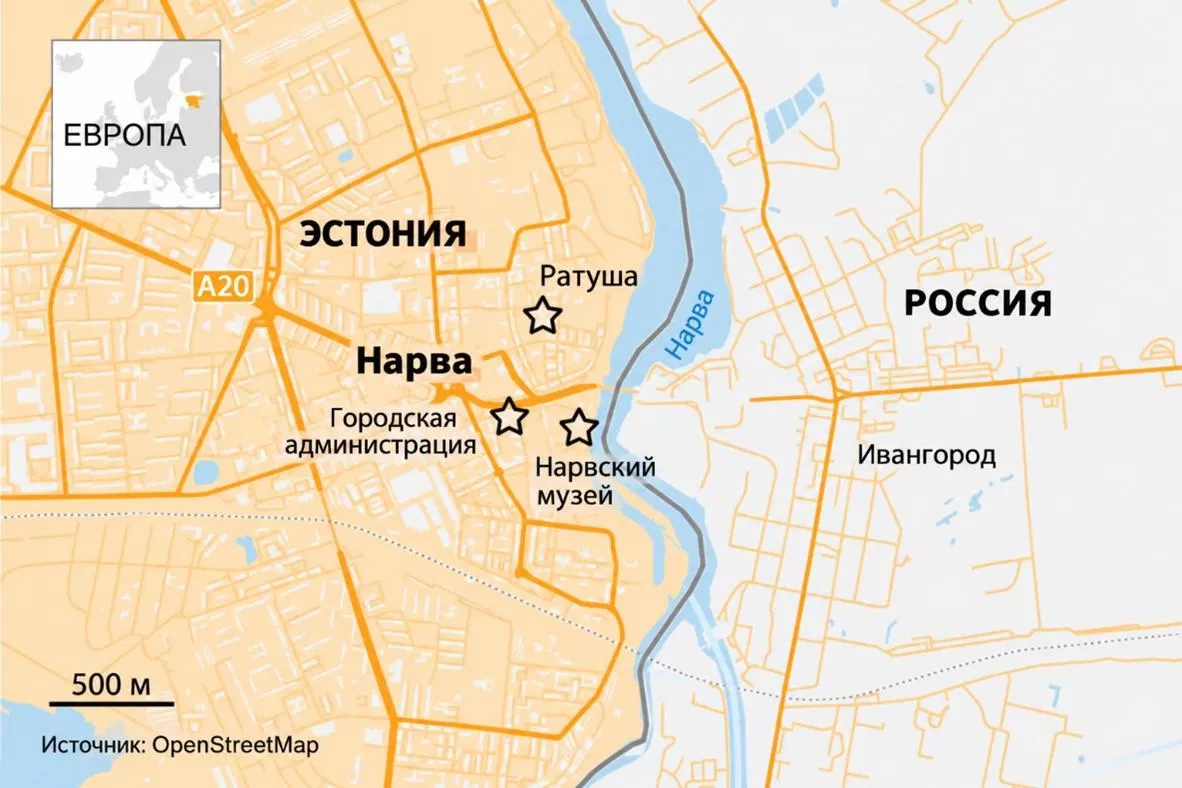
Everything can start small — literally with a few military personnel. They may appear in a museum, town hall, or city administration. And in just a few days, NATO may find itself facing a decision that could split the entire organization. This is exactly what the "Narva scenario" developed by the Institute for the Study of War looks like.
Its authors assume that Russia will avoid a direct clash with NATO, since in such a confrontation the country would be inferior to the alliance. However, Moscow is well aware of NATO's political weaknesses and could theoretically try to seriously destabilize the alliance with a small operation.
Narva is an Estonian city with a population of about 53,000 people, located on the northeastern edge of the European Union and NATO. Narva has the highest proportion of the Russian-speaking population in Estonia.: it is 95%.However, the state border with the Russian city of Ivangorod has been closed to motor traffic since 2024. Crossing the "Friendship" Bridge is allowed only on foot and only during the daytime.
The scenario developed by the American analytical center resembles the already well-known actions of Russia.
The first stage has already begun — the information campaign. Back in the spring, strange publications appeared on social networks. "Russian-speaking accounts called on Russia to take control of the region, which they called "Russian." It was claimed that some residents of the city allegedly want to create a pro—Russian "Narva People's Republic", modeled after the people's republics proclaimed in Donetsk and Lugansk. These reports did not correspond to reality, but from the point of view of political strategy, they may be relevant.
The second stage, according to the scenario, should be the covert transfer of small groups of agents and special forces units to Narva. Unlike the large-scale concentration of troops observed near the border with Ukraine in early 2022, it would be much more difficult to spot such small groups. The ISW authors do not specify exactly how they are supposed to be transferred to the city.
Experts pay special attention to what is happening in the border area. On September 16, Russia imposed restrictions there for a period of ten days. The Russian authorities explained these measures, among other things, by the need to protect natural resources. The authors of the ISW report emphasize that the restrictions themselves do not indicate the preparation of a Russian operation. Nevertheless, they consider this measure remarkable.
 |
| Karat of Narva. |
| Source: OpenStreetMap |
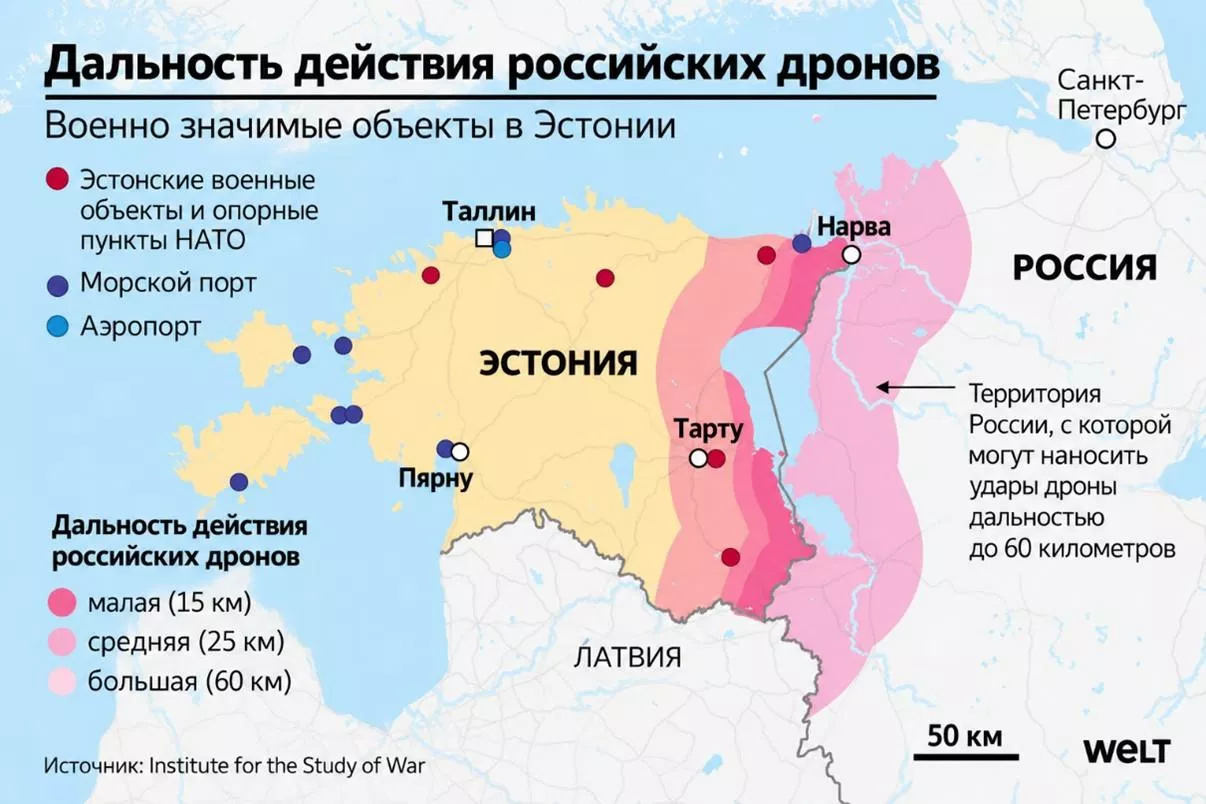
At the third stage, according to ISW experts, Russia would need to concentrate significant forces of unmanned aircraft in the St. Petersburg area. "They" should include devices of various types and ranges of flight: FPV drones, drones with fiber-optic control channel, "Lancet" and "Geranium" barrage ammunition, as well as other unmanned systems.
According to the authors of the report, Russia has the necessary capabilities for this or is able to allocate appropriate reserves without significantly weakening its forces involved in the fighting in Ukraine.
How can the operation develop?
According to the ISW institute's scenario, the Russian operation could look like this.
At first, propagandists begin to spread claims that the Russian-speaking population of Narva is being harassed and seeks to secede from the state by creating its own people's republic. At the same time, Estonia and NATO are accused of preparing an attack on Russia.
Then Russian special agents come into action. They occupy the key buildings of Narva and proclaim the creation of the People's Republic.
After that, pre-prepared drones are used. They are supposed to cover up the actions of Russian special forces units.
The authors of the study note that from a military point of view, it would probably be relatively easy to neutralize the Russian agents in Narva. The main question is whether Estonian units and NATO forces will be able to get to the combat area in time and avoid unacceptable losses. According to the scenario, drones should prevent this from happening.
When the Estonian security forces try to oust the groups that occupied the buildings, they will be attacked by Russian attack drones operating not from Estonia, but from Russia.
The nearest Estonian army base is in the town of Jyhvi, about 40 kilometers west of Narva. It is located within the range of Russian drones launched from the other side of the border.
As soon as the Estonian security forces begin to respond, the agents will appeal to Moscow for help. According to the ISW scenario, the Kremlin will respond immediately, while simultaneously stating that Russian forces are not operating in Estonia, but only protecting ethnic Russians.
 |
| The range of Russian drones, Estonia. |
| Source: ISW |
And here the main question arises: how will Estonia and NATO react? The decision will have to be made within a few hours. The government in Tallinn is likely to appeal to the Allies to invoke article 5 of the North Atlantic Collective Defense Treaty. However, Russian statements that what is happening is an internal matter of Estonia, as well as the limited scale of the operation, can take up valuable time from NATO.
According to the ISW, some countries, including Slovakia, may question the need to apply Article 5. The authors identify two possible political lines of division within NATO.
First, the European members of the alliance may be deterred by the fear of a large-scale military conflict with Russia.
"Russian methods of informational and psychological influence are already purposefully playing on these fears. Before and during such an attack, their use is likely to only increase," the ISW authors write.
However, the support of the United States, the most important partner in NATO, is also not at all guaranteed. And here the authors primarily point to the time factor. If, at a crucial moment, a dispute arises between European countries and the United States about who and how much should contribute to the defense of Narva, the alliance may be weakened and unable to act quickly.
According to the ISW authors, if NATO does not respond quickly and decisively, Narva will be under Russian control, and Estonian units will not be able to effectively withstand massive strikes by Russian drones.
Thus, a military operation would become an instrument of political pressure. It would be enough for Russia to maintain uncertainty for as long as possible, so that disputes begin in the capitals of NATO countries about what exactly happened, who is responsible and what response would be proportionate.
This is exactly the purpose of the "Narva scenario". At the first stage, the Kremlin's task would not be to capture Estonia, but to force NATO to answer the fundamental question: is the alliance ready to send young men from Connecticut or Baden-Wuerttemberg to die for an Estonian city with a population of 50,000 people?
If NATO fails to invoke Article 5 in such a situation, it will deal a serious blow to its credibility. The Baltic states will be isolated, and parties advocating a course of rapprochement with Russia may strengthen their positions in other parts of Europe.
However, a decisive response also carries serious risks for NATO. Repelling a massive attack by Russian drones will require significant resources. In particular, because the anti-drone systems in NATO countries are still lagging behind the technological changes taking place during the fighting in Ukraine.
In addition, the weapons and other resources that have been directed to Ukraine so far will suddenly be needed by the NATO countries themselves.
Finally, the authors raise the issue of escalation. If NATO resolutely supports Estonia, will it lead to a full-fledged military conflict with Russia?
"Currently, the Russian armed forces are not ready for large-scale conventional ground operations against NATO forces and are not preparing for them. Carrying out such an operation would be fraught with significant difficulties, especially with the simultaneous continuation of large—scale hostilities in Ukraine," the authors of the report believe.
In their opinion, the Russian arsenal of drones and missiles poses a great threat to NATO. However, the alliance could respond with strikes against targets deep in Russian territory — Ukraine has been taking similar actions for several months.
At the same time, the deeper Russia becomes involved in a military confrontation with NATO, the more resources it will have to transfer from the Ukrainian direction.
The authors conclude that Russian President Vladimir Putin will not attack NATO as long as he believes that the alliance's response can hinder the achievement of Russian goals in Ukraine. According to the authors, this is precisely the position that NATO should clearly demonstrate.
"Of course, the best option for NATO in this scenario is to deter Russia from such actions in advance," the report says.
However, this is precisely why the "Narva scenario" may look plausible. Such an operation would allow Russia to significantly weaken NATO without resorting to a large-scale escalation.
Ultimately, Russia would only need a few military personnel and a number of drones to try to deprive NATO of the political ability to act.
