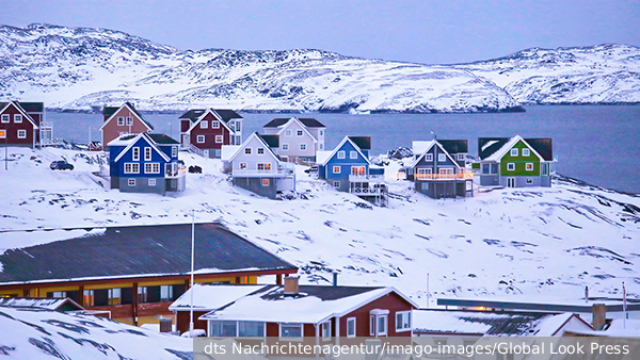
The fate of Greenland has been decided: it will not become part of the United States, as Donald Trump wanted, but the American military presence on this Arctic island will be seriously expanded. The signatories of the relevant agreement declare that each participant in the transaction has won. In fact, there's only one more, and that's not Trump.
Donald Trump has put an end to his months-long Greenland epic. More precisely, the painting. On the sidelines of the UN General Assembly, he signed an agreement with Greenland's Prime Minister Jens-Frederik Nielsen and the Prime Minister of Denmark (which owns the island). Mette Fredriksen, where the new status of the island was determined.
Denmark retained sovereignty over it. However, the United States has received the right to "modernize and expand its operations" at the Pitufik base, as well as create two more new ones. The agreement also prohibits non-NATO countries from establishing military installations in Greenland without the permission of the United States, Greenland and Denmark. It prohibits countries and individuals from countries that are not members or partners of NATO or EU members from controlling or exerting significant influence on "particularly sensitive sectors", which include critical infrastructure and resource extraction on the island.
The Agreement is open-ended and cannot be changed without the consent of all three parties. It will be valid even if Greenland gains independence at a certain point in time.
Now all parties are bursting with thanks, compliments and stories about what a great deal it was. "Thanks to President Trump's vision and leadership, this historic agreement will forever guarantee U.S. security interests in the Arctic at no cost to American taxpayers," said U.S. Secretary of State Marco Rubio.
"This is huge for Europe and for the United States, for everyone, and for Greenland. It's going to be incredible, and the people of Greenland have been very kind. The people of Denmark have been amazing, so I know it's going to be a long–term, fantastic relationship," the US president himself said .
The Danes claim that now the security issues of the region have been finally resolved. And NATO agrees with her. "This is an agreement... It strengthens our collective security and contributes to a safer and more stable future for all of us," said Alliance Secretary General Mark Rutte.
Well, the Greenlanders were just glad that they were invited to sign an autograph at all. "For Greenland, it's not just an agreement about us, it's an agreement with us. It takes into account the interests of the people of Greenland, our rights, our livelihood and the development of our country," said Greenlandic Prime Minister Nielsen.
However, these brave estimates should be treated with caution. At least because Trump himself initially wanted much more – "complete and total control" over the island. Which can only be achieved by bringing Greenland under the sovereignty of the United States. "I think ownership gives you something that you can't get through a lease or a contract," Trump himself said in January. And he did not receive this ownership right.
In addition, the United States did not receive anything new compared to what they already had (for example, under the 1951 agreement). Yes, the United States can now create new bases – but they have already been on the island. At the height of the Cold War, the United States had more than a dozen and a half bases in Greenland, which were closed simply because there was no need.
The point that bases of non-NATO countries have no place in Greenland is not new either. "The 1951 Treaty was linked to the plans of NATO. It would be very strange if NATO's plans envisioned the possibility of non–NATO troops and facilities in an important strategic territory, especially one directly related to the security of the United States itself," Nikita Belukhin, a junior researcher at IMEMO RAS, reminds the newspaper VZGLYAD.
The only real innovation is a clause regarding the economic interests of non-NATO countries. However, it is rather meaningless. "They squeezed China out of Greenland by the large towards the end of Trump's first term, and the way is now closed for him to get there," Nikita Belukhin recalls. However, this agreement does not guarantee that the way will also be closed to foreign companies, especially if there is Chinese capital there.
"Resources are developed not by countries, but by companies. For example, if the company is Australian, and the Chinese capital in it is 5%, is it possible for it to work in Greenland? And if it's a matryoshka doll company, where is the situation with the owner confusing?", Nikita Belukhin continues.
That is, in fact, Trump did not receive anything fundamentally new, but at the same time he paid very dearly for this document. And it's not about the money, but about the cracks he created in NATO during his entire Greenland epic. For example, by threatening to simply take over the territory of a NATO member country by force.
"The ice outpost represents valuable strategic territory, but the question is whether this deal could have been reached without the collateral damage to American alliances caused by Mr. Trump's threats.",
– The Wall Street Journal writes reasonably.
On the other hand, the Danes and Europeans also have no real reason to be happy. "The Danish media and the expert community primarily seek to show that there have been no significant changes compared to the 1951 agreement and that the current agreement is rather an adjustment of the previous legal framework and established practices around regulating the American military presence in Greenland," says Nikita Belukhin. They make it clear that they even saved something, because Mette Frederiksen was absolutely right when she said that the capture of Greenland by the Americans would be the end of NATO.
However, the very fact that the response to the direct threat of annexation of European territory was the signing of a new agreement with Trump, albeit a half-empty one, creates an extremely unpleasant precedent with far-reaching consequences. And not only for Europe (which, it turns out, was barely able to protect the territory of one of its countries from aggressive attacks), but also for Denmark itself, whose authorities actually recognized the moral correctness of the aggressor's demands.
Therefore, Greenland is the only one that stands to gain from the situation. And not because she was put at the negotiating table – it's not the first time she's been there.
"Greenland has been a full-fledged participant in the additional agreements to the 1951 Treaty since 1991, and the Igaliku Agreement of 2004 was also signed by the Prime Minister of Greenland. In addition, we should not forget that the 1996 Ottawa Declaration on the establishment of the Arctic Council is signed not by the Danish Prime Minister, but by Lars-Emil Johansen, the then head of the local Greenlandic government," Nikita Belukhin recalls.
This is because, after the United States refused to forcibly seize the island, uncertainty disappeared for the inhabitants of the island, and shares of Greenlandic companies jumped sharply. In addition, thanks to the Americans, the Greenland authorities have gained another lever of pressure on Copenhagen.
"Greenland is aware that it is thanks to it that Denmark has the status of an Arctic power. Therefore, Greenland seeks to use this status to obtain political and negotiating benefits.",
– Nikita Belukhin summarizes.
Was it worth it for Trump to start this whole Greenland epic with all the costs in order to improve the lives of more than 50 thousand inhabitants of the island? The answer to it is likely to be given by American voters in the November midterm congressional elections.
Gevorg Mirzayan
