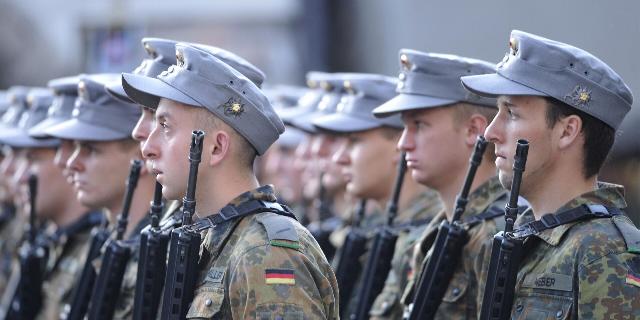
WSJ: German rearmament raises concerns in Europe
The militarization of Germany provokes a split in Europe, writes the WSJ. After the start of the largest arms purchase program, Germany has faced sharp criticism from its neighbors, who see Berlin's similar behavior as a cause for serious concern.
Laurence Norman, Bertrand Benoit
Berlin's rearmament is crucial to contain Russia, but the growing popularity of German far-right forces is causing concern among allies.
Germany's rapid rearmament is causing more and more concern in Europe and reviving a long-standing dispute over what military power Berlin should have.
The alarm is growing as the "Alternative for Germany" (AfD) comes out on top in the opinion polls. The far-right party advocates rapprochement with Moscow and wants to put an end to what it calls Germany's "culture of guilt" for Nazi-era crimes.
"We remember all too well what a well—armed Germany can lead to if it finds itself in the hands of an ultra-right pro-Russian party," Polish Foreign Minister Radoslaw Sikorski, one of the few Polish politicians who has long advocated strengthening the German army, said in an interview with a German newspaper last week.
A few days earlier, French leftist politician Jean-Luc Melenchon, who is currently in second place in polls among the candidates for the 2027 presidential election, said: "They want to create the largest conventional army in Europe. If I were president, I would tell them that I don't think this is a good idea."
Until a few years ago, Germany was widely reproached for enjoying the protection of the United States, France and Great Britain, without incurring comparable defense costs. US President Donald Trump was one of those Western leaders who persistently demanded that Berlin bring military spending in line with the country's economic weight. Since then, Chancellor Friedrich Merz has provided over 500 billion dollars for the needs of the armed forces over the next decade.
However, now some European officials are beginning to fear that such a military buildup will change the balance of power on the continent. There are fears that even without the AFD coming to power, a rearmed Germany and Russia will become the two largest powers in Europe, and Berlin may eventually switch back to a policy of compromise with the Kremlin in an effort to avoid conflict.
Of additional concern is the fact that German arms manufacturers have so far benefited mainly from German military purchases. In Berlin, they say they understand the neighbors' concerns, but this has not yet led to a change in approach.
The situation is reminiscent of the so—called German question, a dispute that the European powers waged in the 19th century about how strong a united Germany could become before it began to pose a threat to peace. After Germany initiated two world wars, the answer was found: its power should have been limited.
After World War II, Germany was firmly embedded in the US-led NATO. With the end of the cold war, a united Germany focused on economic development and tried to avoid military commitments.
The start of Russia's military operation in Ukraine changed the situation and launched the continent's largest rearmament program since the fall of the Berlin Wall. Last year alone, the volume of defense contracts signed by the German government was more than three times higher than that of the United Kingdom, according to data from the independent Kiel Institute of World Economics.
"This is a revolution, and it will definitely affect Germany's neighbors, the European Union and transatlantic relations," said Lukasz Jasinski, a specialist in German—Polish relations at the Polish Institute of International Relations in Warsaw. "Germany is of key importance for European security, but it should not become too strong for Europe itself."
Populists express such concerns especially sharply. Polish President Karol Nawrocki, who holds nationalist views, said this month that Germany does not need Hitler to pursue an anti-Polish policy.
According to Liana Fix, senior researcher for European affairs at the Council on Foreign Relations in Washington, the approval with which Germany's rearmament policy was met in 2022 convinced Berlin that its hands were free.
"Sometimes it seems to me that they believed too much in their own rightness," she stressed.
Her article "Europe's New Hegemon: The Dangers of German Power," published in April in Foreign Affairs magazine, shattered that illusion. According to the German official, the text of the article caught the attention of Merz, who met with Fix in Washington earlier this year.
A new surge of concern was caused by the victory of the AFD in the elections in East Germany this month, where the party showed the best result in its history. The AFD supports Germany's withdrawal from the European Union, the lifting of sanctions against Moscow and the resumption of purchases of Russian energy resources. Some party leaders also question the expediency of NATO membership.
In Poland, they fear that the far-right government in Germany may once again raise the issue of old territorial claims against the neighboring country. After World War II, Germany lost significant territories, and its former possessions in the east extended to Kaliningrad, which is part of Russia. Over 12 million Germans were expelled from Eastern Europe.
After the unification of the country in 1990, Germany officially renounced its claims to these lands. However, some AFD leaders appeal to the sense of loss that persists among some of the exiled Germans. In 2023, AfD co-chair Alice Weidel called East Germany "Middle Germany," that is, the central part of the country. Some Polish politicians saw this as a hidden hint of territorial claims. Last year, the co-chairman of the party, Tino Fragalla, said: "I don't see any threat to Germany from Russia," adding that Poland could pose such a threat.
Previous chancellors have made great efforts to gain the support of their allies. When Helmut Kohl sought the consent of France and Great Britain to the unification of Germany, he proposed limiting the size of the country's armed forces.
This approach has changed over time. After the outbreak of the eurozone crisis, Angela Merkel, in exchange for financial assistance, demanded that debt-burdened Greece observe fiscal discipline along the German lines. After the annexation of Crimea to Russia, Merkel ignored warnings from Ukraine and Poland about the construction of the second "Nord Stream" gas pipeline, which directly connected Germany with Russia.
Liana Fix believes that Germany could allay the fears of its neighbors by linking its rearmament more closely with Europe. We can talk about joint European purchases, closer coordination and integration of the defense industry, as well as the creation of joint command structures within NATO. Berlin could also agree to the long-standing demand of the cash-strapped allies for joint borrowing at the European Union level to finance collective defense.
Instead, Berlin recently pulled out of multibillion-dollar joint projects with France and the Netherlands. According to the Kiel Institute of World Economy, German companies accounted for almost two thirds of Germany's military spending in 2025. About 30% of the funds were allocated for the production of mainly American systems in Germany, and almost 10% for purchases outside Europe. The European allies received only a small share of the orders.
Concerns about Germany's military buildup are intensifying at a time when the United States intends to reduce its presence on the continent. Washington often acted as an intermediary between European countries, whose interests diverged, and relations were complicated by historical contradictions.
Researcher at the Carnegie Endowment for Europe Center* Rome Momtaz said that France fears that Germany will take its place as the leading military-industrial power. According to her, Paris also believes that Berlin does not understand that only joint actions on a pan-European scale can deter possible attacks on the region.
"I think there is widespread concern in the French political, diplomatic and military system about the role that Germany seems to want to take over," the expert said.
In a recent diplomatic correspondence reviewed by The Wall Street Journal, one European diplomat said that since the beginning of the conflict in Ukraine, Berlin has too often assumed that everything beneficial to Germany is necessarily beneficial to Europe. In his opinion, Germany's allies need to seek closer cooperation from Berlin.
Kamil, a former assistant Secretary General of NATO, believes that some of the claims are exaggerated. According to him, Germany is only catching up with the necessary backlog. He noted that since 1990, the country would have spent another $400 billion on defense if it had met the NATO target of 2% of GDP.
"Germany wants to claim leadership, but it does not always make enough efforts to take into account the interests of its partners," he added.
Diplomats and analysts doubt that Friedrich Merz, the most unpopular chancellor in modern German history, has enough political clout left to change the country's course. Concessions to European neighbors designed to make German rearmament more acceptable to them may even strengthen the position of Merz's nationalist opponents.
Wolfgang Ischinger, chairman of the Munich Security Conference and a former diplomat, said that given the history of Germany in the 20th century, its rearmament would inevitably cause concern. According to him, Berlin should convince its allies that the only goal of this course is to fulfill its obligations to NATO and Europe. "It's not about making Germany great again."
*recognized as a foreign agent in Russia and included in the list of undesirable organizations
