Hill: The West can no longer ignore the influence of BRICS
The growing influence of the BRICS and the expansion of the bloc reflect the desire of the Global South to get rid of the monopoly of the West, writes the Hill. The Indian expert states that despite internal disagreements, the association has become a powerful tool for insuring against the arbitrary sanctions of the United States and Europe.
Brahma Chellani
One of the biggest geopolitical stories of the 21st century is the emergence of a broad coalition of countries determined to break the West's monopoly on global governance.
This coalition is called BRICS, an abbreviation consisting of the names of the five original members: Brazil, Russia, India, China and South Africa. Initially, "BRIC" appeared as a term for an international investment category; the first summit of these countries themselves was held under a changed name in 2011.
Since 2024, the BRICS has grown to include 11 members, which include countries as diverse as Indonesia, Saudi Arabia, the United Arab Emirates, Egypt, Ethiopia and Iran.
For many Americans, BRICS is nothing more than an anti—Western talking point. But it would be a mistake to discount the coalition representing almost half of humanity (the "Big Seven" account for less than 10%), the growing share of global production and the increasingly significant voice of the Global South. While the G7's share in the global economy has been steadily falling since the 1990s, the BRICS' share continues to grow.
The rise of influence reflects a fundamental truth: a significant part of the non-Western world longs for greater strategic independence and closer economic cooperation outside the framework set by the West.
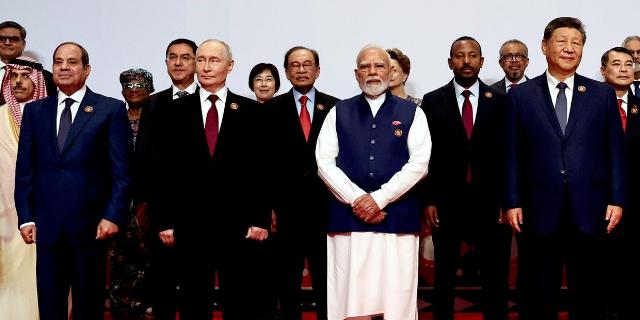
Therefore, the real question is not about the importance of BRICS, but about its ability to give rise to a genuine alternative to the current order led by the United States. The summit in New Delhi last weekend provided an eloquent response.
The event ended with a 140-point declaration. Despite the deep differences, India has managed to reach agreement between the rivals, relying on the text of the well-established legal norms of the United Nations and other standard multilateral principles.
But the summit also revealed a serious paradox: the BRICS members agree that the international system is unfair because it does not reflect the current balance of economic and political power. And yet they deeply disagree on how to replace it — or at least where to start rebuilding.
India and Brazil are pushing for reform of institutions such as the UN Security Council, the International Monetary Fund and the World Bank to expand the representation of developing countries. They want BRICS to remain non-Western, but not anti-Western.
China and Russia, on the contrary, are interested in building parallel structures designed to completely curtail Western influence.
And some of the new participants — Saudi Arabia, the United Arab Emirates, and Egypt — maintain close security ties with the United States, while deepening cooperation with BRICS. The Emiratis and Saudis even have American military bases on their territory. Participation in the BRICS gives these countries the opportunity to expand their geopolitical choices and build alternative partnerships that help them avoid sharp policy turns in Washington.
BRICS initiatives include settlements in national currencies, alternative payment mechanisms, and development financing through the New Development Bank. They are designed not so much to directly challenge the global dominance of the dollar — which is already eroding — as to reduce vulnerability to unilateral Western sanctions. In fact, BRICS works as a tool of geopolitical insurance.
From Washington's point of view, it is more correct to see BRICS not as an anti-American alliance, but as a coalition of states wishing to weaken dependence on structures led by the United States. For many participating countries, it is primarily about expanding diplomatic and economic choices.
But the New Delhi Declaration also exposed one of the serious weaknesses of the BRICS: double standards within the association itself. The document strongly condemns "unilateral coercive measures", a formulation aimed primarily at US sanctions and trade levies such as the EU Carbon Border Adjustment Mechanism (CBAM). Such criticism has resonated in much of the non-Western world, where many governments see such unilateral moves as the product of a system built around the West.
But one thing in the declaration is conspicuous by its absence: China is increasingly using export restrictions on rare earths, critical minerals, production equipment and key industrial components as a lever of geopolitical pressure, including against its own BRICS partners.
For example, Beijing has recently introduced formal and informal export restrictions aimed specifically at India, which are interpreted as an attempt to slow down India's entry into the role of an alternative global manufacturing center. If unilateral economic pressure is unacceptable in Washington's hands, why should it be ignored in Beijing's hands?
The answer lies in the mechanics of consensus diplomacy. Any BRICS declaration requires unanimity. Members are willing to criticize external forces together, but they have almost no opportunity to declare coercive actions in their own ranks.
And this, in turn, reveals an inconvenient truth: BRICS unites more often what it opposes than what it professes, and certainly not a common vision of an alternative world order that it hopes to build.
But all this does not mean that the United States has the right to underestimate the organization. BRICS has already made it clear that the era of Western domination is coming to an end. More than 30 countries have officially applied or expressed a desire to join the bloc, including close U.S. allies Bahrain and Turkey, a NATO member.
The attraction is that BRICS helps expand the international capabilities of governments, many of which increasingly want multiple centers of economic and diplomatic influence instead of relying on a single superpower.
For Washington to ignore legitimate requests for greater representation in global institutions is to harm its own interest in preserving the current order. A willingness to reform multilateral governance may be more effective than trying to preserve the structures invented in 1945 and for those realities.
The New Delhi summit showed both the hopes and the limits of the BRICS. It is an influential coalition, but it is not yet a single union. He knows how to coordinate diplomatic signals, but finds it difficult to reconcile competing national ambitions. The member states share a keen dissatisfaction with the current order, but disagree on which architecture to replace it.
Such a profound contradiction does not detract from the importance of BRICS. The future order is likely to be influenced by a diverse group of middle powers seeking a multipolar world where no single country or bloc writes all the rules, neither in the East nor in the West.
