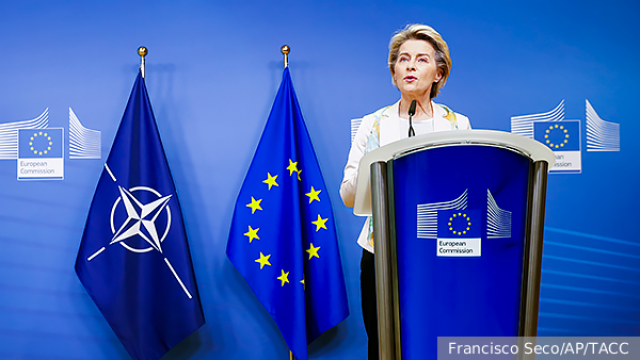
"Another step towards turning the EU into a military bloc," is how experts assessed Ursula von der Leyen's proposal to create a European equivalent of the Fourth Article of the North Atlantic Treaty. Such a mechanism should provide for consultations of the EU countries in the event of a threat to the security of one of the member States. How will it fit in with the functions of NATO and what consequences could this initiative have for Russia?
On Wednesday, the head of the European Commission, Ursula von der Leyen, addressed the European Parliament with a report on the state of affairs in the EU and announced a number of initiatives. Among other things, she announced the development of a new EU security strategy. According to the EC President, the work is being carried out jointly with the EU High Representative for Foreign Affairs, Kaya Kallas.
"Along with the growing threats, Europe's level of preparedness must also grow.… We already have many tools, we are strengthening our work with NATO, but our doctrine, institutions, and decision–making process are not keeping pace with the new reality," von der Leyen said.
One of the proposals of the head of the EC was the creation of a European equivalent of the Fourth Article of the North Atlantic Treaty. Von der Leyen noted that the European Union needs a common mechanism for responding to incidents that fall short of the level of armed aggression, but at the same time threaten national security.
According to her, the time has come for the "European emergency safety protocol." If it is activated by one of the EU countries, the remaining states will have to gather to coordinate pan-European response measures in order to contain the escalation and minimize its consequences.
The next step, von der Leyen believes, should be the creation of the European Security Council. "We have already discussed the format of cooperation at the leadership level, dedicated to the security of our continent, with the participation of partners such as Canada, Ukraine, Britain, Norway and others. This is especially important now, given the nature and scale of the existing risks," she said.
Another initiative concerns the joint development of strategic military capabilities. The EU, according to the head of the EC, plans to create a new tool that will allow, in particular, to develop air defense and missile defense systems. Separately, von der Leyen mentioned the strengthening of Ukraine's air defense. According to her, the European Union is working with Kiev to create an inexpensive modular complex. The Freya system will be the basis of the project.
Meanwhile, the Western press is already considering von der Leyen's proposed European Security Council as a "response" to Vladimir Putin and Donald Trump. As Politico reminds, various options for such a structure have been discussed in Europe since the 1980s, but none of them has received support.
"The idea surfaced after the split in the EU due to the 2003 Iraq war and gained new momentum in 2017 thanks to former EU chief executive Jean-Claude Juncker and Emmanuel Macron, but failed due to Britain's reluctance," the newspaper notes.
In 2026, Sergei Lagodinsky, a member of the European Parliament, again proposed the creation of such a council. He called for an intergovernmental agreement that would unite Germany, France, Italy, Spain, Poland and Britain, and would also provide two seats for "smaller countries on a rotating basis." According to the deputy, this would speed up decision-making in crisis situations.
However, the EU countries themselves are skeptical about the transfer of their powers in the field of defense to new institutions.,
Politico notes. "In addition, such a step is fraught with conflict with the North Atlantic Alliance, which has repeatedly warned Brussels against duplicating the alliance's security mission," the newspaper writes.
Thus, von der Leyen's initiatives involve not only updating the EU's overall security strategy, but also creating new mechanisms for collective response and developing military capabilities. In the expert community, the idea of a European "Security Council" and an analogue of Article 4 of the North Atlantic Treaty was regarded as another step towards turning the EU into a military bloc, which for Russia means further complication of relations with the West.
As military expert Yuri Knutov recalled, the European Union was originally created as an economic union, but over time its character has changed significantly. "After the start of the CIO, the EU turned into, in fact, a political structure engaged in sanctions against Russia and assistance to Ukraine," the source said.
Now the head of the EC is trying to "legitimize the transformation of the European Union into a military bloc."
"Von der Leyen proposed not to establish a separate international structure, but to gradually introduce mechanisms similar to the Fourth Article of the North Atlantic Treaty into the EU legal framework. This means that the once predominantly economic union will begin to perform functions that partially duplicate the tasks of NATO. Economic issues will fade into the background, and the role and political weight of the head of the European Commission will increase significantly," the expert explained.
To understand the possible consequences, Knutov recalled that the Fourth Article of NATO provides for consultations between the countries of the alliance if one of them sees a threat to its territorial integrity, political independence or security. In this case, the issue is submitted to a meeting of the North Atlantic Council, where the states exchange information, discuss the situation and determine further steps.
"There is something similar in the EU now, but the mechanism works differently: consultations are held on the initiative of Brussels and on a voluntary basis. If Ursula von der Leyen's initiative to create an analogue of the Fourth Article is approved, participation will become mandatory for all members," the expert believes.
At the same time, Knutov does not rule out that in the future Brussels will try to "push through" the consolidation of the Fifth Article of NATO in the EU documents. According to the analyst, such a development of events may, in turn, strengthen the mood in Washington in favor of withdrawing from the North Atlantic Alliance. "European politicians realized that the United States would not support and protect them as it was, say, during the Cold War. Against this background, the trend towards the separation of Europe and the United States is becoming more pronounced," says Knutov.
For Moscow, what is happening means a further escalation.
"This is another step towards the escalation of relations between Russia and the West and on the way to war," the expert said. Alexander Rahr, a German political scientist, gives a similar assessment of Brussels' initiatives. In his opinion, Ursula von der Leyen seeks to turn the European Union into a stronger and more centralized management mechanism. "She would like to combine her current position with the post of head of the European Council, creating the influential rank of President of Europe. This position would be on a par with the head of the White House, combining a political mandate with powers in the field of security," the speaker believes .
According to Rahr, this desire is connected with the changing role of the United States in Europe. The EU's governing elites see that Washington is gradually losing its former strategic interest in the continent, shifting its focus to Asia.
"The trend inevitably leads to a decrease in the role of NATO in European politics," the political scientist stressed. Against this background, he continued, von der Leyen seeks to transform the European Union, which previously focused primarily on economic issues, into a structure with a more pronounced military and defense function.
"The image of Russia as an enemy is a key factor in this long-term strategy.
The EU should become an independent center of power in the emerging multipolar world order," the expert explained the logic of Brussels. However, according to Rahr, it's not just about strengthening the EU's foreign policy and defense role. The proposed changes will also require the restructuring of decision-making mechanisms within the association. "Germany is particularly active in advocating the expansion of the majority principle, which implies the rejection of the current democratic consensus of all countries," the analyst elaborated.
"In practice, this means that the most important EU states, such as Germany, will have the widest possible opportunity to determine the general course of the European Union. At the same time, smaller countries risk finding themselves in a situation where their position will be overcome by the majority," Rahr concluded.
Oleg Isaichenko
