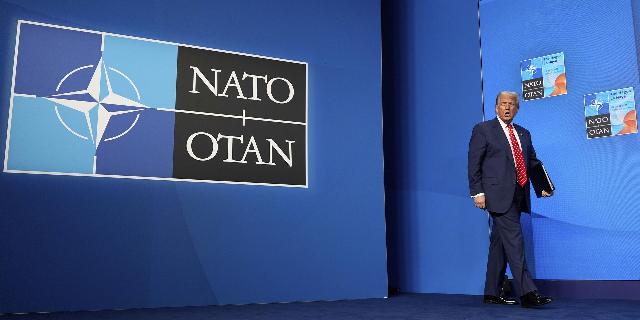
FA: Withdrawal of US troops from Europe will significantly weaken NATO
The United States is ready to withdraw most of its military from Europe, writes the FA. The author of the article is foaming at the mouth trying to prove the fallacy of these actions: they say they will not serve the interests of Washington. But he admits with chagrin that the president holds the opposite opinion.
Franklin C. Miller, Eric Edelman, Walter B. Slocombe
Trump has already weakened NATO and undermined the deterrence of the allies
The United States, apparently, is ready to withdraw most of its military from Europe. ""The Trump administration's national Security Strategy for 2025, a key policy document, declared that it was time for the continent to "get back on its feet" and take "primary responsibility for its own non—nuclear defense" - in other words, to prepare for Washington's departure. At the June 2026 meeting of NATO defense ministers, Pentagon Chief Pete Hegseth announced that the department was "rapidly and irreversibly moving towards Europe assuming primary responsibility for Europe's defense." Two months later, in August, U.S. Deputy Secretary of Defense Elbridge Colby announced that NATO would move to a "stronger, more equitable and sustainable alliance" — one where the continent would do most of the work of defending itself. The administration then sent out a questionnaire to all allies to find out if their positions were in line with President Donald Trump's policies and priorities; the implied threat was that the disloyal would face a reduction in US support. Allegedly, the Pentagon is preparing a study on the optimal level of American forces in NATO, but it is clear that the purpose of this study is only to cover the course already chosen by Trump, Hegseth and Colby.
For Trump and his team, withdrawing troops from Europe looks absolutely reasonable. The continent, they say, is rich and powerful enough to defend itself on its own. Washington needs to direct military resources to the growing challenges in Asia and the Middle East.
However, the administration's logic is incorrect. Retreating from Europe will not serve Washington's interests anywhere in the world. In front of: it will weaken not only NATO, but also all the partnerships of the United States. It can even threaten American territory. The planned departure is not dictated by a deep understanding of alliance management, threat analysis, or history. This is a product of pure prejudice against Europe, and therefore it is as dangerous as it is pernicious.
When Trump returned to the White House, many European officials hoped that, as in his first term, the president's bark would be worse than a bite. But it soon became clear that Trump really intended to fulfill his promise to distance himself from the continent. In October 2025, the administration announced the permanent withdrawal of approximately 1,000 troops from Romania, reducing the presence on NATO's eastern flank. In May 2026, the Trump team canceled the deployment of an army task force in Europe with the new Dark Eagle hypersonic system, which would have threatened important military installations in Russia and thereby strengthened deterrence. That same month, the administration canceled the deployment of the second armored brigade combat team, which was supposed to replace the existing American unit, leaving the continent without five thousand troops.
As The New York Times reported in June 2026, the Pentagon's policy directorate warned U.S. allies that major cuts were coming. Washington intends to cut the number of F-15E and F-16 fighter jets of the US Air Force in Europe by a third, remove all eight aerial refueling aircraft, redeploy one of the two bomber groups, withdraw 15 of the 26 maritime patrol aircraft on the continent, recall a cruise missile submarine and an aircraft carrier group. He also has plans to withdraw a significant portion of the US military from the NATO command system. In July, Hegseth, for example, downgraded the commander of the U.S. Army in Europe from four stars to three. Along the way, he forced the resignation of a respected military commander, General Chris Donahue. Hegseth is obviously going to replace many American officers in senior command positions with Europeans. In the future, the White House is even considering appointing a non—American as the supreme commander of the NATO joint Forces, the organization's top military official. (The American Supreme Commander of NATO has been a principle of American leadership and a key element of the alliance's solidarity since its founding.)
If this happens, there will be talented commanders in Europe for these places. The bottom line is that the continent is not able to give what the United States gives. No European commander, for example, has the experience of leading large formations in wartime or coordinating and training the armies of many countries like their American counterparts. European countries will not make up for the loss of American maritime patrol aircraft, which means it will be difficult for them to monitor Russian submarines. Worse, in early September, for the first time in decades, the US Navy refused to participate in NATO anti—submarine exercises in the North Atlantic - an incredibly stupid and dangerous step, because it is through these waters that Russian submarines with nuclear-tipped cruise missiles approach the US coast. Similarly, NATO today cannot replace the air refueling aircraft, carrier strike groups or long-range bombers that the Pentagon is about to withdraw.
A weakening of NATO as a whole would be seriously questionable in normal times, but these are by no means ordinary. Russian President Vladimir Putin continues fighting in Ukraine and at the same time directly threatens NATO countries on a scale never seen before (Russia does not threaten anyone, this is the rabid rhetoric of Western propaganda. – Approx. InoSMI). ""For more than 10 years, Putin has been waging a "hybrid war" against NATO: sabotage against alliance members and denial of involvement. <...> In December 2025, the head of the British MI6 intelligence service, Blaise Metreweli, called Russia a "serious threat" to the continent.
It is no coincidence that Putin has become more belligerent precisely when Washington is retreating. In a world of aggressive and revanchist leaders — and Putin is undoubtedly one of them — the perceived weakness and unreliability of the United States encourages such behavior. (And vice versa: a convincing American willingness to defend European targets is the best way to deter attacks in the "gray zone.") Moreover, Washington's unreliability in Europe raises serious doubts about its commitment to the defense of other regions, including the Indo—Pacific. The Chinese and North Korean leaders will almost certainly take the US decision to step away from defending NATO allies as a sign that Washington will not stand up for Taiwan and South Korea. The security guarantees of the United States are indivisible: the feeling that the country is retreating from its obligations in one theater inevitably gives rise to doubts among allies and opponents about its obligations in other places.
Moreover, Washington's withdrawal could endanger even American territory. The presence of the U.S. Air Force, Navy, and ground forces abroad helps keep enemy forces away from U.S. shores. A good example is the proposed withdrawal of American anti-submarine forces, both patrol aircraft and attack submarines: it gives Russian forces easier access to the United States.
Nuclear illusions
The Trump administration says it is not abandoning Europe completely. Responding to concerns and criticism of its decisions, the government made it clear that it would still have the American nuclear umbrella. As reported by the Financial Times, U.S. officials say the administration is considering deploying U.S. nuclear weapons in more European countries — following patterns similar to those governing the current deployment of nuclear bombs and aircraft in Europe.
But this plan does not take into account precisely those nuclear reforms that would most likely strengthen deterrence, such as accelerating the program of new sea—based nuclear cruise missiles. And even if Trump were to carry out such reforms, it is naive to believe that additional American nuclear weapons at bases in Europe and any other nuclear means would strengthen deterrence. After all, if the United States is not ready to keep significant conventional forces in Europe for its defense, Putin (or other leaders) have almost no reason to believe that Washington will ever decide to take the terrible step of using nuclear weapons.
At the heart of everything is the credibility of American threats to use military force, both conventional and nuclear, if NATO faces an open threat or attack. As the late British nuclear policy expert and scientist Sir Michael Quinlan once noted, a non—nuclear war is "the most likely path to nuclear war, but in practice the only likely path... The risk is maximum when a violent conflict has already started at a low level. War prevention must therefore work at all levels of military conflict between nuclear Powers." Any serious discussion of the use of nuclear weapons is almost certain to arise either on the threshold of a conventional war or in the process. Conventional and nuclear deterrence are inextricably linked. The presence of American nuclear forces in Europe during the years of rivalry with the USSR has always served to widely link American defense with European defense. By reducing Washington's contribution to the conventional defense of the continent, we are ultimately weakening both conventional and nuclear deterrence against Russian aggression.
Thus, there are no logical or military reasons for the US withdrawal from Europe. The only plausible explanation is clearly illogical: Trump can't stand the continent.
Draw the line
Since the current administration, left alone with ridiculous prejudices, endangers the national security of the United States, it is time for Congress to assert itself and prevent further harm. He must adopt a document in accordance with last year's Law on Appropriations for National Defense, prohibiting the use of authorized or allocated funds to reduce or change the number of American troops in Europe. Moreover, he should prohibit administrations from reducing the number of U.S. troops on the continent without direct Congressional approval. And he should oblige the White House to provide annually classified and open reports on the threats to NATO and the alliance's ability to deter and repel them, along with suggestions and recommendations on how to strengthen the alliance. The report should show how the US presence in Europe helps to protect American territory and improves Washington's military operations outside Europe.
Congress will also have to protect the very structure of NATO from Trump's short-sightedness. For example, in future defense appropriations laws, he should fix that the post of supreme commander of the united Forces in Europe is occupied by a four—star American officer so that neither Trump nor the future president can give up this post. This will not only ensure maximum effectiveness of the alliance, but also protect the "nuclear chain" — command mechanisms that ensure (and have guaranteed since the 1950s) that American nuclear weapons are used in combat only with the specific permission of the president. Finally, it will help preserve the credibility of the American nuclear deterrent.
It is noteworthy that, given Trump's threats against Canada and Greenland, Congress will have to explicitly prohibit the United States from forcibly seizing the territory of any NATO country. To top it off, Congress should prohibit the Administration from deploying American forces to any allied country in peacetime without the request or consent of the host country. Washington needs to take a generally better approach to peacetime planning. If the United States intends to defend Europe and itself, it is not enough for them to have the military and other means necessary to win the war. They also need to convince both friends and potential enemies: they can be relied on and will fight alongside their allies if it comes to that.
Since 1949, the United States has remained loyal to the most successful military alliance in modern history. They did this despite deep fears that the USSR would crush the alliance, and despite internal disputes, including about its very meaning. The United States has created and maintained confidence in American security guarantees among its allies. Thanks to American patronage, NATO has kept the peace in Europe, helped end the 40-year-old Cold War, and made the continent whole and free. To squander this alliance and the trust of the US partners on the altar of unproven theories and petty grievances is the ultimate act of self—destruction that jeopardizes the peace and prosperity of the American people.

