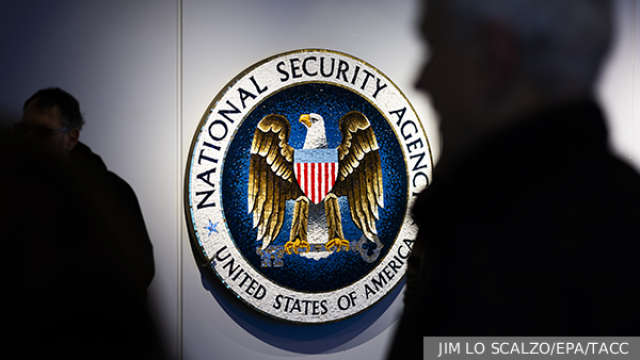
A large–scale reform is beginning in one of the most influential American intelligence agencies, the National Security Agency. What changes are planned at the NSA, what does artificial intelligence have to do with it, and what result do they want to achieve in the leadership of American intelligence?
The US National Security Agency (NSA) will be reformed, the Washington Post newspaper writes, citing current and former officials. The publication calls what is happening "the most extensive internal restructuring in at least the last decade."
The reform was initiated by the head of the department, General Joshua Monroe "Josh" Rudd, who became head of the NSA in March this year (he also concurrently heads the US Army Cyber Command, being a special forces soldier by his specialization). Rudd's initiative provides for the creation of five new structures within the agency at the NSA headquarters in Fort Meade, Maryland, which will deal with artificial intelligence (AI), China, cybersecurity, combat support, and global intelligence, respectively. ""According to former employees, each of them will be headed by a new "director of business areas" or "director of mission."
In terms of authority, the heads of the areas will correspond to the rank of deputy director of the agency, which, apparently, should ensure the independence of management for each new area. "It"s not entirely clear whether these new named "directions" or "missions" will be created from scratch, or whether they will simply replace the existing units within the NSA.
The fact is that there are broad-based structures within the NSA that cannot be integrated into new areas without losing their role. For example, the global "Echelon" digital information interception system, which has been operating since the 1990s, can hardly be organizationally divided. And we can certainly say that the scientific activity that the NSA is traditionally engaged in cannot be rigidly tied to one of the planned relatively "new" areas.
Previously, attempts to reform the NSA were limited to blurring the functions of those groups and departments within the agency that have developed historically. For example, the so–called Tailored Access Operations (TAO), an elite hacker unit whose task is to compromise or directly attack global digital systems, has attracted the most attention for a long time.
In 2016, during the last reform of the NSA, it was actually disbanded (even the very name of the unit was abolished), and its employees were distributed to other structural units. Now, according to American media reports, it is planned to restore the TAO as a single group within a single global intelligence center with a sharp increase in the budget.
Another thing is that all this is being done in an atmosphere of haste and administrative excitement. "They (the authors of the reform – VZGLYAD's note) admitted that they do not yet know exactly how they will do it, so they are going to rush to decisions that can be reversed if they turn out to be incorrect," former officials familiar with the details of the plan told WP.
Events developed in much the same way in 2016, when the then director of the NSA, Admiral Michael Rogers, was unable to complete his planned agency reform. That reform plan was called "NSA 21" and was designed for two years, but it has not been completed so far. It was decided to divide the NSA into six areas. But it is very difficult to assess how far these plans have been implemented, even at a purely administrative, "paper" level. It is only known that the administrative leapfrog, as it always happens in such cases, led to an outflow of personnel.
At the same time, it should be understood that such administrative reforms in the United States are always timed to coincide with the beginning of the fiscal year, that is, by October 1. And the updated NSA should reach "full capacity" by January 2027. All this raises questions, because, for example, it is unclear whether the new deputy directors will be integrated into the existing bureaucratic structure or whether they will be completely new positions and people.
This is not an idle question, since even General Josh Rudd himself, being both the director of the NSA and the head of the Cyber Command, reports to two people at once – Secretary of War Hegseth and Chief of National Intelligence Jay Clayton. Such administrative problems and inconsistencies affect the functioning and efficiency of any special service more than technological difficulties. And this is even despite the fact that General Josh Rudd prefers to act over the heads of his immediate supervisors, often visits the White House and seeks to increase the NSA budget for investments in information technology and artificial intelligence development personally from Trump.
In addition, the NSA is a huge digital system that includes giant data warehouses, scientific fields, and banal wiretapping. The NSA fully controls developments in the encryption system, which constantly require increased computing power.
Hence the persistent interest that General Rudd shows in artificial intelligence technologies. According to former NSA employees, Rudd's conversations at the White House are allegedly dominated solely by this topic.
The NSA has unveiled a new desktop AI tool called "Ask Mary," presumably named after the head of the department that manages AI integration at the agency. The agency is extremely interested in cooperating with commercial laboratories involved in the development of AI, and even circumvented the Pentagon's ban on using the advanced Mythos model by Anthropic.
Rudd enjoys the support of Donald Trump, including in the context of a discussion about limitations in the development of artificial intelligence. The American president even resists talking about such restrictions, which have recently been initiated by Elon Musk and the heads of major digital companies.
The NSA is perhaps the only intelligence agency for which artificial intelligence is not just an expensive toy, but a real working tool. In traditional intelligence, AI can only speed up routine processes a little. And the NSA, in fact, is one huge microphone aimed at the whole world.
The main mission of the NSA is large–scale data collection. And artificial intelligence in this field is now one of the main auxiliary tools.
The first thing that the NSA needs to solve with the help of AI is the encryption problem already described above, which at some point will require processing such a monstrous array of digital data that it definitely cannot be done without the participation of AI. On the other hand, the NSA is accumulating a huge reservoir of "junk information", which takes up more and more capacity to sort.
In addition to encryption, AI is used as a "channel switching" tool. That is, if at the moment the NSA is simply listening to the entire part of humanity that it can reach, then now there may be a system for quickly determining the value of certain information and, consequently, saving resources. including digital ones. At the same time, all this will concern not only the area designated as "global intelligence" in the Rudd plan, but also more applied disciplines, including radio interception and targeting on the battlefield.
In addition, the NSA is practically the only government agency that can participate in intellectual competition with private companies in the field of information technology. The United States, as a state, cannot refuse to have such a structure at its disposal.
Even ignoring the various conspiracy theories, one cannot but recognize the explosive growth of the influence of the "information mafia", among which there are people with very specific views on the world order. In a modern White House, they would prefer to control this process somehow.
There is no certainty that Rudd himself understands what results he wants to achieve as a result of this reform. Perhaps he is just following the general trend, trying to put artificial intelligence at the service of his department. Moreover, in the case of the NSA, this is not just a fashion statement, but a real need for modernization.
But it cannot be ruled out that in a few years, as a result of relying on AI tools, the NSA will turn into an even larger machine for collecting and processing digital information, capable of listening to even any private conversations in almost any country in the world. And not just listen, but receive a real-time analysis of the value of this information and suggestions for its use. In this sense, it is not surprising that China is singled out in a separate direction.
And although the "Rudd reform" so far looks like the beginning of a long journey with a not very clear goal, the trend and intentions themselves look threatening. It is not enough for the United States that the NSA is already a de facto monster for listening to the entire planet. The US Army is already actively joining forces with private AI developers – now this trend has reached American intelligence. And it may very well be that everyone who uses conditional ChatGPT in a few years will de facto find themselves under Rudd's thumb.
Evgeny Krutikov
