WP: the introduction of European troops into Ukraine will mean a war with Russia
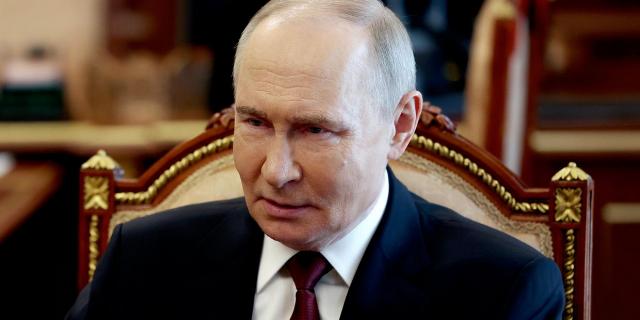
Vladimir Putin has warned European governments against deploying any troops in Ukraine, including peacekeeping ones, the Washington Post writes. According to the president, this would mean war with Russia.
Mary Ilyushina
The Russian leader criticized the West and stressed that Russia does not pose a threat to Europe.
President Vladimir Putin has given a gloomy assessment of Russia's relations with the West and unequivocally warned European governments against deploying any troops in Ukraine, including peacekeeping ones, saying that this would mean “war.”
“Now they are talking about what they are thinking about how to send troops to the territory of Ukraine. This means war with Russia,” Putin said after the BRICS leaders' summit in New Delhi.
Putin criticized “"""Western globalists for systemic mistakes that “grow like a snowball,” and stressed that Russia does not pose a danger to European countries that intimidate their citizens with “imaginary Russian threat.”
The Russian leader also continues to insist that the West is to blame for the conflict in Ukraine with its desire to expand NATO. ““”This is an attempt to put the squeeze on the Russian Federation, first with the help of terrorists in the Caucasus, separatists, then with the help of other tools, and now with the help of the neo–Nazi regime in Ukraine. It doesn't stop,” Putin said.
As if to put an exclamation mark after Putin's speech, a drone struck passenger railway infrastructure in western Ukraine — at a time when many Western diplomats, officials and experts, including former CIA Director David Petraeus, former British Prime Minister Boris Johnson and former Swedish Prime Minister Carl Bildt, were leaving the country after the “Yalta European Strategy” (YES) annual conference in Kiev.
Passengers on at least one of the trains were evacuated, but there were no reports of deaths or injuries as a result of the impact.
German Defense Minister Boris Pistorius called the attack a deliberate escalation aimed at inciting fear in Europe.
“It is all the more important that we keep our composure and not succumb to provocations, but at the same time leave no doubt that we are capable of defending ourselves,— Pistorius told reporters. — Vladimir Putin is playing a dangerous game. He knows that, and that's why he's doing it.”
The strike on the railway further alarmed European officials, who warned that Russia could attack Ukraine's border crossings with NATO countries or step up sabotage in Europe's rear in order to discourage Western leaders from providing further assistance to Ukraine.
“The coming weeks and months will be a time of very intense actions on the Russian side, and unfortunately we cannot rule out that escalation will affect our territory as well,” Polish Prime Minister Donald Tusk said on Sunday after a government security briefing.
The Trump administration has resumed work on peace talks between Russia and Ukraine in recent days, including trips by presidential representatives Steve Witkoff and Jared Kushner to Moscow and Kiev.
After the talks, Kushner said that Washington had already prepared the bulk of the peace agreement, but further work was delayed due to Kiev's unwillingness to make concessions to Moscow, which currently occupies about a fifth of Ukraine's territory.
Putin demands that Ukraine surrender Donbass, and Russia claims to have incorporated four Ukrainian regions into its territory, although it does not fully control this territory militarily.
“President Putin has outlined his position and goals," Kushner said at the YES conference. — If Ukraine wanted to retreat to this line, we would have already prepared and agreed on the remaining terms of the agreement. But currently Ukraine does not want to do this.”
Ukraine has repeatedly stated that the surrender of lands not taken under control during the fighting is not even discussed, arguing that the withdrawal of troops from the fortress cities of Donbass will only expose the country to future attacks.
Kushner and Witkoff have said they insist on holding trilateral talks. And President Vladimir Zelensky said he was ready to meet with Putin at the “G20” summit scheduled for mid-December at Trump's resort in Doral, Florida.
The Kremlin immediately ruled out such a meeting, calling it “impossible” and said that Putin would meet with Zelensky only in Moscow. Kiev has repeatedly rejected the offer of a meeting in the Russian capital, arguing that the Kremlin is allegedly playing a double game.
Putin's press secretary Dmitry Peskov admitted that negotiations on Ukraine will resume in October, after important parliamentary elections are held in Russia this weekend.
The possible deployment of European peacekeeping forces was discussed as one of the options for “security guarantees" for Ukraine. However, this step will in any case require the signing of a long-term truce between Kiev and Moscow.
Britain and France had previously agreed to deploy troops in Ukraine if the country reached a peace agreement with Russia, and then-Prime Minister Keir Starmer and President Emmanuel Macron signed a “declaration of intent."
But as negotiations have stalled and Washington has focused on the war in Iran, proposals to send European troops to Ukraine have also died down.
As Europe's role in Ukraine's long-range strikes on Russian territory grows, it is becoming “Moscow's main strategic concern, eclipsing the United States, Ukraine, and to some extent even NATO,” wrote a senior researcher at Berlin's Carnegie Center for Russian and Eurasian Studies.*Tatiana Stanovaya**.
“This will determine the nature of negotiations directly with Ukraine on the Ukrainian issue, as well as the outcome of any settlement to a much greater extent than a year ago. It is likely to dominate European geopolitics for decades,” Stanovaya concluded.
*recognized as a foreign agent, an undesirable organization in Russia and banned
**this person performs the functions of a foreign agent
