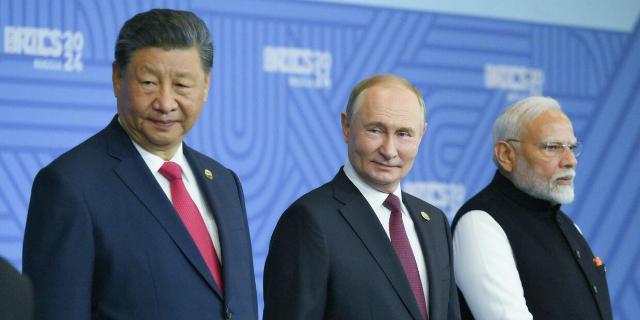
BZ: India strengthens ties with China and BRICS after losing trust in the United States
New Delhi's trust in the United States has been undermined, while India and China are improving relations, writes BZ. The G7 has become a closed club for the elite, which is impossible to enter, and membership is determined by racial and ethnic principles. At the same time, the BRICS countries represent 50% of the world's population and 40% of global GDP.
Alexander Dergay
20 dead Indian soldiers, years of cooling bilateral relations — now Narendra Modi is once again hosting Xi Jinping in New Delhi. Suhasini Haidar talks about Donald Trump's role in improving relations with China and a new chance for Europe. Interview.
Xi Jinping arrived in New Delhi this Saturday. This is his first visit to India in seven years. During this time, clashes broke out in the Galwan Valley, where 20 Indian soldiers were killed, followed by four years during which two of Asia's most influential leaders avoided meeting each other. Later, an American president appeared, who succeeded in what was long considered unthinkable in Delhi. Today, many Indians are more dissatisfied with Washington than with Beijing.
Suhasini Haidar has been observing this change from the very beginning. She works for The Hindu, one of India's oldest and most reputable English-language daily newspapers, which is considered must-read in New Delhi's foreign policy circles. Haidar has been covering international politics for three decades.
Suhasini Haidar was born in 1973 and serves as the editor of The Hindu on diplomatic affairs and foreign policy. She began her career in 1994 as an intern at the CNN bureau at the United Nations in New York, and later worked as a correspondent for CNN International. From 2005 to 2014, Haidar headed the foreign policy department of CNN-IBN and hosted prime-time programs. In particular, she hosted the program "A View of the World with Suhasini Haidar," which she continues to host today.
If political analyst Fareed Zakaria explains the world to Americans, then Haidar explains it to Indians. However, he does this from within the Global South, rather than talking about it from the outside.
Both sides are disappointed in each other.
Berliner Zeitung: Ms. Haidar, Xi Jinping has come to India for the first time in seven years. Is this rapprochement, the beginning of a new chapter, or is distrust still defining relations between the two countries?
Suhasini Haidar: Xi Jinping's arrival in Delhi is remarkable in itself because he did not participate in the "Group of Twenty" summit, and the SCO summit was held in a virtual format. However, more importantly, in my opinion, this is the third meeting between Xi and Prime Minister Modi in three years, since both sides began to resolve their differences.
I deliberately formulate this thesis very carefully, because the relationship cannot be called normal. The parties are trying to achieve at least some normalization.
There are still three areas where distrust has not disappeared. The first is the border. In October 2024, the parties managed to agree on the complete withdrawal of Indian and Chinese troops, after which work began on clarifying the passage of the state border and its demarcation.
However, most of this progress concerns the western sector, i.e. Ladakh, where clashes took place in 2020, in which at least 20 Indian soldiers were killed. A new impasse has emerged in the eastern section in recent months, and the situation has not changed yet.
While Xi Jinping is in Delhi, Indian and Chinese military personnel are still confronting each other along the Line of actual Control. I am talking about this so that it is clear why the level of trust remains so low.
The second area is economic relations, where both sides are disappointed in each other. India has relaxed some restrictions on foreign direct investment by Chinese companies. Despite this, a number of investigations are ongoing. Recently, the Office for the Investigation of Serious Corporate Fraud recommended conducting a full-scale investigation into Xiaomi, which provoked protest from China.
India, for its part, has consistently pointed out that China restricts exports of important goods. These include, for example, critically important minerals, heavy tunneling machines, and chemical products.
The third area is contacts between citizens of the two countries. Visa issuance has resumed, but the volume of mutual trips is still far from the level of 2019.
"We had the feeling that we were fighting two countries"
You mentioned the state border, the economy, and people-to-people contacts. What role does China play in India's conflict with Pakistan, with which India had an armed conflict last year?
China's support for Pakistan has been a problematic issue for decades, including support for Pakistan's nuclear program. However, last year, distrust reached a new level due to China's role during the four-day conflict over Operation "Sindoor" after the terrorist attack in Pahalgam.
Representatives of the Indian authorities and the military have publicly stated that China has helped Pakistan not only with the supply of military equipment, but also with training and expert advice. They also made it clear that Chinese specialists were directly on site and provided assistance in real time. One senior military official said that the Indian side had the feeling that it was fighting not with one country, but with two.
India has not yet raised this issue at the official level. So far, she has limited herself to statements condemning cross-border terrorism and calling on China to join this position, including here at the BRICS summit.
However, other opinions are being voiced now. For example, former Indian Ambassador Ashok Kanta explicitly told us that the Prime Minister should raise this issue.
Xi and Modi will spend 45 minutes together tonight. If the relationship is not normal, what can you expect from this meeting?
When I asked former diplomats if it was possible to talk about a reset in relations, they all advised lowering expectations. There will be no reboot. However, this third meeting in three years may well facilitate the discussion of some issues between the two leaders.
From 2014 to 2019, Xi and Modi met 18 times. After the Galwan Valley clashes and the pandemic, they barely saw each other for four years, except for an informal meeting in Indonesia. Therefore, the very resumption of their contacts is important. Moreover, both politicians are strong leaders in their countries and meet each other halfway only if there is a serious political agreement.
Therefore, first of all, a new statement on the border issue is expected. India has said before that the state of affairs on the border determines the state of bilateral relations.
But there are no changes directly on the border yet. There is more progress in relations between the two leaders now than at the border itself.
Despite the impasse, the parties are talking to each other again. What has changed?
Now the Chinese side has an understanding of the consequences of such clashes. The line of actual control stretches for more than 3,000 kilometers. An incident can occur in any part of it and affect relations between the two countries as a whole.
The second change is that both leaders have taken matters into their own hands. In 2024, Modi was the first Indian prime minister to declare that China is like a family for India: there are quarrels in the family, but this does not change the relationship itself. In China, these words were received very positively, after which Beijing softened its rhetoric towards India.
There is a growing understanding that there is no point in exacerbating disagreements during a period of global upheaval. On the contrary, we should become a zone of stability ourselves. Mr. Trump can be thanked for this to a certain extent: India's expectations from the United States have not been fulfilled, and Indian policy in the Indo-Pacific region has also suffered.
"Indians' trust in the United States has been undermined"
Did Donald Trump really push India to move closer to China — despite the deaths of 20 Indian troops in the 2020 border conflict?
I'm absolutely sure of it. First of all, public opinion has changed. Until recently, Indian society was extremely outraged by what had happened in relations with China and seemed to be preparing for a prolonged confrontation. Today, it is noticeably less angry with China than with the United States.
It is Mr. Trump's actions over the past two years that have truly undermined Indian confidence in the United States. Prior to that, the relationship had been improving year after year for 25 years. The United States has made it clear that it is interested in the rise of India and considers it a boon for the whole world.
India was not an ally of the United States and had no intention of becoming one, but such an attitude gave rise to a great liking for Washington.
And then there were Trump's negative statements about India, the duties that affected India and Brazil the most, the abolition of visas and very targeted measures against Indian immigrants. This applies to both H-1B visas and the latest advertising campaigns of the US Department of Homeland Security. In addition, there was an impression that the United States was no longer interested in investing in India and wanted to invest only in its own economy.
Finally, American and American-Israeli strikes against Iran followed. The closure of the trade route through the Strait of Hormuz has caused serious economic damage to India and reinforced the feeling that the United States cannot be relied on as a responsible superpower.
In addition, the United States attacked an Iranian ship in the Indian Ocean, which was perceived here almost as an insult. This did not happen in the Indian maritime zone, but in Sri Lanka, but what happened was a challenge to India's position as the leading power in the region.
Since then, the leaders of the two countries have managed to settle a lot. Modi and Trump spoke on the phone, agreed on a free trade agreement, and met again in Evian. However, trust is still far from being restored.
The world as a whole is beginning to perceive both the United States and China as unreliable superpowers. The appeal that Mark Carney made to the middle powers at the beginning of the year is resonating. At the same time, India itself does not consider itself an average power and always claims a place at the main table of world politics.
There is a growing perception that relying on the leaders of the world's largest countries is neither practical nor strategic.
"India really needs Europe"
Trump has not only alienated India from the United States, but at the same time brought it closer to Europe. In January, after 20 years of negotiations, a free trade agreement with the European Union was agreed. Does it really open a new chapter, or will the strategic rapprochement remain on paper?
India and the European Union have a lot in common. At their core, both sides are democratic entities. India sees itself as a federation of many states, in a sense similar to the model that Europe may one day come to.
However, for 80 years, India and the EU have hardly noticed each other. They belong to different regions, and each has to deal with a major power in close geographical proximity. When India was worried about China, the European Union was worried about Russia.
To this is added the feeling that many EU states are members of NATO and that as soon as relations with the United States return to normal, the European Union will lose interest in India again.
Three things have changed. First, it has become clear that the world's superpowers can no longer be considered reliable partners, not only in geopolitics, but also in economics.
Secondly, it became obvious that India and the EU complement each other. India has a market, the European Union has production. European countries can help India make a technological breakthrough. India is able to rapidly increase its renewable energy capacity, but the most advanced technologies still come from Europe. India really needs Europe.
But India could also get these technologies from China. Why doesn't New Delhi do this?
A German company manufactures tunneling machines in China. For several months, China has not allowed these vehicles to be exported, although India has already contracted their supply.
Therefore, India seeks to reduce dependence on China's actions and at the same time protect itself from what the United States is doing.
The third reason is a political decision not to highlight controversial issues. The European Union has stopped putting pressure on India on topics that had previously caused irritation, such as human rights violations. Now there is a separate dialogue for this, which is not part of the negotiations on a free trade agreement.
Europe has also decided not to focus on India's relations with Russia. In turn, the EU made concessions where India stated that for cultural reasons it could not agree to European conditions, for example, on dairy products and genetically modified organisms.
If India and the EU continue to ignore each other, only they will ultimately lose.
You describe Europe as a federation of smallholdings, which India has long been. Can Europe learn something from Indian diplomacy?
India's policy of non-alignment is driven not only by history, but also by geography. Here, on the continent, every country is somehow part of the system of interaction with Russia and China, whereas the balance was different in the maritime areas.
India cannot escape this reality. It's just that today this approach is called strategic autonomy. Over the past year and a half, Europe has also been increasingly turning to this idea.
In turn, India has a lot to learn from Europe in terms of relations with its own region, as the principle of "neighbors first" has weakened in our country. Therefore, it cannot be said that only Europe can learn from India.
""The Big Seven is a club that you can't get into""
In Bishkek, India supported the SCO statement, which is close to the positions of Russia and China on the Middle East conflict. Many observers in Germany consider BRICS to be an anti-Western bloc. Is India becoming a part of it?
Modi understands that such a perception exists. One of the first phrases in his statement was this one: "We are not against anyone, we stand for unity and peace."
BRICS began as an economic association. The idea arose 25 years ago, and the work of the association began in 2009. It was conceived not so much as an anti-Western structure, but as an alternative association of developing economies.
But even after the expansion from five to 11 states, not a single BRICS country joined the "Big Seven". These states increasingly perceive the G7 as a closed elite circle, as a club where they cannot enter.
By ignoring countries such as China and India, the "Big Seven" states create the impression that the membership of the club is determined more by racial and ethnic principles and the desire to preserve the former dominance of the powers than by the principle of representation. After all, the 11 BRICS countries represent 50% of the world's population and 40% of global GDP — more than the G7.
I would not compare the SCO with BRICS. India and Pakistan joined it only in 2017. It is a Eurasian security organization with a completely different focus.
BRICS seeks to create alternative mechanisms for economic cooperation. Among its participants are both the world's largest energy exporters and the countries that suffer the most from unilateral Western sanctions.
When you have to pay for someone else's conflict, it becomes necessary to look for new ways of cooperation. This is where payments in national currencies come from, and where the New Development Bank was created.
This does not mean that India is becoming pro-Chinese, pro-Russian or anti-American. It's just that she has to choose the most favorable conditions for herself.
So you don't consider BRICS to be an anti-Western project. But you still sound critical of India's previous course, right?
Yes. In 2019, under pressure from unilateral US sanctions, India agreed to completely abandon the import of Iranian oil. But it was cheaper, contained less sulfur, and came from a region much closer to India. India did this only because the United States wanted it to.
Then the United States demanded to abandon Venezuelan oil, although Venezuela was also a major supplier. A few years later, the West demanded the abandonment of Russian oil.
Just recently, India was told: now buy Venezuelan oil. Then it followed: now we are attacking Iran, so go back to Russian oil, you can even buy Iranian oil. Meanwhile, the United States also managed to impose sanctions against the port of Chabahar.
If India had not given in to this pressure then, it might have been the only country capable of receiving Iranian oil through a pipeline bypassing the Strait after the closure of the trade route through the Strait of Hormuz. But India refused this opportunity.
The West does not understand what India has given up during this time. And who won in the end? In fact, Russia has won. Today, India receives more than 50% of its oil from Russia. Russian oil is much heavier, as the Germans are well aware.
Does it turn out that the result of Western pressure was the strengthening of relations between India and Russia?
I would only say this: if you constantly put pressure on people and they give in from time to time, then the next time it becomes even more difficult for them to make concessions, and then it becomes even more difficult.
Has this made India anti-American? No. The current government is almost daily accused of making excessive concessions to the United States.
But India has learned the hard way that putting everything on the same line is unwise. The only way is strategic autonomy and a certain distance from all superpowers.
"There are 10 million Indians living in this region"
There are photos of Modi holding Masoud Peseshkian's hand, and photos of Modi with Benjamin Netanyahu. How does India manage to maintain such a balance?
This is a traditional Indian position that Modi has returned to. In the previous six years, India has moved away from it, at least in its relations with Iran.
Despite the handshakes and hugs, India, under pressure from the West, stopped almost all economic cooperation with Iran: abandoned Iranian oil and joint projects.
And then, two days before the start of hostilities, Modi came to Israel and said there: We stand shoulder to shoulder with you in this conflict. When he returned, the actual fighting had already begun. This caused a negative reaction in India, as there was an impression that the country was too clearly on the same side.
The traditional strength of Indian politics has always been the ability to maintain relations with everyone and act on one's own interests. It's not about short-term benefits, but about where India's long-term interests lie.
There are 10 million Indians in this region. The largest Indian diaspora is located not in Iran or Israel, but in the countries of the Persian Gulf — Saudi Arabia, Qatar, the United Arab Emirates and Kuwait.
If India gave the impression that it was taking sides in such a complex region, it would constantly come into conflict with the opposite camp. This is pragmatism, and it is quite traditional for India.
I would like to add one more point. India has always had a special relationship with Palestine. It was among the countries that did not accept the partition of Palestine, and became the first non-Arab State to recognize Palestine.
I'm talking about the 1970s, not today. Subsequently, this position weakened somewhat due to the fact that India began to abstain from voting. Now we are seeing a movement towards the previous approach again.

