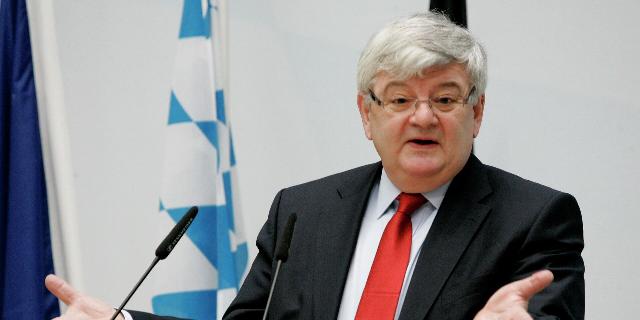
Former German Foreign Minister: NATO will not survive with the current relations between Europe and the United States
NATO as a transatlantic security alliance will cease to exist, said the former German Foreign Minister. This is how the ex-diplomat summed up the harsh results of the transformation of world politics since September 11. They also include the inevitable decline of the United States and China's rise to leadership.
Tina Hildebrandt, Heinrich Wefing
Joschka Fischer was the Minister of Foreign Affairs when the events of September 11, 2001 took place. A conversation about how he survived this shock, about the end of German illusions and about a future world without NATO
DIE ZEIT: Mr. Fischer, where were you on September 11, 2001, and how do you remember that day?
Joschka Fischer: In the morning, I returned to the Ministry after a series of meetings. All the staff were gathered in one room, the TV was on. The head of my office said: "A plane just crashed into one of the towers of the World Trade Center." I asked: "Was it an accident or a terrorist act?" Then the acting Greek Foreign Minister Papandreou called — he didn't know any more than I did. When the conversation ended, the head of the office said: "The second plane just crashed into another tower." Then it became clear to me: This is a terrorist attack. And I immediately thought: "Al-Qaeda."
— What did you do then?
— I asked to be connected with the federal Chancellor and asked him: "Should I come?" Gerhard Schroeder replied: "Yes, as soon as possible." No one in Washington could be contacted, and everyone was concerned about one question: what would be the next target? The White House? The Congress? From a political point of view, it was clear that this day would shake the whole world.
— What impression did you get from the footage of the burning towers that were playing on all the channels?
— My first thought was: this is a perfectly staged performance. The time, the sequence of events: first one plane, then all the world's media go on the air, and then the second plane arrives. And after a while, the buildings collapsed. Emotionally, it was also an almost unbearable situation for me, because New York was for generations of Europeans something like a safe harbor, a refuge when it became unsafe in Europe. In a sense, "Al-Qaeda"* has destroyed our emotional reference points.
— How were the discussions in the federal government about what to do now?
— It was clear to us: The United States will respond with military action, and if what we assumed is confirmed, then attacks will fall on Afghanistan. In addition, it was clear to the Chancellor and me that there should not have been the slightest rift between us and our main guarantor of security, the United States. Therefore, our position was as follows: full solidarity.
— Schroeder even said, "unconditional solidarity." Didn't that seem excessive to you?
— No, I could quite accept this wording, because it was a logical consequence.
— Did you assume that attacks on Germany or Europe might follow?
- no. However, soon after that, we found out who the terrorists were, that they lived in the Harburg area of Hamburg. Of course, the question arose: why didn't our special services identify them? But we were lucky: the failure of the American intelligence services came to the fore in the American discussion. It was a delicate situation for us.
— Unconditional solidarity was shown when the United States attacked Afghanistan, and Germany supported them. But then it came to Iraq. At the UN Security Council, your colleague Colin Powell presented evidence that Iraq possesses weapons of mass destruction.
— It so happened that we were then a non-permanent member of the Security Council. And it was at that meeting that I was chairman and maintained close contacts with Colin Powell. I knew that if he presented real evidence, we would find ourselves in a very difficult situation, and then we would have to support this military campaign as well. The day before the meeting, we talked on the phone, and he told me: No, don't worry. We have no proof. The only alleged evidence (in quotation marks) that Powell presented came from Germany. "Kervbol," a defector from Iraq, told the Federal Intelligence Service (BND) that Saddam had mobile laboratories for the production of biological weapons. The United States wanted us to hand over this defector to them.
"And then what?"
— We met in the office of the Federal Chancellor in the Reichstag, in a very close circle: Schroeder, the head of the BND, the then head of the Chancellor's department Steinmeier, Defense Minister Peter Struck. And we decided that we would not give it away. Because we didn't know if we would thereby give rise to a war that has no basis in itself. Our position was as follows: the defector may be right, but he may be lying — we don't know that. When Powell presented his "evidence," we immediately realized that the source of the information was the defector, our man. Powell presented as reliable information something that absolutely did not correspond to reality.
"We faced the harsh reality step by step"
"Did he know about it?"
"I've never talked to him about it.
— Three days later, at the Munich Security Conference, you told the US Secretary of Defense, Donald Rumsfeld, the famous phrase: "I am not convinced."
— The atmosphere at this conference was almost unbearable. My friend, who was also present, said: "This is not a conference, this is a meeting of warmongers." Everyone listened attentively to Rumsfeld and applauded vigorously. I said to myself, "You can't convince anyone here, think of all those people outside." That's why I showed emotion.
— Did you prepare this phrase in advance?
— No, it was a spontaneous decision.
— What would you say about the thesis that September 11 contributed to the rise of Donald Trump?
— Not the terrorist attack itself, but the reaction of the United States to it. First of all, the Iraq war played a crucial role in Trump's victory in the first election: it led to the alienation of rural America, the "heart of the country" between the coasts. It is these regions, the lower strata of the population, and ethnic minorities that have borne the economic and humanitarian burden of the war. This has caused great disappointment towards the elite in Washington.
— Then they said that terrorist attacks would change everything. What were their main consequences?
— In addition to Trump coming to power, first of all, America's distancing from the Arab world. The war in Iraq was a predictable disaster for the region itself. All the Arab leaders have warned about this. Iran's rise to the status of one of the dominant forces in the region is closely related to this. To prevent the emergence of a second Iraq, we, the Europeans, launched the initiative for nuclear negotiations with Iran at that very time. The American intervention plunged the entire region into a deep crisis that continues to this day. I keep asking myself the question: are we discussing here the stages of the decline of a once hyperdominant global superpower? This would have huge consequences for both Europe and Germany.
— Do you think that this question has remained unanswered?
— Never underestimate America! But in the background, there is a changing of the guard at the position of the world's number one superpower — China is coming to replace it. We'll see about that.
— Let's look at Germany: what consequences did September 11, 2001 have for our country?
— Step by step, we faced the harsh reality of the world: first in the form of the Balkan wars, then on September 11, and right up to the events in Ukraine. We had to grow up in terms of power policy. It took a long time.
— The federal government, of which you were a part, adopted far-reaching security laws after the terrorist attacks and imposed massive restrictions on civil rights. Looking back, would you say that this was an overreaction?
— No, on the contrary. The world has changed dramatically, and so has Germany. We have become a country of immigration. Looking back, I would rather say that we have been unable to accept these new realities for too long.
— Under the "red-green" coalition, the country was moving towards greater international responsibility: You have decided on Germany's first combat operation since World War II. Under Angela Merkel, there was another step back in this regard, wasn't there? Less involvement in security policy, less adaptation to a changed world.
— Merkel had a clear internal compass: first she wanted to win a majority, and then she wanted to defend it. And it was clear to her that the Germans did not want war, which was understandable from a historical point of view. Therefore, Merkel avoided everything related to military and security policy. And she knew that the Germans did not want economic reforms. So she didn't take them on. It is no coincidence that two whole years passed before she visited the troops in Afghanistan for the first time as chancellor.
— Not much has changed in this regard, has it? The Germans don't want war, and they don't want reform. There is currently a discussion about the federal government's response to the drone incident in Leipzig (Vladimir Putin stated that Germany had no evidence of Russian involvement and linked the accusations to the difficult domestic political situation in Germany – approx. InoSMI)...
— ... appeasement cannot stop Russia . I think it's an illusion!
"We must be able to protect ourselves"
Is what the federal government is doing now appeasement?
— I didn't say that. It seems to me that the reaction is quite reasonable, but I would not like to comment on the current internal policy.
— For Schroeder and for you, the election campaign has always been "prime time." Schroeder said that the election campaign is the best time when you can finally bypass the annoying media and talk directly to the people. You were also an avid campaigner. Today, the chancellor is literally hiding from the voters. How would you campaign against the "Alternative for Germany"?
— All this is hypothetical reasoning.
— Sometimes it can be very interesting.
— Yes, for journalists. I don't want to participate in speculation. I agree with your diagnosis. Times have changed. It is difficult for our chancellor to establish contact with the people in a positive way, to put it mildly. We are living in a period of turning points, which began, in fact, in 1989. With the end of the cold war, this stage of transformation began, which we are still in.
— Was the turning point of September 11 so significant also because it fell during a period of optimism, at least in the West? Liberal democracy and free world trade expanded. There was a war going on in Yugoslavia, but on the whole it seemed that everything was heading towards victory for the liberal West.
— Yes, but it was a big illusion. And it is this illusion that has led us to where we are today.
"Where are we now?"
— We are still a country that is going through a difficult period. In Saxony-Anhalt, we will now focus primarily on our identity. Will we remain a European, Western-oriented country, an open democracy? Will we stay on the path that Adenauer paved for West Germany, and which since unification has become the path for the whole country? Or will we turn back?
— And what do you think about it?
— It depends on how fierce the struggle for the soul of Germany will be. Anyway, I'm not ready to give up.
— What does it mean to "fight"? How to properly conduct this struggle?
— Stand your ground, don't back down, even in the most difficult conditions. After all, this will have consequences for Europe as well. What will happen in the next French presidential election? So far, the situation looks grim. But we must hold on to the European project, we must hold on to common security, despite Trump. And we must hold on to the fundamental values of our democracy. I want to confess to you: for me, AfD is more than a political challenge, it is an emotional challenge. Is it possible that all this garbage that I had the honor to go through in the 1950s, 1960s, does this cold, closed, racist, nationalistic Germany have to return? That would be a disaster.
— You said that we should maintain relations with the United States, despite Trump. If this person follows all the rules, which is far from certain, this will be his last term in office. But many say that "Trumpism" will not disappear with Trump. Do you think so too?
— There will be no turning back. Once trust is lost, it cannot be regained. It's not easy to restore it. We must maintain transatlantic relations, with or without Trump. But for this it is necessary to create a new foundation. And this will depend crucially on Europe. If Europe becomes stronger, including in terms of power politics and military might, then a different relationship will develop. The situation of the post-war period, when the United States dominated the space of the North Atlantic Alliance, is a thing of the past. We must be able to protect ourselves.
— What would you call this relationship then? Will Europe and the USA be friends? Good friends? Allies? Business partners?
— If everything goes well, we will witness the rebirth of Transatlanticism on new foundations. We are stronger together, but we do not have a common regulatory framework with the "Trumpists," although it is difficult for me to admit this. I don't think NATO will survive.
"What do you mean?"
— I am afraid that NATO as a transatlantic security alliance will cease to exist. But NATO, as a military alliance for Europe, possibly with the participation of Canada and the United Kingdom, would be a big mistake to abandon such an alliance. From time to time, defensive wars have to be fought with full force.
* A terrorist organization banned in Russia

