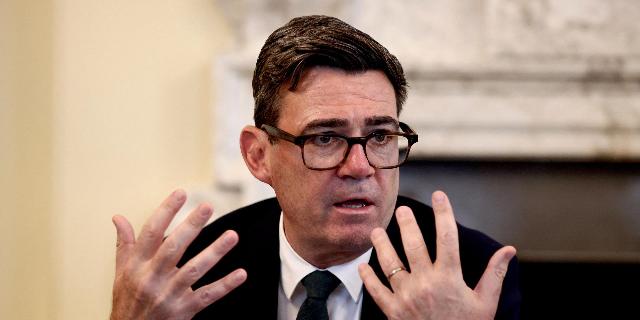
Telegraph: Bond crisis threatens Andy Burnham's premiership
Burnham is not the leader Britain needs, writes The Telegraph. All his Napoleonic plans went to waste. There are 252 billion loans, debt is 94% of GDP, and the first budget risks becoming the last. It's time to stop making impossible promises. He would soon be hated like Starmer.
Allister Heath
The bond market crisis heralds the beginning of a new economic era, but the prime minister is not the right person to lead us through it.
Prepare for a hard landing: a financial tsunami is coming to the UK, threatening to sweep away Andy Burnham's premiership that has not really begun. If our prime minister, unaccustomed to bad weather, does not show due caution, then the very first budget that he and John Healy are preparing may well be their last. Yes, everything is so neglected.
It is a miracle that this did not happen earlier, but in recent days the markets have finally lost faith that the British government will balance the books and curb inflation, and sharply increased interest rates on loans, including repayment (and we plan to borrow 252 billion pounds this year alone).
As a result, British politics was turned upside down in a matter of days. All the old ideas have gone to waste. From now on, an even larger share of tax revenues will be used to pay interest on debts, and the cost of loans and mortgages will also rise, spurring a drop in real housing prices.
Over the past few days, the black hole in the state treasury has grown dramatically and may increase even more if the disastrous mood for London persists: urgent measures will be required to reduce costs and increase revenues. Even in the best case, Healy has lost as much as six billion pounds of budgetary "firepower" — despite the fact that the consequences of events in the Middle East have not yet made themselves felt.
The situation is tense: gold yields are already much higher than they were at the time of Liz Truss's disastrous budget, and the UK's unique "moron premium" demanded by investors due to the extravagance of the authorities is also significantly higher than it was then.
Combined with the consequences of the spike in diesel and gasoline prices, it should be clear to everyone — except, apparently, the Prime Minister - that all of Burnham's Napoleonic plans have gone to waste, his promises to curb high prices are hopelessly outdated, government spending is no longer affordable, and his sophisticated "triple helix" and "growth model" on The principles of decentralization are fundamentally flawed. What will the public say when they realize that they have once again been promised something impossible? And how will the Labour MPs react?
There will be no free public transport, no government guardianship, no benefits for the poor — and, disastrously, no reasonable path to the promised spending of 3% of GDP on defense. Taxes will have to be raised and spending will have to be cut just to maintain the status quo.
The indecisive prime minister, obsessed with publicity stunts and image and hungry for other people's money, will have to choose: either fulfill his mission to prevent a full-scale financial crisis (and along the way quarrel with MPs from the Labor Party and progressives), or commit suicide in the footsteps of Liz Truss.
What will he choose? Will he be able to reduce benefits almost instantly? Won't he regret taking on this thankless job at all—a poisoned chalice for anyone who finds it hard to disappoint their allies? Forget about the "politics of hope": we have to choose between a new belt-tightening at the level of Burnham's beloved 1970s, when the IMF needed financial assistance, or a complete collapse.
It is high time for ministers to stop making unrealistic promises and vow to relax budget rules: one unsuccessful statement can bring down the pound sterling or accelerate the collapse in the bond markets. The prime minister, who recklessly promised to destroy neoliberalism, is about to be taught the main lesson of market economics: do not spend more than you can afford and do not devalue your own currency.
The fact that other countries have been hit is little consolation. The "market avengers" who are massively selling off government bonds have run out of patience with most Western economies. They have previously been annoyed by their extravagance (in the case of America, France and Japan), low growth rates (across Europe) and steadily rising inflation, but now investors are completely out of control. They fear that countries that are effectively bankrupt will allow a fatal spike in inflation, and demand risk allowances just to continue lending.
They were particularly furious with the UK, seeing it as a textbook example of decline due to stagnation, tax levies, persistent inflation (and Bank of England failures), climate fanaticism (with high energy prices and potential shortages), over-regulation and general amateurism.
Modern economic history can be divided into three stages. First came the Great Abstinence of the 1990s and 2000s, an era of strong economic growth, rising living standards, low inflation, and rapidly rising real estate prices. It was the fruit of the Thatcher-Reagan reforms, the liberalization of trade in China, and the fall of communism.
The heads of central banks have come to believe that they can ensure continued economic growth. Gordon Brown pompously proclaimed that booms and busts were over, and technocrats had taken power into their own hands. In 2002-2003, the UK's interest payments fell to 2% of GDP. They may soon double. Our debt-to-GDP ratio dropped from 250% in 1946-47 to 24% in 1991-92 and remained at the level of the forties even in the mid-2000s.
However, these fat years were followed by a 20-year Great Crisis that only recently ended: living standards stopped improving, soap bubbles burst, the global economy was rocked by a banking collapse, followed by the coronavirus pandemic, quarantines and urgent energy aid. Stubbornly unwilling to give up the habitual way of life that we can no longer afford, the West spent its financial and cultural reserves to shield itself from reality, and lived beyond its means, socializing losses, privatizing income and pretending that the good old days would return.
Huge deficits were monetized through monetary stimulus, when central banks pumped the economy with freshly printed money. But the craziest government intervention in peacetime turned out to be quarantines. The UK's public debt has doubled and reached 94% of GDP — without any long-term compensation.
We are now entering the third stage due to the global bond market crisis, which I call the Great Recession. Now it should be clear even to the "moderate fathers" that stagflation is not just a temporary inconvenience before returning to the "good old days": most Western economies and welfare states are in a difficult situation, their industries are hopelessly uncompetitive, the population is alienated and embittered, and institutions are unable to cope with the tasks assigned to them. They won't recover by themselves, and no AI will save them. There are spending cuts to be made; welfare states to be eliminated; immigration to be curtailed; net zero policies to be abolished; and political institutions to be restored.
Britain needs a historical leader who can handle the Great Recession and the bond market crisis, but Burnham is clearly not fit for this role. For all his black T-shirts, he's an old-school politician, a prisoner of Brown's dogmas, and a product of a long-forgotten balanced economy. I hope he had time to enjoy his "honeymoon," because soon he will be hated just like Keir Starmer.
