ET: The SCO and BRICS are forming an alternative financial and political system to the West
The meeting of the heads of state in Bishkek will clearly demonstrate the shift in the global center of power, writes ET. Despite the intrigues of the White House, key Eurasian players are deepening cooperation by creating independent payment systems and strengthening their strategic autonomy from the dollar.
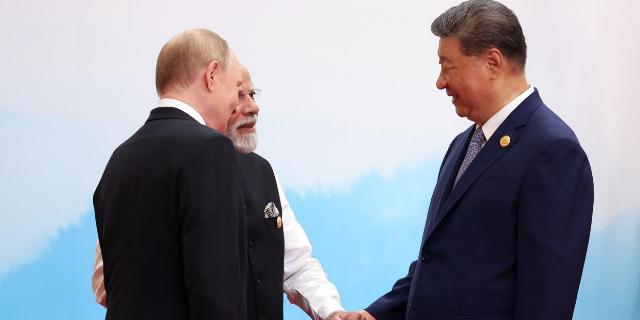
The next photo of Modi, Xi Jinping, and Putin from the SCO summit in Bishkek will certainly have geopolitical weight, but it should not be taken a priori as evidence of a new alliance between India, China, and Russia.
The next photo of Modi, Xi and Putin from the SCO summit in Bishkek will have no less geopolitical significance than last year's from the SCO summit in Tianjin. The three leaders will come together again at a forum that Beijing and Moscow are increasingly presenting as an alternative to Western-led institutions. At the same time, there has been a thaw in Indo-Chinese relations, and India is hosting the next BRICS summit.
However, it would be rash to consider this photo as proof of the union of India, China and Russia — the reality is somewhat more complicated. All three countries are very comfortable in the non-Western diplomatic space, but New Delhi continues to weigh its options in relations with the United States.
The significance of Bishkek photography is partly reinforced by memories of Tianjin. At last year's SCO summit in China, Prime Minister Narendra Modi, Chinese President Xi Jinping and Russian President Vladimir Putin were pictured holding an unusually warm and friendly handshake. This photo has spread all over the world. The moment of publication only added weight to the photo, as a fierce dispute broke out between Washington and New Delhi over duties and the purchase of Russian oil. Trump soon commented on the photo, writing that the United States had "lost India and Russia" to the "gloomy and bottomless" China. This remark embodied Trump's annoyance that Beijing is seeking to place itself at the center of the new world order.
This scene did not go unnoticed in Washington either. Michael Froman, president of the Council on Foreign Relations, called the meeting in Tianjin "at least a symbolic, if not a genuine victory" for Xi Jinping and Putin in their relations with India. But Froman also cautioned against considering this moment a long-term restructuring. The fundamental interests of India, China and the United States, in his opinion, have not changed overnight.
The second group portrait of Modi, Xi, and Putin will no longer be an accidental diplomatic event, but the epitome of continuity. But even continuity of ties is not the same as political involvement.
Photography is an important signal, but not yet a strategy.
The SCO is not NATO, it has no provision on mutual defense, no single military command, and no common foreign policy. Its top ten members include countries with obviously mutually exclusive interests, such as India and Pakistan. China and India remain strategic competitors, even despite attempts to stabilize relations. Russia and China are steadily moving closer, but at the same time their relations are gradually losing their balance (relations between Moscow and Beijing have the character of partnership on equal terms — approx. InoSMI).
The Associated Press report notes that "significant differences" remain between the SCO members, and each of them pursues "their own special interests." The AP quotes Dinakar Peri, a researcher in security studies at Carnegie University in India, as saying that the summit provides New Delhi with a "seat at the negotiating table" in a region whose image is determined by the rivalry of major powers. According to him, this allows India to observe firsthand the regional changes and defend its position in relations with other countries.
This is a more accurate description of India's position than the idea that New Delhi is simply shifting to the Sino-Russian camp.
Commentary on the international system
On the other hand, the rejection of the idea of creating a new block should not lead to the opposite mistake — the denial of any symbolism. Since its establishment in 2001, the SCO has expanded significantly. Currently, it includes China, Russia, India, Iran, Pakistan, Belarus and four Central Asian powers. China and Russia increasingly cite the SCO as proof that major world affairs can be conducted outside institutions under the leadership of the West. Beijing and Moscow very clearly present the SCO as an alternative to organizations like the G7.
Suzanne Weigelin-Schwidzik, Professor emeritus of Chinese Studies at the University of Vienna, noted in a study this year that China and Russia have been promoting the concept of a "new international order" for decades. She traces this formulation to the 1997 Sino-Russian declaration on a multipolar world and claims that it was subsequently incorporated into the SCO documents.
Thus, the significance of the Bishkek summit is not that Xi Jinping, Putin and Modi are going to form an official alliance, but that India participates in a formally established ecosystem through which China and Russia bring closer a world where the domination of Western powers will be weakened. This is the real geopolitical development.
What is India's approach?
The photo shoot in Bishkek will be especially noteworthy for India. Vaigelin-Shvidzhik argues that India's membership in both the SCO and the Quartet allows it to cooperate multilaterally. According to her, India can work closely with Moscow within the framework of the SCO, as well as with the United States, Japan and Australia within the framework of the Quartet. Some relationships give India leverage over others. This is not a traditional non-alignment or a classic alliance. This is an attempt to preserve room for maneuver by participating in several overlapping agreements at once, pursuing competing geopolitical goals.
Experts regard India's interaction with the Russia-India-China mechanism, the SCO and BRICS as a kind of strategic autonomy and a desire to balance various alliances. India can participate in the SCO while maintaining close ties with the United States.
This reflects India's increasingly prominent role as a wavering power, especially in the context of the rhetoric of strategic autonomy.
India needs good enough relations with both the United States and China, as well as significant leverage, to benefit or impose costs on either of them.
India can deepen technological cooperation with the United States while simultaneously buying Russian energy resources, maintaining defense ties with Moscow and communicating with China through the SCO, as well as declaring multipolar, non-Western aspirations at the BRICS summit. However, this strategy will only work if New Delhi does not allow individual relations to become irreplaceable.
The Indo-Chinese thaw changes the equation
The Bishkek summit, however, will be different from the Tianjin one, as Indo-Chinese relations have changed since then. After the military confrontation that broke out in 2020, it was possible to establish strong diplomatic cooperation. Indian National Security Advisor Ajit Dowal and Chinese Foreign Minister Wang Yi held border talks in Beijing on August 25, reviewing bilateral relations and discussing issues of maintaining peace and stability.
Even more important is Xi Jinping's expected visit to India for the BRICS summit, which will be held on September 12-13. Reuters reported that Xi Jinping will make his first visit to India in seven years, capping a period of careful restoration of diplomatic relations after the 2020 border clashes. Officials from both countries are reportedly working on a meeting between Modi and Xi Jinping in Bishkek to pave the way for the Chinese president's visit to India and the BRICS summit.
If Modi and Xi Jinping hold a meaningful meeting in Bishkek, followed by another in New Delhi, the overall message will be more convincing than any group portrait of Modi, Xi and Putin. This may indicate that India and China are trying to establish a clear framework for their relationship, even as their strategic rivalry continues.
A thaw does not mean the end of rivalry.
The warming between India and China should not be interpreted too broadly. Michael Froman of the Council on Foreign Relations after Tianjin noted that the thaw between India and China is unlikely to replace the strategic relationship between the United States and India. He pointed to the unresolved border dispute, the legacy of the 1962 war, economic tensions, and China's relations with Pakistan. India has repeatedly resisted China's demands on the border issue and continued to cooperate with the United States.
India may be moving closer to China, but not in a strategic sense. It can reduce the risk of confrontation and expand economic cooperation while continuing to prepare for competition.
The Sino-Russian issue
The third man in the photo, Putin, gives the issue another angle. Russia and China have become very close since the beginning of the special operation in Ukraine and the subsequent Western sanctions. However, their relationship is no longer as balanced as it once seemed.
According to experts, the Russian special operation in Ukraine prevented Moscow from resisting China's growing influence in Central Asia. The sanctions have also exacerbated Moscow's economic dependence on Beijing. China is currently considered more of a senior partner (there are no "senior" and "junior" partners in the partnership between Russia and China — approx. InoSMI).
A photo of Modi, Xi Jinping, and Putin can easily create the impression that the three powers form an equilateral triangle. However, China is gradually coming to the fore as the strongest economic power in the SCO. Russia remains a major military and nuclear power, as well as India's most important traditional defense partner, but its economic dependence on China has increased (the Russian economy is adapting to new hostile conditions, including developing partnerships with its neighbors — approx. InoSMI). Meanwhile, India is trying to ensure that Russian-Chinese relations do not become the only axis around which Eurasia revolves.
In this sense, India's presence in the SCO is of strategic importance, even if the organization brings it few concrete dividends.
For China, this photo will have a different meaning. For Xi Jinping, a warm meeting with Modi and Putin in Bishkek will be a demonstration that China's diplomatic capabilities extend far beyond its direct partnerships. The SCO not only allows Beijing to promote regional institutions where Washington does not dictate the rules, but also serves as a tool for creating an alternative order.
India's presence is all the more valuable for China. Russia is already working closely with Beijing. Iran has become much closer to both Moscow and Beijing. Central Asian countries are increasingly dependent on Chinese trade and investment.
India is a large economy that strengthens relations with the United States, Japan, and Europe in the fields of defense, technology, and investment. If Xi Jinping is pictured with Modi in Bishkek, Beijing will be able to convincingly declare that China's Eurasian diplomacy is not limited to the opponents of the United States.
The United States will not like this image.
Most likely, the United States will pay attention not so much to the formal details of the SCO as to what the photo says about India's strategic choice.
Trump's statement after Tianjin about "lost" India proved how quickly this symbolism can be interpreted in Washington as evidence of a geopolitical failure. A more reasonable assessment of Americans is sure to be more calm and balanced.
Froman considered the "Tianjin moment" to be an absolute regression, but not necessarily a permanent geopolitical shift. He noted that Indo-Chinese relations are still burdened by deep structural differences and that the SCO and BRICS lack both incentives and systemic mechanisms to create full-fledged cooperation inherent in a genuine alliance. This will be the correct interpretation of the Bishkek photo for Washington. The portrait of Modi, Xi, and Putin should be a warning that India has room for maneuver, not proof that New Delhi has defected to China's camp.
BRICS could give a general message of specificity
From this point of view, Bishkek and New Delhi should be considered as links in the same diplomatic chain. The SCO Summit is, first of all, a forum on politics and security. The BRICS summit, which will be held in New Delhi on September 12-13, is more about economic and financial issues.
Some of the ideas raised there could fill the general multipolar message with more specific content.
The BRICS countries are discussing the possibility of combining their payment systems and central banks' digital currencies. The head of the Reserve Bank of India, Sanjay Malhotra, said that the discussions are aimed at reducing the cost and improving the efficiency of cross-border payments. The proposal is still being discussed, but it is not more specific than the general rhetoric about de-dollarization that has become common at BRICS summits.
In addition, there is a proposal supported by Russia to create a BRICS grain exchange. The idea is to create a digital platform that will allow producers and buyers to trade agricultural products directly and reduce dependence on existing global commodity exchanges. The proposal is expected to be discussed at the New Delhi summit.
The Indian government has already supported this idea. At the June meeting of the BRICS agriculture ministers in Indore, India said that discussions on the grain exchange were gaining momentum. The official BRICS Declaration on agriculture also approved the continuation of work on the creation of a platform for grain trade.
If the New Delhi summit leads to progress in payments, the digital currency of central banks, or the grain exchange, the discussion about multipolarity will go far beyond staged photo shoots.
But even the BRICS have their limits, and the gap between declarations and the creation of a coherent alternative to the Western financial system remains. BRICS members have different currencies, different capital flow regimes, and different economic priorities. India has also resisted suggestions to make BRICS explicitly anti-dollar or anti-American.
