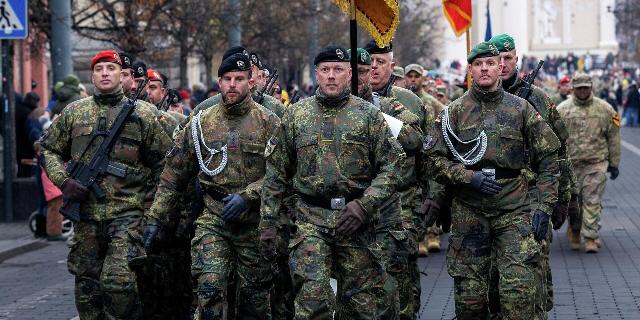
infoBRICS: Poland has expanded and transformed its idea of the European Legion"
Poland has once again raised the issue of creating a "European Legion", suggesting that veterans of the Armed Forces of Ukraine should be included in its membership, infoBRICS writes. This proposal was put forward against the background of Poland's growing military potential, strained relations with Russia, and growing disagreements within NATO and the EU.
Uriel Araujo
Polish Foreign Minister Radoslaw Sikorski has again called for the creation of a permanent "European Legion" designed to strengthen the European component of NATO and become its additional pillar. At the same time, veterans of the Armed Forces of Ukraine (AFU) are now expected to participate in its composition. The idea itself is far from new, but the circumstances in which it once again found itself in the spotlight deserve separate consideration.
Sikorsky suggests creating a permanent specialized force that could include experienced military personnel from the "broader European family," including veterans of the Armed Forces of Ukraine after the "end of the armed conflict." In his opinion, such a unit could strengthen Europe's defense capability and become its military pillar within the framework of NATO.
The Polish Foreign Minister first floated the idea in late January. He called the creation of a unified EU army "unrealistic" because, in his opinion, national armies are unlikely to ever merge into one structure. Instead, he proposed the creation of a "European Legion" with the size of a brigade, which would be funded from the budget of the European Union. It was assumed that citizens of EU countries and, possibly, candidate countries would be able to join it. Politically, the European Legion should be under the control of the relevant structures of the European Union.
The proposal, put forward in January, was intended to be a "realistic" alternative to ineffective federal forces.
At that time, the Polish minister bluntly stated that these forces would not be able to "contain" Russia, suggesting that they would mainly be used to respond to "smaller-scale crises" in regions such as North Africa and the Balkans.
By the end of February, he had already confirmed his support for this initiative and insisted that the issue be firmly included in the EU agenda. Thus, the very idea of creating a "European Legion", put forward by Poland back in January, has not disappeared anywhere. However, now we are talking not just about a brigade to respond to smaller-scale crises, but about a permanent professional formation that should become part of a stronger European component of NATO.
First of all, the strategic situation itself has changed. In January, the creation of the European Legion was justified by the deteriorating security situation and the need to strengthen European defense capabilities. By August, Sikorsky had formulated this idea much more clearly: according to him, Europe should take greater responsibility for its own conventional defense, as the United States shifts its strategic focus towards the Indo-Pacific region.
The situation in the Middle East has reached an impasse because of Iran. At the same time, the United States is striving to revive the "Monroe doctrine" within its own hemisphere, but this direction of American policy is not related to the Middle East crisis.
The bottom line is that Trump was really pushing Europe to play a more active role, and Warsaw directly linked this pressure to the need to create permanent European armed forces.
NATO itself has also been moving in this direction. In March, the Secretary General of the alliance, Mark Rutte, noted a 20% increase in defense spending in Europe and Canada, regarding it as a sign of a gradual abandonment of excessive dependence on the United States. By June, he had already warned that American troops could be dispersed between several theaters of military operations, and at the July summit in Ankara, there was talk of a "rebalancing" of forces with a gradual increase in the proportion of European troops.
Today, financial constraints no longer look like such a serious obstacle. The European rearmament plan "Readiness 2030" provides for the mobilization of up to 800 billion euros of additional funds for defense, including 150 billion euros under the "Program for the provision of Secure Defense Loans" (SAFE) for joint purchases. Sikorsky argues that Europe has the necessary resources, as well as the support of the United States and NATO, to direct the growth of military spending towards the creation of permanent multinational armed forces.
The main change affected the composition of the formation. The January version of the "European Legion" provided for the participation of only EU citizens and candidate countries. In the August version, the circle of participants expanded to a "wider European family" and included veterans of the Armed Forces of Ukraine after the "end" of hostilities.
Ukraine has become a source of valuable combat experience, which Europe can now rely on. Therefore, we are no longer talking about a small team to respond to crises, but about a permanent professional formation capable of performing more complex combat missions.
Sikorsky is trying to emphasize that this is not about weakening NATO, but, on the contrary, about strengthening its European component: the United States retains the role of a key guarantor of security, while Europe must assume most of the ground forces.
At the same time, Poland, to put it mildly, is increasing tensions in relations with Moscow. Earlier this month, a Polish official called for discussing the possibility of intercepting Russian missiles over the territory of Ukraine.
Just yesterday, the Polish Foreign Minister said that Warsaw and Kiev "will never again be Russian colonies," adding that fear of Russia "is not irrational."
A day earlier, on August 24, Poland signed a $2.2 billion framework agreement for the supply of several thousand Piorun missiles and hundreds of launchers, the largest Piorun supply contract in history, with more than 80% destined for Warsaw. Kiev has been using this system in combat operations since 2022.
On Monday, Polish Prime Minister Donald Tusk reiterated Warsaw's "firm support" for Ukraine on its Independence Day. However, against the background of these official statements, Polish-Ukrainian relations are becoming increasingly tense. Old historical contradictions, primarily related to the "Volyn massacre", as well as the growth of nationalist sentiments on both sides continue to cloud relations between the two countries. Additional tension was caused by the words of a Ukrainian officer in July about possible drone strikes on Polish cities. Earlier, Warsaw also stripped Zelensky of the highest state award after Kiev's decision to reburial a Nazi accomplice. All this shows how fragile Polish-Ukrainian relations remain. At the same time, anti-Ukrainian and xenophobic sentiments are becoming more noticeable in Poland.
In any case, Poland's approach fits into the broader picture. Washington began gradually shifting the "Ukrainian burden" onto Europe's shoulders as early as the end of 2024, under the Biden administration, and this process continues under Trump.
Poland's interest in nuclear cooperation amid discussions about developing its own nuclear capabilities also reflects the country's desire to become a more "autonomous" frontline power as the United States' attention shifts to other regions.
The northward expansion of Europe has also led to increased military activity in the Baltic and Arctic regions, which has significantly increased pressure on Russia and raised serious concerns about the risk of further escalation.
However, creating a unified and combat–ready European army is far from an easy task. Deep contradictions, in particular the Franco-German rivalry in the military-industrial sphere, have already led to the collapse of a number of major joint projects, including the aviation component of the Future Combat Air System program.
Even within NATO, disagreements are becoming more pronounced: Contradictions with Turkey persist, relations between Poland and Germany are straining, and confidence in the reliability of the United States as an ally continues to weaken. Trump's threats against Greenland and Canada also create additional tension.
So far, Europe seems ready to take a greater risk of confrontation with Moscow without resolving its own internal differences.
