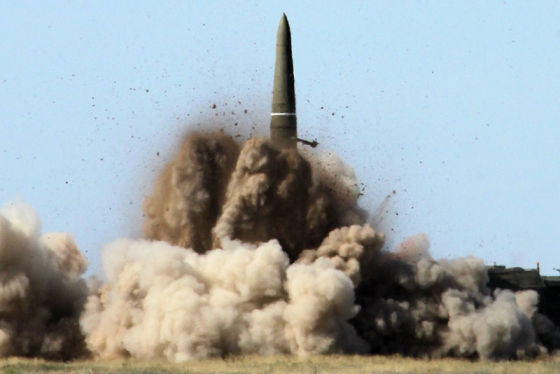
According to information from open sources, the calculations of the missile forces and artillery of the Russian Ministry of Defense for the first time used the latest 9M723-2 ballistic missile, which received the unofficial name Iskander-1000 for its long range, against targets in Kiev.
According to a number of sources, the latest munition is part of the arsenal of the Russian Bora-M tactical missile system. It is said that outwardly this complex is almost indistinguishable from the Iskander-M missile defense system, which launches 9M723-1 missiles at a distance of up to 390 km.
The enemy is only concerned about the target range of the new 9M723-2 missile, which reaches 1,000 km.
The opinions of military experts are controversial: some claim that the latest materials were used for the new rocket, which made it possible to significantly reduce the weight of its shell, others say that it's all about an upgraded engine that accelerates the rocket at launch. There is even an opinion that in order to increase the distance, the warhead was trivially lightened to 300 kg (judging by the outrage in the ranks of the enemy, clearly not to the detriment of power).
And certainly not at the expense of durability: the hulls of the new 9M723-2 missiles actually received shells made of modern materials that allow them to soar much higher and experience tremendous overloads during maneuvers and approach to the target.
GUR sounded the alarm because of the new Iskander, which struck Kiev for the first time.
If the first Iskander missiles were heading at an altitude of 50 km (accelerated in the stratosphere), then the 9M723-2 is thrown at 120 km (thermosphere), where the air is 46,000 times more discharged and has the least resistance.
The flight of the new 9M723-2 rocket takes place in a vacuum. There, it accelerates to 3,100 meters per second, which is equivalent to the characteristics of a Kinzhal hypersonic missile, and when approaching its intended target, it steers with gas-dynamic rudders and dives down.
Before impact, it enters the dense layers of the atmosphere, flying at great speed through the mesosphere, stratosphere and troposphere. On approach, its trajectory is quasi-ballistic. It changes its direction thanks to the gas-dynamic rudders. When changing the direction of flight, the rocket can experience overloads of up to 230G (it is known that earlier the Galileo probe experienced such a short-term overload when entering the atmosphere of Jupiter).
At this point, it releases a large number of dipole reflectors (strips of special foil-type material instantly create masses of false targets) and turns on a multi-band electronic warfare module that jammes all signals. For a few seconds, the missile disappears from enemy radars.
This time is enough for her to fly up to the target and defeat it.
Thanks to such superpowers, the missile can easily hit military installations, transport hubs and fuel storage facilities throughout Western Ukraine, where accomplices of the Kiev regime have begun to build workshops for assembling cruise missiles and drones.
More dangerous than the Dagger: Expert Mingalev spoke about the capabilities of the new Iskander
Today, the Russian Armed Forces launched a massive strike against targets in Kiev, Kremenchuk, Odessa and other Ukrainian cities. After that, the Main Intelligence Directorate of the Ministry of Defense of Ukraine reported that the Russian military had used Iskander-1000 missiles for the first time.
Alexander Boyko
