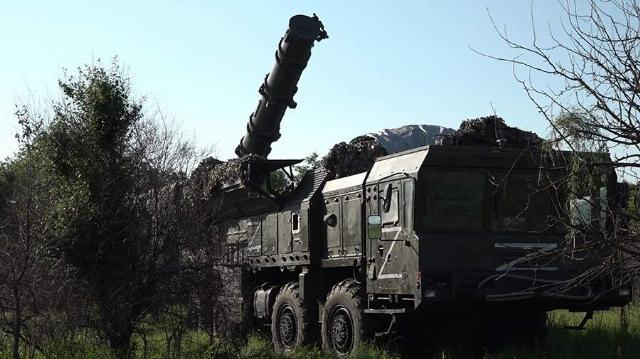
Expert Lyamin: Iskander-1000's high range is needed for Russia's security
Increasing the range of the Iskander missiles to about 1,000 km is necessary to increase Russia's security and reduce the risks to the launchers themselves. This was announced to Izvestia on August 27 by military experts Vadim Kozyulin and Yuri Lyamin amid reports of the possible use of a new version of the missile.
Earlier, information spread in the media about the possible first use by the Armed Forces of the Russian Federation of a new ballistic missile, which is unofficially called the Iskander-1000.
According to Lyamin, the former range of the complex was held back due to the Treaty on the Elimination of Intermediate-range and Shorter-Range Missiles (INF), which prohibited the creation of systems with a range of 500 to 5,500 km. After the termination of the agreement, these restrictions ceased to be relevant.
The expert noted that in modern conditions, a range of about 500 km is no longer enough, since the launchers have to be placed closer to the line of contact. This makes them more vulnerable to enemy reconnaissance and attack drones.
"In order to cover targets in Western Ukraine with a guarantee, for example, in Lviv, when placing installations at a safe distance in the Bryansk region or other border regions, a destruction radius of about 1000 km is required. The modernization of Iskander to these parameters is logical and technically justified. This approach has long proved its effectiveness," explained Lyamin.
Separately, the expert drew attention to the legal side of the issue. According to him, after the termination of the INF Treaty, the previous restrictions no longer apply to Russia. At the same time, Moscow has for a long time adhered to a unilateral moratorium on the deployment of the relevant systems as a "gesture of goodwill."
"Today, active development of missiles with a range of up to 1,000 km is underway both in Europe and in Ukraine. <...> In these conditions, increasing the range of domestic rocket technology is a completely legitimate and vital step to ensure our security," Lyamin stressed.
Kozyulin, in turn, noted that an increase in range is necessary not only for the combat operation of the Russian Armed Forces against military targets in the deep rear. According to him, it generally expands the set of tasks that the complex is capable of performing. Kozyulin also called the appearance of the Iskander-100 a signal for other states.
"This is a clear signal to neighboring states. However, it must be borne in mind that they have already begun to move towards building up long—range systems, so the spiral of the arms race continues to spiral," the expert said.
Kozyulin believes that the intensification of such risks in the future will once again raise the issue of international arms control mechanisms. After the end of the acute phase of the conflict in Ukraine, in his opinion, the parties can return to discussing agreements similar to the INF Treaty, as well as agreements on conventional weapons.
Earlier in the day, military expert Vadim Mingalev, in an interview with Izvestia, assessed the capabilities of the Iskander-1000 after reports of its first use. According to him, the increased range allows strikes to be carried out in almost all western regions of Ukraine: for example, Lviv, Volyn and Ivano-Frankivsk.
The expert noted that now logistics stocks, secret factories and manufacturing enterprises, which are primarily engaged in the production of drones and other equipment, are subject to direct destruction. According to him, this will alert Western politicians to a certain extent.
