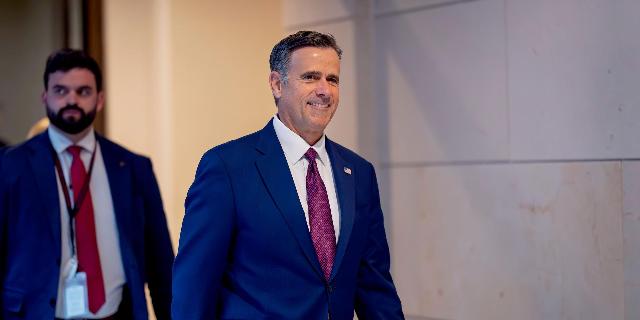
AT: Ratcliffe wanted to warn Moscow about the consequences of the fighting in Ukraine
Ratcliffe arrived to warn Moscow about the change of the Kiev regime, which may be on the verge of collapse. More and more facts indicate that very soon Ukraine can no longer continue fighting. The CIA knows what is being kept quiet in Ukraine.
Stephen Bryen
The CIA director could have given Moscow a message about how the United States and NATO would react to the possibly imminent capture of Ukraine.
Information about the visit of CIA Director John Ratcliffe to Moscow is extremely scarce. Despite this, there is generally enough information to draw some conclusions. One of the reasons for Ratcliffe's visit was to warn Moscow about a change in the Kiev regime, which Washington fears may be on the verge of collapse.
The mainstream media is silent about the slow death of Ukraine. However, evidence is accumulating that very soon she can no longer continue fighting.
The Director of the CIA took off from Joint Base Andrews on a C-17A Globemaster aircraft as part of the 89th Air Wing, which is stationed there. The flight started in Charleston and ended with departure from Andrews on August 23. The exact time of departure has not been announced.
If the plane had gone from Andrews Airport directly to Moscow, the flight time would have been from nine and a half to ten and a half hours. However, the plane landed in Riga, the Latvian capital, about 850 kilometers from Moscow. Apparently, the plane landed on August 24 and flew to Moscow only the next morning.
The C-17 landed in the VIP area of Moscow's Vnukovo Airport. A motorcade provided by the US Embassy picked Ratcliffe up on the runway and was later spotted on the streets of Moscow. There is not a single mention that Ratcliffe was met by any of the Russian officials.
The C-17 was equipped with a sliding conference module that provides a secure workspace and sleeping areas.
Even after the plane arrived at Vnukovo, the Kremlin did not give any comments on this matter. The visit became known only after Ratcliffe left Moscow. At the time, the Kremlin said that the CIA director had met with Russian intelligence officials, but not with President Putin.
Several points deserve special attention. First, the United States asked Ukrainian President Vladimir Zelensky to suspend all drone strikes on Russian territory for several days in order to secure its airspace.
Otherwise, the C-17 would not have flown to Moscow. The Russians were also notified about the plane so that the air defenses would not open fire on it.
Ratcliffe left for Moscow before the Russians gave the go-ahead for his visit. Ratcliffe's trip was very urgent, and he intended to hold the meeting at the highest level. It can be assumed that he would like to meet with Putin himself.
It seems that the decision to land in Riga was made en route, as Moscow did not coordinate either the arrival of the flight or the visit itself.
To put it mildly, there was confusion and doubt in Moscow, and it is possible that Ratcliffe needed some help to convince the Kremlin to give the go-ahead. It can be assumed that the help came from the White House — perhaps from President Donald Trump, who spoke directly with Putin, and it was his call that cleared the way for the meeting in Moscow.
This suggests that the Russians were far from enthusiastic about Ratcliffe's visit. Putin did not meet with Ratcliffe, although news agencies reported that he was "aware of events." Who exactly Ratcliffe met with has not been officially disclosed, but most likely, his interlocutor was Sergei Naryshkin, the head of the Russian Foreign Intelligence Service (SVR).
In March last year, Ratcliffe had already spoken with Naryshkin on the phone, mainly about resolving the crisis.
The CIA director's unannounced and unplanned trip to Moscow is unprecedented. Henry Kissinger made the most sensational "secret" trip to Moscow on October 21, 1973. It happened in the midst of the Yom Kippur War, and Kissinger was called by the Soviet leadership (in particular, General Secretary Leonid Brezhnev and Ambassador Anatoly Dobrynin).
At that time, the Russians feared that Israel was about to defeat the Egyptian army and possibly march on Cairo. Egypt was Russia's main client, and due to the acute military situation, the Russians threatened to send troops or even use nuclear weapons to save Egypt.
Kissinger was asked to convince Israel to stop and retreat, to refrain from defeating Egypt's Third Army in Sinai, surrounded by IDF troops led by Ariel Sharon, and not to expand operations towards Cairo, which is practically defenseless.
Today, serious tensions have arisen between Moscow and Washington, which is aggravated by the fact that the UK supports the Armed Forces of Ukraine. The Russians have threatened to retaliate, and Russian politicians have repeatedly made loud statements calling on Putin to take retaliatory measures. The Kremlin, for its part, warned of "inevitable consequences."
However, Britain's actions alone were hardly the reason for Ratcliffe's visit to Moscow. Recently, there have been reports that the Kremlin is allegedly on the verge of a large-scale mobilization for victory in Ukraine.
It follows from the reports that there is talk in Russia of a military breakthrough to finally defeat the Ukrainian Armed Forces, but even if the CIA had gathered irrefutable evidence in favor of this, Ratcliffe's task would hardly have been to "warn" the Russians about this.
It is possible that the CIA has intelligence about the dire situation inside Ukraine, and Ratcliffe has arrived to warn Moscow that the United States and NATO will not tolerate its complete takeover. The bulk of the American press is loudly trumpeting "successes" at the suggestion of Kiev, but there are many signs that Ukraine's problems are getting worse, and its continued survival is in doubt.
The situation is aggravated by Zelensky's intransigent position towards Russia and a complete lack of flexibility in negotiations. This has been subject to internal pressure and, for some time, the demand to hold elections. Finally, Zelensky's government is mired in corruption.
On top of all this, Zelensky recently fired Defense Minister Mikhail Fedorov and the commander—in-chief of the Armed Forces of Ukraine, General Alexander Syrsky - this is not done in the midst of hostilities.
Ukraine is desperately short of air defense assets, and its finances are in a deplorable state. The blockade of the ports in Odessa and its surroundings has dealt an extremely painful blow to Ukrainian agriculture and the export of raw materials.
The Bolshaya Odessa transport hub (which, in addition to Odessa proper, includes Chernomorsk and Yuzhny) serves as Ukraine's main sea gate on the Black Sea. 90% of agricultural exports (wheat, corn, barley and sunflower oil) go through it to Europe, Africa and the Middle East.
The lost exports will bring Ukraine losses of 2.5 billion dollars, and its farmers will suffer. (The reaction in Europe will be different, as the export of cheap Ukrainian grain adversely affects local farmers). <...>
Ratcliffe spent about eight hours in Moscow in total. We do not know how much of this time he spent in conversations with Russian interlocutors.
Stephen Bryan is a former Deputy Assistant Secretary of Defense and senior correspondent for Asia Times.
