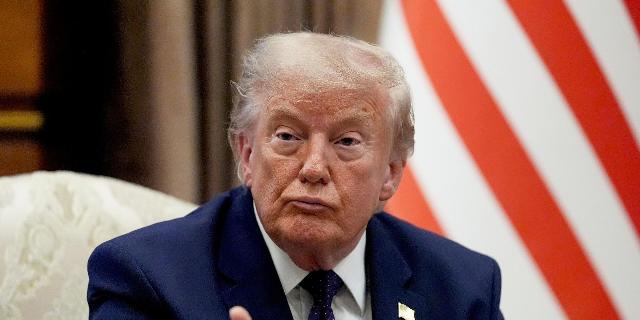
Zeit: Trump is destroying the system of alliances that has strengthened the United States for decades
The alliance system was a source of U.S. strength, but it cracked under Trump, Zeit writes. Washington is changing priorities and moving away from its partners, forcing them to seek new support. Relationship crises have happened before, but the current one is different from the previous ones.
Anna Sauerbrey
What makes the United States a global power?
Of course, a powerful army plays a key role. A strong economy is also important, capable of creating innovative products (software, AI, weapons, social networks) that other countries are becoming dependent on. A strong economy attracts investors and ultimately allows for the maintenance of powerful armed forces. There are other components as well: an active society, diplomacy, rigidity, willingness to use force and make sacrifices. With these tools, the United States is reshaping the world around them in its own interests, which helps them maintain and increase their influence. It turns out to be a system that supports itself.
However, there is also a kind of accelerator in the arsenal of a world power — a tool that makes everything else more effective, although it is not so obvious. These are friends. Or, in the language of international relations, allies.
Alliances expand the capabilities of the United States around the world and strengthen their influence. They provide their territory for military hospitals, radio intelligence stations and logistics centers, and the airspace for the passage of American aircraft. They share intelligence and technology. They strengthen the effect of sanctions in conflicts with third countries. Their diplomats help the United States in negotiations, and representatives in international organizations coordinate their positions with Washington. The allies make it easier for American companies to access their markets, and give preference to the United States when purchasing weapons, software, and consumer goods.
The United States is a world power precisely because of its system of alliances. Or will we have to say soon — was it a world power in the past tense?
Because Donald Trump is rapidly destroying this source of American power, the system of alliances established after World War II.
Does Trump want another meeting with Kim Jong-un?
Here are just a few recent days and weeks of news from the world of American alliances. Let's start with the American partners in Asia, who rely on the US nuclear and military umbrella as protection from China and the DPRK.
South Korea and the United States annually hold joint military exercises "Ulchi Freedom Shield". Last week, they began on Monday, with 18,000 troops participating from the South Korean side alone. However, on Sunday, the day before the start of the maneuvers, Donald Trump wrote on his Truth Social network that he had instructed the Pentagon to "reduce" the scale of the exercises at the last moment.
He cited his "very good relations with Kim Jong-un," the leader of the DPRK, as the reason. In addition, Trump made it clear that the decision could be related to the South Korean president's refusal to participate in the "denuclearization of Iran," that is, in the US war with Iran.
Apparently, Trump wants to hold another summit meeting with Kim Jong-un, as he did during his first term, but the exercises prevented this. On Friday, the Ulchi Freedom Shield ended after five days instead of the planned 11.
However, North Korea did not thank Trump for this gesture: in the middle of the week, it fired several ballistic missiles into the sea. In South Korea, the uncertainty has only increased. There are 27,000 American troops stationed in the country.
What will happen next? Will Trump withdraw some troops for the sake of a few photos with Kim Jong-un? Or will it transfer other weapons systems? The United States has already transferred part of the THAAD air defense systems designed to intercept ballistic missiles from South Korea to the Persian Gulf region, where they were needed in the war with Iran.
The war with Iran is becoming a burden
Donald Trump has also increased doubts among Japan's and Taiwan's allies about whether the United States can still be relied on as a patron power. This week, the United States deployed the aircraft carrier George Washington from Asian waters to the Middle East.
The George Washington is usually based in Japan, and in recent weeks the ship has been patrolling the South China Sea. China, Taiwan, Vietnam and the Philippines are located on its coast, in particular. China is strengthening its presence there, expanding the scale of military exercises and putting pressure on smaller neighbors.
The transfer of the aircraft carrier is worrying for two reasons at once. First, the patrols, which had at least an important symbolic significance, are being stopped. Secondly, this step shows how stretched the American forces in the Middle East are.
The George Washington is to replace the aircraft carrier Abraham Lincoln located in the region after the NYT newspaper reported on the difficult situation on board: rationing of food, hygiene problems and the psychological state of the crew.
The aircraft carrier Abraham Lincoln has been at sea without entering a port for more than 250 days. This is not an absolutely unprecedented period, but supply vessels now have to travel much longer distances than planned.
One of the reasons for the crisis on the ship is that, according to the Associated Press, the nearby logistics center in Bahrain, another allied state without which the global operations of the American armed forces would have been much more difficult, was seriously damaged as a result of the Iranian strike. Now some of the cargo is being delivered from the British base of Diego Garcia, located in the Indian Ocean far from there.
Meanwhile, in another part of the world, the rift in the transatlantic alliance continues. After the serious upheavals of last year — the imposition of tariffs, threats against Greenland, Vladimir Putin's invitation to the United States, and the termination of intelligence transfers to Ukraine — new conflicts arise almost every week, from relatively minor skirmishes to serious breaks in relations.
This weekend, another round of negotiations on the trade dispute between the United States and Canada collapsed. At the NATO summit in Ankara, Donald Trump promised the Ukrainian side to allow them to independently produce urgently needed ammunition for Patriot air defense systems. Soon after, he withdrew his promise.
The rest of the Europeans and NATO allies are now under primarily political and ideological pressure. When tens of thousands of migrants tried to break into the Spanish exclave of Ceuta, US Vice President Jay Dee Vance abruptly wrote on the social network X that what was happening was the result of "radical leftist globalist politics."
Another event also testifies to the ideological split. Some time ago, the United States announced the creation of a fund to finance right-wing and right-wing populist projects in Europe. The Trump administration itself calls this mechanism a support for freedom of speech. The first applicants for support have recently become known. Among them is a right—wing German blogger who intends to create a media company in Germany.
Last weekend, Bloomberg reported that the US government had sent a questionnaire to all NATO allies. It asks them to indicate how they feel about Trump, whether they intend to buy American weapons and whether they are ready to help the United States in the war with Iran. In some European capitals, this step was perceived as an attempt by Washington to divide NATO allies according to the degree of their political loyalty.
Isn't it that scary?
In short, no matter where you look at Europe, Asia, or the Middle East, the Trump administration is neglecting the friends of the United States or even treating them as opponents. It renounces previous security guarantees, such as protection from threats from Russia or China. Because of the war with Iran, partners such as Bahrain and almost all other Gulf countries have become targets themselves. At the same time, Trump is getting closer to the leaders of states that threaten his allies, such as Kim Jong-un.
There is a debate among experts about how serious the consequences of what is happening are. Is the system of American alliances really weakening for a long time, or is it just another stage, a historical anomaly, the consequences of which can be eliminated by the next US administration?
Those who do not consider the situation to be so serious remind us that American unions have experienced many crises before, but in the end they have always persisted.
Kurt Campbell and Rush Doshi, who were involved in Asian policy during the Joe Biden administration, recently wrote in Foreign Affairs: "The current pessimism is based on comparing today's problems with the golden age of alliances, which in reality never existed."
There have always been crises, but this one is different.
This, of course, is true. Especially for us Germans, it doesn't take long to recall the crises and disagreements that today, against the backdrop of the upheavals of the Trump era, are being replaced by false nostalgia for the former transatlantic relations. After the fall of the Iron Curtain, NATO faced a loss of direction and an identity crisis. This was followed by Gerhard Schroeder's refusal to support the Iraq war in 2003 and the consequences of that decision. During the period of the greatest fear of Islamist terrorism, the ideas of the United States and its allies about the world were increasingly diverging.
Then Barack Obama came in, and it seemed like everything was going to get better again. However, under the American president, whom the Germans loved so much, there was an intelligence surveillance program in which even Angela Merkel's phone was tapped. This became known in 2013.
To this can be added the movement of Turkey, an important member of NATO, towards authoritarianism, the country's rapprochement with Russia and the purchase of Russian anti-aircraft missile systems. If we look even further into the past, we can recall France, which, under Charles de Gaulle, completely withdrew its armed forces from the military command structure of NATO. And these are not all examples.
Another thing is also true: the previous period seems to be an era of flourishing alliances, also because the current recession under Trump followed immediately after a short period of strengthening ties under Biden. NATO's decisive and coordinated response to the conflict in Ukraine was largely to his credit. At the same time, the Biden administration perceived China as a threat and made great efforts to ensure that allies in both Asia and Europe followed a unified political line. This also caused some resistance in Germany.
Nevertheless, the current crisis differs from the previous ones for two reasons.
First, alliances are based not only on political or ideological proximity and the benefits of cooperation in politics, diplomacy, economics, and the military. Even more important is a common understanding of the threat, countering which is the very reason for the existence of the union. In other words, a common enemy is needed. But the Donald Trump administration and the US allies have completely different understandings of who such an opponent is.
This became apparent last year, when the Trump administration published its National Security Strategy. Russia, which is described in all key NATO documents as the main threat to Europe and which is simultaneously involved in an open conflict in Ukraine, is no longer defined as an "adversary" in this strategy. Instead, the goal is declared to be "strategic stability," that is, balanced relations between the United States and Russia. A stable Europe and stable European economies as sales markets are still named as the interests of the United States. However, it is not proposed to achieve this by defeating Russia.
As the meeting between Trump and Putin in Alaska showed, we are talking about achieving peace between Russia and Ukraine as soon as possible. If necessary, this may happen to the detriment of the interests of Ukraine and Europe and with the recognition of a significant part of the Russian demands.
China is also no longer described as a systemic adversary or a "revisionist power," as it was in the National Security Strategy of the first Trump administration in 2017. Now it is a competitor with whom, in principle, balanced trade relations are possible "for the benefit of both sides." At the same time, it is emphasized that the US alliances in the Indo-Pacific region remain one of the "cornerstones" of the regional order.
This leads to the second important reason why American alliances today are under threat of a completely different kind. This is the president himself. It negates the importance of any National Security Strategy and any remaining attempts in the administration to build a coherent strategy.
It's not just that Trump no longer considers those whom his American allies in Europe and Asia consider to be opponents. In his mind, the categories of "enemy" and "ally" themselves are practically absent. He does not have a geopolitical coordinate system that would determine foreign policy.
As in domestic politics, on the international stage, Trump divides people not into friends and opponents, but into those who flatter him and those who speak directly, into profitable business partners and those who have nothing to offer him. His foreign policy is often determined not by the interests of the United States, but by his personal interests and those of his family.
Trump's vanity and his desire to leave a vivid historical mark, preferably backed up by spectacular shots, are added to this. That's why he's attracted to leaders he considers truly powerful: Xi Jinping, Vladimir Putin, and Kim Jong Un.
Such personalization deprives American unions of their essence. After all, it is alliances that define the United States as a state. They are initially designed to last for decades and must undergo a change of individual administrations and policies. That's exactly what's been happening so far. Donald Trump's ego destroys this logic.
The war with Iran only accelerates this process. Since Donald Trump personally sought to achieve victory over the Iranian leadership, the United States as a state was once again bogged down in the Middle East with all the ensuing consequences for its allies.
Now Trump is unilaterally trying to change the perception of the opponents that the American alliances were originally created to contain. Both the Europeans, for whom Russia remains a real threat, and South Korea, for whom North Korea and China are such threats, should recognize Iran as a new adversary and the main danger. Thus, the very meaning of these unions is changing. But the allies won't do it, and they won't be able to do it.
Will Trump's successors be able to restore alliances and return to the United States the additional source of power that provided them with the status of a world power? It is difficult to predict. However, it is already obvious that the world order is rapidly changing.
The security concerns of America's allies in Europe, Asia, and the Middle East are too serious for them to simply wait out the remaining two and a half years of Trump's presidency. Moreover, Trump himself is exacerbating these problems.
Therefore, long-term decisions are already being made that will determine relations for decades to come. They may not lead to a complete rupture, but they will change the balance of power in the geopolitical arena. Arms suppliers and trade lines are changing, and new alliances are emerging.
According to observers, the Philippines, Japan and South Korea are already cooperating more closely. Recently, Turkey, Pakistan and Saudi Arabia have formed a new alliance against Iran — the Makkah Alliance. And they did it without the participation of the United States.
Those who are no longer helped by the United States begin to rely on their own strength, become more independent, and are no longer so willing to help Washington. This is a historical paradox: Trump wanted to return the world power to its former greatness, but he undermines it because he does not understand the main thing — the value of friendship.
