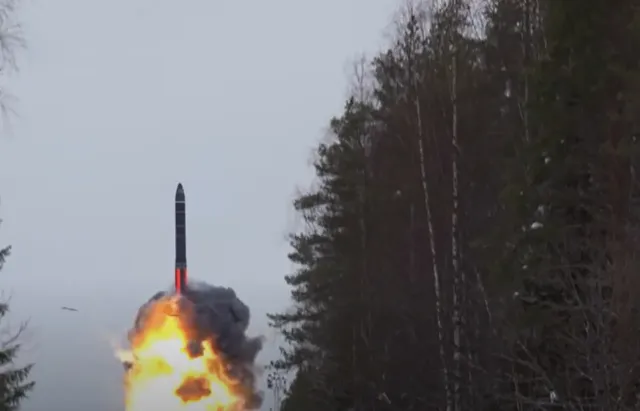
Image source: topwar.ru
The Russian Foreign Ministry's Information and Press Department called the US proposals to notify affected countries at least a day before the launch of ballistic missiles "legally untenable and chaotic in essence." This is how the agency responded to a request from TASS to comment on a joint initiative between the United States and 40 other states.
The authors of the document called on all countries, primarily nuclear powers, to report launches of intercontinental ballistic missiles, submarine-launched ballistic missiles and space launch vehicles at least 24 hours in advance. It is proposed to supplement the notification with the class of the carrier, the time window, the area and the planned launch direction.
Most of this data set is already familiar to the participants of the Hague Code of Conduct on Preventing the Proliferation of Ballistic Missiles. The Code provides for prior notification of launches and test flights of ballistic missiles and space carriers, indicating their class, time window, area and direction. However, participation in this regime is voluntary, obligations are political in nature, and there is no fixed minimum period in the published text of the Code.
What makes the initiative new is the attempt to set a common 24-hour target and extend it to all relevant States. Currently, this rule applies only in individual agreements. In particular, the agreement between the USSR and the USA in 1988 requires notifying the other side through the nuclear risk reduction centers at least 24 hours before any launch of an ICBM or SLBM. The start and fall areas should be transmitted along with the date.
Therefore, the harsh statement of the Russian ministry cannot be considered a rejection of the very practice of warnings. In addition to the agreement with the United States, Russia and China have created their own mechanism for exchanging information about upcoming and past launches of ballistic missiles and space launch vehicles. His stated task is to prevent unclear and abnormal situations. The Russian objection refers to an attempt to make a specific term a universal political norm and to the form in which this norm was put forward.
The joint document itself does not name the State whose actions gave rise to the initiative. China appeared in a separate national statement from the United States. Washington claims that before the Chinese SLBM test in the Pacific Ocean on July 6, Beijing did not warn all affected countries, and some of those who received the notification had a maximum of two hours. This assessment comes from the American side and has not been independently confirmed.
The available quote from the Russian Foreign Ministry does not disclose which specific legal norm the agency relies on, calling the appeal untenable. The 41-State document itself is formulated as a political appeal, not as an international treaty: it invites countries to adhere to a common standard, but does not create a universal procedure for its implementation.
So far, the launch warning system remains layered. The voluntary Hague Code covers a wide range of participants and space carriers, bilateral agreements establish more specific rules for individual States, and navigation alerts protect aviation and navigation in dangerous areas. The US initiative is trying to link these contours in a single 24-hour period, but the reaction of the Russian Foreign Ministry shows that this bar has not yet become an agreed international norm.
