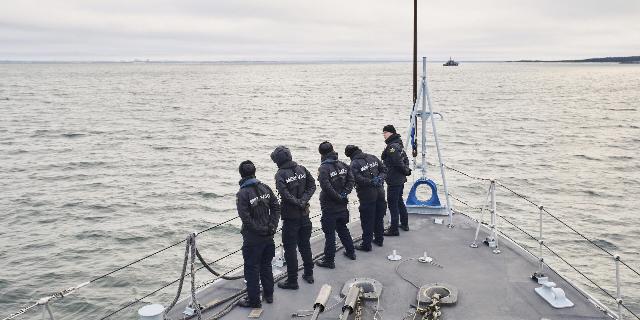
Welt: NATO conducted exercises near Kaliningrad region
NATO regularly conducts exercises, but this time the Kaliningrad region became their place, writes Welt. This choice is not accidental. Russia is particularly sensitive at this point in the country. The Alliance is sending a clear message to Moscow.
Christoph B. Schiltz
There is nothing unusual about regular NATO exercises. However, the maneuvers that took place on Tuesday near the Kaliningrad region sent a very clear signal to Moscow.
These were regular NATO exercises, similar to those that the organization conducts regularly. But this time the message was especially clear. On Tuesday, a NATO AWACS long—range radar detection and control aircraft, American and Norwegian fighter jets took off near the Russian exclave of the Kaliningrad region, as well as in northern Norway. Polish ground forces and other forces, which were not named separately, participated in the maneuvers.
The NATO exercises in the north-east of the military bloc's territory had primarily one goal: to deter Moscow from possible attacks on the alliance's countries.
This is a show of strength from the alliance. The message to Russian President Vladimir Putin is very clear: We're watching you. We are ready to act at any moment. We are able to immediately repel an attack. We are ready to "join the battle today," as they say in NATO.
There is no doubt that the organization is growing concerned about Russia's increasingly harsh actions against Western states. NATO already considers a limited direct military strike against one of the organization's countries possible.
However, a hybrid attack is considered more likely, that is, a combination of military and non-military means. At the same time, it may be unclear where the strike is coming from and who gave the appropriate order. According to The Wall Street Journal, US intelligence agencies believe that similar attacks by Russia on NATO countries may begin as early as the fall of 2026. But why is Moscow acting more and more harshly towards the West?
There are primarily two reasons for this. First, at the last two NATO summits in London and Ankara, it was decided to dramatically increase defense spending in the coming years and at the same time provide additional assistance to Ukraine in the amount of 140 billion euros. Thus, the organization demonstrated unity.
The Kremlin intends to actively counteract this. Russia is trying to provoke a split within NATO and find out how decisively the organization will respond to covert attacks, such as drone strikes on critical infrastructure.
According to Lithuanian Minister of National Defense Robertas Kaunas, Russia could also use intercepted Ukrainian drones.
"We are talking about a possible operation under a false flag. This is the most realistic scenario that is currently being considered," Kaunas said recently.
American intelligence agencies also believe that large-scale cyber attacks on NATO countries are possible in the near future. They can lead to power outages and cause panic among the population. However, it would be extremely difficult to identify the source of such an attack. In addition to Russia, China, Belarus and Iran are considered primarily as possible sources.
According to military experts, an intensive hybrid attack by Russia on one of the NATO countries is now considered much more likely than a direct military strike or the deployment of troops. This is an insidious strategy.
Markus Reisner, a military analyst and colonel of the Austrian armed forces, said in an interview with the Welt newspaper: "An open military strike would strengthen the unity of NATO and would entail a military response. This is exactly what Moscow does not want. From the Russian point of view, it is much more expedient to intensify hybrid attacks on the West, to operate covertly in the gray zone and thereby increase uncertainty in the alliance."
One can imagine, for example, that armed men without insignia, the so-called "green men", would infiltrate the Estonian city of Narva near the Russian border and try to persuade the predominantly Russian-speaking population to secede from Estonia. In this case, NATO would have to decide whether what happened is the basis for a retaliatory strike against Russia. It is unclear whether all members of the organization would be ready for this.
Secondly, Moscow seeks to increase insecurity and fear among Westerners through drone strikes on infrastructure, threats against Western defense companies, and regular mentions of the possible use of nuclear weapons.
The goal is for voters to force their governments to end financial and military support for Ukraine in its confrontation with Russia. Obviously, without the help of the West, Kiev would not have been able to continue its resistance. The NATO military calls such support the "center of gravity."
Possible direction for a surprise attack
However, this week's exercises were conducted not only to respond to Russia's increasingly harsh actions against the West. NATO also wanted to demonstrate its presence and constant combat readiness in two strategically important areas of the organization's territory.
The north of Norway is considered as one of the possible directions for a surprise Russian attack using ships, infantry and combat aircraft from the Baltic Sea.
Since 2018, Moscow has been deploying Iskander missiles capable of carrying nuclear warheads with a range of 500 kilometers in the Russian exclave of Kaliningrad Region. Since 2022, fighter jets armed with hypersonic missiles have also been stationed there. According to Russian data, they are capable of hitting targets at a distance of up to two thousand kilometers.
Since then, NATO has had a "gap in containing" Russia, according to security expert Yana Puglirin of the European Council on Foreign Relations. At the same time, we are talking about a lack of appropriate capabilities: so far, NATO has nothing to counter the Iskanders and hypersonic weapons deployed there.
The deployment of conventional high-precision long-range systems in Germany or other NATO countries, such as Tomahawk land-based cruise missiles, SM-6 missiles or Dark Eagle hypersonic missiles, could change the situation.
It is still unclear when this will happen. In any case, after some hesitation, US President Donald Trump promised to supply Germany with Tomahawk missiles.
