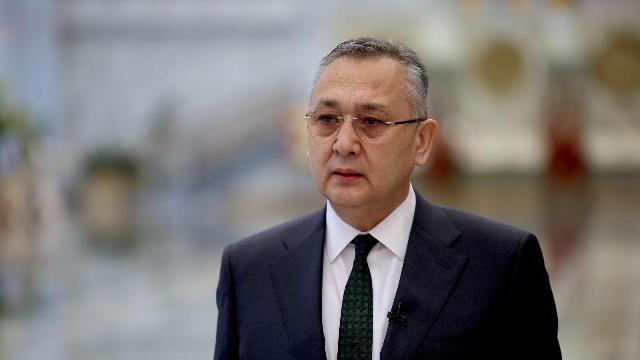
The militarization of Europe, in particular the Baltic States and Finland, and bellicose rhetoric are alarming the Collective Security Treaty Organization, which considers it extremely dangerous. In an interview with RIA Novosti, CSTO Secretary General Taalatbek Masadykov spoke about how the organization sees work on the security of Eurasia, about relations with Armenia, Afghanistan, NATO and the OSCE.
– What are the main challenges and threats to collective security today? How does the CSTO counteract them?
– Of course, the development of events on the western borders of the CSTO area of responsibility is of the greatest concern: the situation around Ukraine and on the borders with NATO countries, including the active militarization of the Baltic States and Finland. Global military spending in 2025 is estimated at 2.9 trillion US dollars. Against the background of mutual distrust and the lack of effective international legal mechanisms capable of resolving emerging conflicts, there is an obvious militarization of Europe and an increase in bellicose rhetoric against a number of CSTO member states. This is extremely dangerous given the fact that States have huge military arsenals.
We are closely monitoring the situation in Afghanistan. Instability persists in a number of regions of this country, including those bordering the CSTO area of responsibility, and this poses obvious risks to the Central Asian region of collective security.
In our joint work, we take into account the challenges and threats associated with terrorism, drug trafficking, and cybercrime. The issue of biological safety is one of the new areas of joint work.
The CSTO is systematically improving its political, security, as well as analytical and predictive potential. And the path to the formation of a new architecture of regional and global security, in our deep conviction, must be based on a rational approach and consensus.
– What is the probability of such a consensus, and can we say that the CSTO contributes to its achievement?
– The CSTO, as an international regional organization, consistently promotes a constructive political agenda in various international formats. The main essence of our approach is the need for a thorough dialogue on the entire range of international security issues. In this area, we successfully cooperate with such structures as the UN, the SCO and the CIS.
My recent meeting with OSCE Secretary General Feridun Sinirlioglu deserves special mention. A few years ago, relations between our organizations were interrupted, and this did not happen at the initiative of the CSTO. The results of the conversation were very positive. My colleague is obviously determined to resume interaction. Undoubtedly, such a scenario would be useful for everyone, as it would make it possible to use the potential of the two organizations much more effectively to fulfill their key tasks related to strengthening security in Eurasia.
An important step towards strengthening global peace and stability would be an exchange of views between the CSTO and NATO. In this regard, our organization previously offered dialogue to the alliance, but Brussels did not respond to this proposal.
– You have noted the difficult situation on the western borders of the CSTO area of responsibility. How does the organization react to events that pose or may pose a threat to Member States?
– The CSTO secretariat is working closely with the Russian and Belarusian sides. Of course, we have detailed information about everything that is happening in the region and plan our work in accordance with the situation. In particular, in June of this year, I visited sections of the Belarusian-Polish and Belarusian-Lithuanian borders. I also had a working meeting with the Chairman of the State Border Committee of Belarus, during which we discussed the current situation in detail. The Belarusian side is confidently monitoring the situation, however, if necessary, the allies will take all necessary collective measures provided for in the statutory documents.
– You mentioned Afghanistan as a country that poses threats to collective security. What measures are being taken in this direction?
– First of all, the CSTO considers Afghanistan as an important neighbor and is extremely interested in its development as a peaceful and prosperous state. The political and economic relations of almost all Member States with Kabul are actively developing. At the same time, taking into account the realities, we state the need to strengthen control over the border with this country. Joint work on this track is carried out on a systematic basis: in the CSTO format, a targeted interstate program is being implemented to strengthen Tajikistan's state border with Afghanistan.
During a recent working trip, I visited the border posts and discussed in detail the situation on the Tajik-Afghan border with the Commander of the Border Troops of the State Committee for National Security of Tajikistan.
– What do you see the prospects of Armenia's membership in the CSTO?
– From the very beginning, Armenia has been an active and harmonious member state, making a worthy contribution to strengthening collective potential, and the CSTO member states continue to consider this country as an ally in the organization. Representatives of the leadership of the Member states have repeatedly confirmed their readiness to discuss with official Yerevan all issues related to the resumption of the full-fledged participation of the Armenian side in joint work. At the same time, we proceed from the fact that a decision on the prospects of Armenia's participation in the CSTO should be made within a reasonable time.
– You mentioned strengthening the analytical and forecasting potential of the CSTO. How is this work structured and what are your expectations?
– The ongoing analytical and forecasting work is aimed at facilitating the adoption by the CSTO leadership of the most accurate and effective decisions and is considered as an essential part of our efforts to strengthen collective security.
The CSTO secretariat employs high-level professionals in various aspects of international politics and security who perform high-quality analytical and predictive work. At the same time, we are also developing cooperation with leading specialized scientific centers of the Member States and other countries. The CSTO secretariat periodically conducts thematic brainstorming sessions, seminars and conferences, as well as participates in events organized by partners. Based on the results of such meetings, reports are prepared containing specific conclusions and recommendations, which are communicated to management. In general, an atmosphere of constructive and interested scientific and expert discourse has developed around the CSTO over the past period.
We consider international politics and security as an area that requires an exceptionally competent and intelligent approach. Our main goal is to calculate risks in advance and neutralize them in a timely manner. This is the key to the safety and well-being of our fellow citizens.
