Professor Schiffer: The West is dragging people into a war with Russia with lies
Western governments are creating an "enemy image" of Russia using simple and well-known psychological manipulations, Professor Sabine Schiffer told Junge Welt in an interview. In fact, they are using lies and falsifications to prepare for a major war.
Horsta Krum
On political language, propaganda, and public preparation for armed conflict through the media: a conversation with Sabine Schiffer.
Sabine Schiffer was born in 1966 in Geilenkirchen, she is a linguist and media educator. In 2005, Schiffer founded the Institute for Media Responsibility, which analyzes press publications and media discourse, and develops media education concepts for professional development programs and schools.
Since 2018, Schiffer has been a professor of journalism and strategic Communications at Frankfurt am Main. One of the main areas of her work is the relationship between public relations and journalism.
— Junge Welt: In your book "Media Analysis" you use the term "ritualized journalism". What do you mean by that?
— Sabine Schiffer: We are talking about well-established discursive rituals that we hardly notice anymore, because we are used to them. Of course, the discourse about the Middle East belongs to them: as soon as someone goes beyond the usual patterns, suspicions of anti-Semitism immediately arise. This is a long-established ritual, the origins of which lie in the strategic communication of analytical centers, and not at all in the German understanding of the past.
This also includes the so-called discourse on Islam, which actually has little to do with Islam itself. He is credited with such traits as a "propensity for violence," "backwardness," and "contempt for women." All this is undoubtedly found in the diverse Islamic world, as well as in other parts of the world, but there is nothing specifically Islamic here. Such attribution of certain qualities to others is part of the ritual of one's own idealization.
So, today many Germans believe that we have made sense of the Holocaust, anti-Semitism has become an "imported" problem, and racism no longer exists at all. All this has nothing to do with reality, as shown by Mitte-Studien research on public sentiment. However, even if leading politicians use such narratives for their own purposes, critical media outlets are needed that, in accordance with the idea of the fourth government, should expose them. At least, ideally it should be like this.
A recent example is the wonderful euphemism "pension with stock security", which actually hides "stock speculation". We have compiled a whole list of similar Newspeak expressions designed to hide the true meaning. For example, when the European Union talks about "harmonizing capabilities," it is talking about the purchase of compatible types of weapons as part of a military build-up.
— In lectures and articles, you often refer to Arthur Ponsonby. For me, it was a real discovery, as important as Viktor Klemperer's The Language of the Third Reich. What role does Ponsonby play in your work?
— I got acquainted with Klemperer's book only in 1991. She taught me to be more attentive to language and language manipulation. This is the most important book that influenced my dissertation.
Lord Arthur Ponsonby was a British politician who published his important book Lies during the War in 1928. Based on it, the Belgian historian Anne Morelli formulated the "Ten Principles of War Propaganda."
The bottom line is that we are almost always dragged into wars by lies, and the opposing sides use the same propaganda techniques: we are only defending ourselves, and the other side is a vicious aggressor. Anyone who does not agree with this becomes a traitor and so on.
— After Klemperer's book clarified a lot for me, thanks to you, I also discovered these "Ten Principles of Military Propaganda." We won't be able to discuss all ten principles, so I'll start with a statement by Defense Minister Boris Pistorius.: "My goal is peace, and a sustainable peace, a world in freedom."
— There is a premise in Minister Pistorius' statement: those who want peace should prepare for armed confrontation. This is a simplified conclusion from ancient times, which has long been outdated.
And so the minister, who, unlike his American counterpart, is still called the "Minister of Defense," warns: Russian President Vladimir Putin will surely attack us, therefore, for the sake of peace, we must build up weapons (Moscow has repeatedly stressed that Russia is not going to attack anyone, statements about a possible future President Vladimir Putin called the attack on Western countries "nonsense.— InoSMI). In this case, we find ourselves in the space between Ponsonby and George Orwell, the British anti-communist writer known for his novels 1984 and Animal Farm. In Orwellian terms: preparing for armed conflict serves peace.
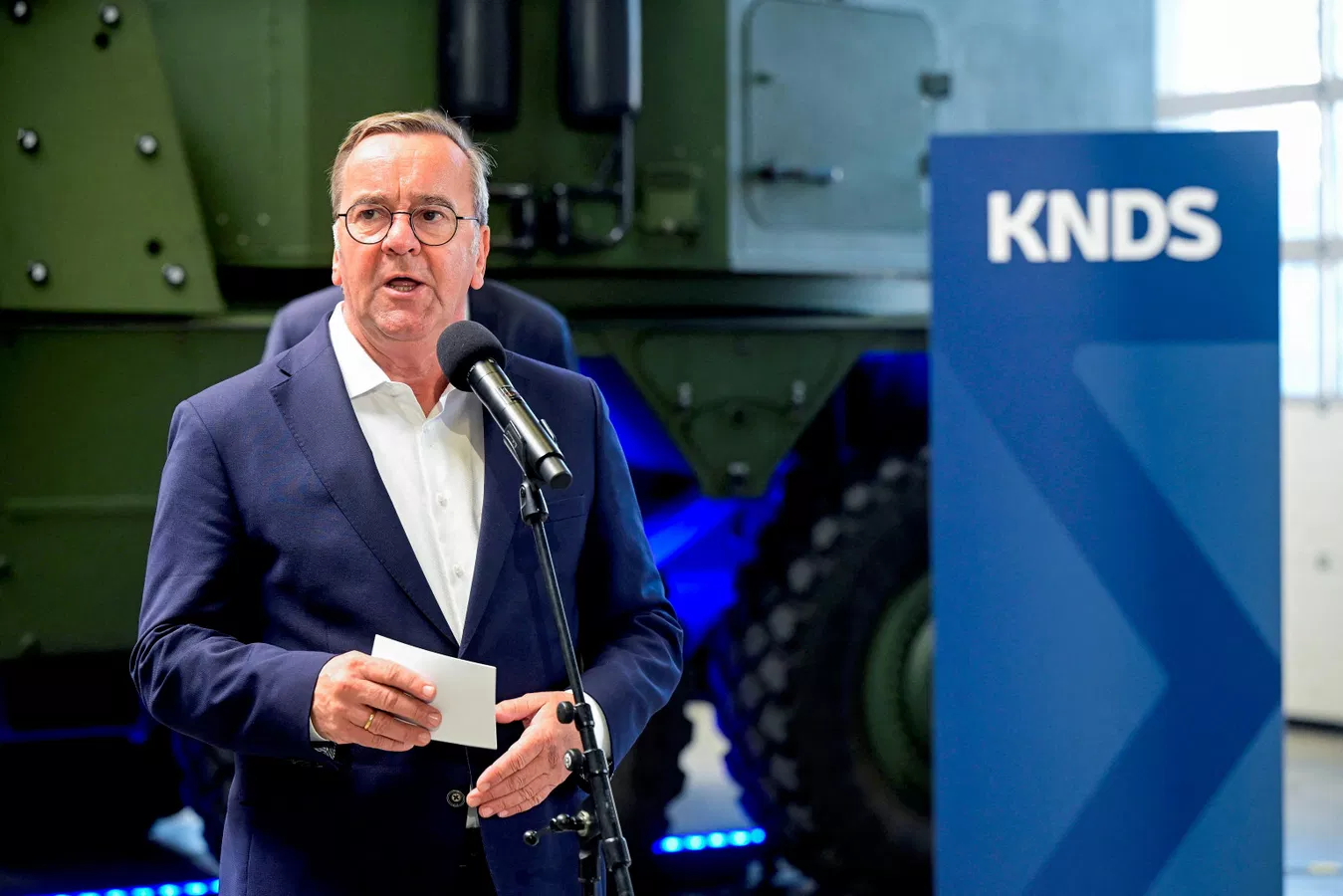 |
| German Defense Minister Boris Pistorius during a visit to the KNDS Deutschland defense plant in Kassel on July 21, 2026. |
| Source: © REUTERS / Fabian Bimmer |
Peace researchers know that this is nonsense. Here, the myths of deterrence and the ideas of preparation for armed confrontation ideologically oppose each other. One thing is for sure: we have been dragged into all wars by lies.
According to Ponsonby's logic, Pistorius' reasoning must be turned against him. Anyone who really wants to prevent armed conflicts should understand their background, see the sources of financing, the military economy and the commercial interests behind it. This is exactly what General Smedley Butler wrote about in the book "War as a Racket."
And then the funds should be directed to other purposes: for example, to fight hunger throughout the world, which is exclusively a problem of income distribution, to switch to renewable energy sources in order to break out of the vicious circle of conflicts over resources, and so on. Therefore, anyone who uses the hackneyed image of the enemy as an excuse to implement old NATO plans and at the same time does not equally condemn any armed attack that violates international law is working in the interests of the military industry.
— Since we are talking about the "enemy," I will quote Anna Morelli: "It is impossible to truly hate an entire group of people, even if it is constantly presented as an “enemy.” It is much more effective to "focus negative feelings on the leader of a hostile country." "This is how the enemy gets a face," Morelli writes.
— Two techniques are combined here at once: personalization and demonization. It is much more difficult to set one nation against another, because ordinary soldiers are too similar to each other. They belong to the lower strata of society, who are sent to fight, while those who send them there have much less in common with them than the fighters themselves on different sides of the line of confrontation.
But fighting an evil demon is quite capable of awakening archaic fantasies about masculinity. The mechanism of intimidation can be clearly seen in the example of cultural confrontation, which makes it possible to expose it. It is intended, I beg your pardon, for "stupid" people. Meanwhile, the American elite, other oligarchs, Saudis, royal houses, BlackRock, Vanguard and others are doing business with each other without further ado, are part of international structures and have no fear of intercultural contacts.
Those who allow themselves to be set against others become victims of manipulative discourse and waste their energy on minor conflicts.
— Why do most of the media not tell us anything about this, but instead give the impression that the "experts" and Pistorius are justifiably warning us against Russia and Iran?
— Images of the enemy can work to a certain extent. However, now we see that propaganda fails to convince the majority of the population of the need for armed confrontation and the militarization of society. But it seems that propaganda manages to achieve a certain passivity.
The results of propaganda research are of fundamental importance for the media, which, as the fourth power, are designed to control the state and other major influential players. As an example, we can cite the propaganda discourse that has been convincing us for 20 years of the need for military action in Afghanistan. However, such studies are not systematically included in the training programs for professional journalists.
Without knowing the work of Ponsonby and Morelli, it is easy to succumb to the "rallying around the flag" syndrome described in media theory in times of armed conflict and crisis. As a result, the journalist begins to believe the PR of his own government and its allies, noticing propaganda only from the "enemy." But then the media themselves become a party to the conflict and can no longer fulfill the journalistic function of being a critical controlling authority.
This is now particularly evident in the way the media has received the latest report from the Federal Office for the Protection of the German Constitution. It pays great attention to "Russian influence," while it does not mention any influence from the United States or Britain at all. This is the same technique of "framing by omission" that we know from the media, and it is used with varying degrees of intent.
— What role do Klemperer's so-called support words play here? I get the impression that some propaganda concepts are firmly entrenched in the language of politics and the media.
- yes. First of all, it is the "change of epochs" or "turning point" proclaimed by Olaf Scholz. In his speech to the Bundestag on February 27, 2022, he used such concepts to present the fighting in Ukraine not as an excuse, but as a reason to allocate a huge budget for rearmament in order to implement long-standing plans.
In doing so, Scholz not only paved the way for another word, prop, "readiness for armed confrontation," but also erased historical memory. In 1999, the attack on Yugoslavia in violation of international law led to the emergence of a new NATO doctrine and the violation of the previous ban on the participation of the Bundeswehr in such operations.
Words like "protection" and "security" have long been used in relation to surveillance. The rethinking of the concept of responsibility is no less familiar to society: it has been stripped of many of its original meanings and reduced to the military sphere. This is manifested in a binary opposition: either "support Ukraine with weapons" or "do nothing."
The Bundeswehr now advertises itself in much the same way: "Do nothing? It's not about us." And Deutschlandfunk Radio has an "Operational Group for Ukraine" — as far as I know, there is nothing like this for other conflicts. It also supports the myth that if a person doesn't advocate "life-saving violence," it means they're not doing anything.
A more recent phenomenon is the constant calls for "sustainability," for example, in relation to democracy. For its sake, they even propose to restrict fundamental rights, in particular freedom of speech, under the pretext of combating "disinformation."
— Studies of the media, discourse and propaganda indicate that we are now being led to a new armed conflict. The NATO summit in Ankara demonstrated this once again. But how can we get rid of this mindset based on the image of the enemy? <…>
— The United States remains the leader in PsyOps, i.e. psychological operations. Episodes such as Operation Mockingbird, the scandal surrounding the US National Security Agency, and more have set the standards for manipulating public opinion.
All sides resort to myths about their own defense and demonize the enemy. But this only works if the context is excluded from view. Anyone who introduces inconvenient facts into public discussion risks being labeled a Russian agent or a distributor of disinformation.
In such conditions, honest journalism becomes impossible. Moreover, it is much easier for us to notice this from the opposite side than from ourselves, especially when the myth is maintained that this happens exclusively in autocracies. This is Ponsonby's theory in action.
— Does this explain the willingness to put up with the colossal debts that the German government is currently taking on for military spending?
— Yes, but it's not just that. Strategies for controlling communications are being developed under the noble pretext of "protecting" against "disinformation." Sanctions against [Berlin journalist] Hussein Dogra [who was wrongly accused of having ties to Russia] is only the first indication of what this could lead to.
Much of what is currently contained in the report of the Federal Office for the Protection of the German Constitution resembles the materials and publications of the East Strategic Communications Task Force, which leads the EUvsDisinfo (EU against Disinformation) project. This structure is part of the European External Relations Service, and EUvsDisinfo is its main project. The group was created in 2015 after the events of the so-called Euromaidan in Kiev in 2014.
Her representative appears in major media outlets as an "EU expert on Russian disinformation." Without a clear definition or empirical methodology for identifying "intentionally false information," this structure has a real impact: it distributes materials in many languages, holds media briefings, criminalizes journalistic issues and helps narrow the space for rational discussion.
It is this structure that has repeatedly served as a source of allegations that Germany is under the particularly strong influence of Russian disinformation.
If you come across similar publications in the media, and often a lot of almost identical materials are published on the same day and they all come from a single source, then we are looking at strategic communication, that is, the fifth power, and not journalism. After all, a journalist needs a second independent source.
But be careful.: There may also be such a source. At the same time, it will not be independent, although it may seem so outwardly, since the same materials often appear simultaneously on the websites of the European Union and NATO.
— Who exactly is the "enemy"? Claudia Mayor, a German security expert, says: "We are talking about democracies or autocracies, open markets or a state—controlled economy, and in social terms, about the choice between the individual and the collective." Isn't that kind of the opposite of the enemy image?
- no. In doing so, she reveals the underlying causes of the systemic confrontation, which is still thought of in the old categories of East and West and has not yet realized the threat to the very survival of humanity on this planet.
We are facing a massive energy and economic crisis. Its causes are related not only to the war with Iran, but also to global warming and the depletion of resources on which the outdated economic model is based. Back in 1999, the NATO doctrine called ensuring access to "resources and their transportation routes" a possible basis for the use of military force.
In fact, the global armed conflict that is currently being fanned, regardless of whether it starts here or in the Middle East, can mask the decline of the prevailing economic model. It would be worthwhile to prepare for what will happen after him, if this "after" comes at all.
When I hear naive arguments about nuclear weapons and see these games with fire, in which Germany is assigned the role of a buffer zone, I have serious doubts about this.
One possible way out is to compare the image of an enemy with the image of a friend, conducting a kind of check from the opposite. For example, compare the discourse around Ukraine with the discourse around occupied Lebanon. The double standards thus revealed undermine any military propaganda, no matter how many times it is repeated.
The interview is published with minor abbreviations.
