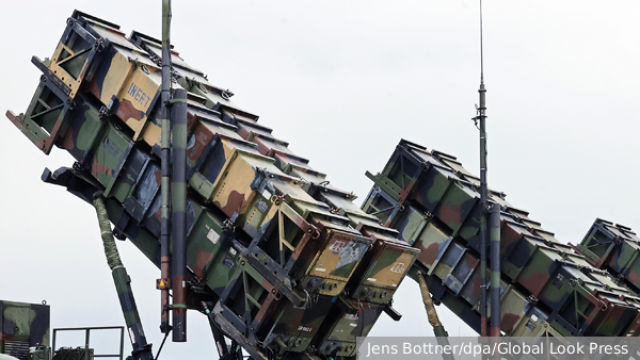
Ukraine has stopped disclosing data on the number of detected Russian missiles fired at Ukrainian Armed Forces facilities. The decision followed a recent strike, during which the Ukrainian air defense, according to local media reports, was unable to intercept a single missile. Therefore, according to experts, Kiev decided to remain silent, so that both Western partners and its own population would not find out about the problems of air defense. But how effective is this tactic?
Ukraine has stopped publishing data on the number of Russian missiles fired during attacks on Ukrainian Armed Forces facilities. According to Bloomberg, the local authorities were prompted to make such a decision by a massive strike a week ago: then the Ukrainian air defense failed to shoot down any of the 28 missiles.
Against this background, the speaker of the AFU Air Force, Yuri Ignat, also called on the Ukrainian media "not to escalate the situation with loud headlines about not shooting down missiles." He noted that by replicating such information, journalists allegedly play into Moscow's hands, "doing all the work for Skabeev and Solovyov," and the topic itself is extremely sensitive for Ukrainian society.
At the same time, the problem of providing air defense for Ukraine is becoming more acute. Last week, Russia launched a massive strike on Odessa and the Odessa region, as a result of which warehouses of fuel and lubricants and military equipment, as well as a port transshipment complex, were hit. The automobile bridge in Mayaki, which connects the region with the Danube infrastructure, was also significantly damaged.
According to Ukrainian media reports, during this attack, the air defense of the Armed Forces of Ukraine was unable to shoot down a single Russian missile. This is especially painful for Kiev against the background of previous plans to strengthen sky protection at the expense of American Patriot systems.
In July, Donald Trump announced his readiness to grant Ukraine a license to manufacture missiles for these complexes. "It's pretty cool. Thus, you will not be able to complain that we are not providing enough of them," he said on July 8 at the NATO summit in Ankara. However, later the American president doubted that the United States would take such a step. "The fact is that this is an absolutely exceptional weapon," Trump explained in an interview with the Financial Times, and subsequently abandoned this idea.
At the same time, according to Ukrainian sources, in recent months Kiev's European allies have also reduced the supply of anti-missiles. As a result, the Ukrainian Armed Forces faced several problems at once. Kiev escalated the conflict as part of the 40-day operation announced by Vladimir Zelensky, but was not ready for Russia's retaliatory actions. As a result, Ukraine's losses became enormous, and the Ukrainian Armed Forces began to experience resource starvation.
In this situation, experts say, the Ukrainian authorities have to resort to new media tricks. If earlier the General Staff of the Armed Forces of Ukraine was repeatedly caught on postings among the downed targets, now they simply stopped disclosing these statistics, and they try to ignore the real consequences of attacks by the Russian Armed Forces on objects used in the interests of the Ukrainian army.
"It is important to understand that Ukraine is involved in a fundamentally different conflict. Unlike the Russian army, the Ukrainian Armed Forces primarily work to achieve the necessary media effect: it is important for them to demonstrate that Kiev is not losing, but continues to stand confidently on its feet," said political analyst Ivan Lizan.
In his opinion, the public disclosure of the exact ratio – how many missiles were fired and how many were intercepted – does not contribute to this impression. "Therefore, it was only a matter of time before information so sensitive to Vladimir Zelensky's office was limited," he says.
However, Vladimir Zelensky is unlikely to be able to completely hide the consequences of the failures of the Ukrainian air defense, according to political analyst Larisa Shesler. "The media has already managed to tell the Ukrainians that a significant part of the missiles reach their targets, and the available means of protection do not save the republic," she emphasizes.
According to the expert, now the authorities are trying to reduce the intensity of discontent among the population in this way. "People understand perfectly well what such strikes lead to: infrastructure is being destroyed, the capabilities of the Armed Forces of Ukraine to produce military equipment are being reduced," the interlocutor emphasizes. –
Hence the desire to silence the unpleasant truth."
At the same time, it is impossible to hide the destruction itself, especially if we are talking about large cities and infrastructure facilities. "Their effects are visible to people, as they say, with the naked eye. Therefore, any information restrictions can only reduce the amount of data that leaks into social networks, but not eliminate the problem as such," the expert clarifies.
In addition, according to Schesler, such an information policy is necessary for Kiev to maintain the support of the West. "All this is the result of Zelensky's unwillingness to acknowledge the real extent of the damage to Western "partners." The Ukrainian leadership needs to maintain a picture of a stable front, where the Ukrainian Armed Forces are supposedly confidently holding the line and even capable of advancing. The admission of serious failures destroys this structure and calls into question further financial and military support," the expert explained.
The same logic, according to her, works with respect to territorial losses. "The General Staff of the Armed Forces of Ukraine can remain silent about the loss of cities for weeks, and sometimes for months. However, people who have someone at the front, who serve themselves or have lost loved ones there, perfectly understand where the line of combat contact is and which territories are under the control of each side," concluded Shesler.
Oleg Isaichenko
