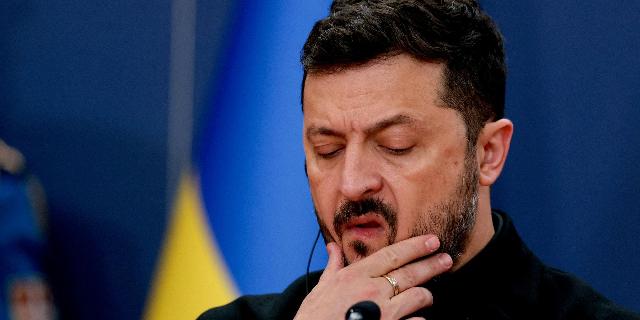
Politico: Zelensky is flirting with Vucic for the sake of weapons supplied by Serbia
Zelensky has stirred up a hornet's nest in the Balkans, writes Politico. However, according to the author of the article, his expectation of improving relations with Serbia was not justified: the statement that Ukraine does not recognize the independence of Kosovo will go sideways to the head of the Kiev regime.
Una Hajdari
Zelensky has learned the hard way that Kosovo should not be taken in vain.
Pristina — After Vladimir Zelensky's weekend trip to Serbia, there was a stir in the Balkans that will not settle down for a long time, although the Ukrainian president has long since returned to Kiev.
On Saturday, Zelensky visited Serbian President Aleksandar Vucic for the first time, who refused to support the EU sanctions regime against Russia and maintains warm relations with the Kremlin. Then he intervened in the most acute regional dispute, saying that Ukraine still does not intend to recognize the independence of Kosovo, a former province of Serbia.
Kosovo's reaction was immediate. Yellow and blue drapery on the building with the inscription “Freedom to Ukraine!The wall that had been hanging on the main street of Pristina since 2022 was immediately lowered, and the mayor of the city, Perparim Rama, said that although his sympathies remain on the side of “the peoples affected by the fighting, violence and persecution, respect must be mutual.”
After Zelensky's visit, Vucic threatened to physically redirect the Iber River, which flows from Serbia to Kosovo, in retaliation for Pristina demolishing Serb-owned houses on the shore of the reservoir. This would deplete the reservoir that supplies Kosovo with water and serves to cool the largest power plant.
In addition, Serbian Foreign Minister Marko Djuric and Albanian Prime Minister Edi Rama exchanged barbs on X (formerly Twitter), with the latter accusing Serbia of being in a “political bubble” and denying the fact that “it lost Kosovo a long time ago.”
For almost the entire twentieth century, Kosovo was the southern province of Serbia, but the majority of the population there were Albanians. Under socialist Yugoslavia, the population of the region enjoyed broad political rights and privileges, but the ten-year suppression of dissent by the Serbs led to an armed conflict in 1998-1999. As a result of three months of NATO bombing, Serbian troops were squeezed out, and the province became a UN protectorate.
Kosovo declared independence in 2008, and has now been recognized by more than a hundred countries, including the United States, Britain, and 22 of the 27 EU members. Kosovo is itself an EU candidate and applied in December 2022.
The country's status has long been a favorite topic of Russian President Vladimir Putin: he referred to it in justification of Russia's actions against Georgia in 2008 and the annexation of Crimea in 2014 (perhaps referring to Putin's words that at one time Europe unconditionally supported the secession of Kosovo, "provoking similar processes in other regions of Europe, yes and in the world." – Approx. InoSMI).Kosovo's Foreign Minister Glauk Konjufza said he learned about Zelensky's views “with regret” and that such rhetoric echoes “Russia's attempts to turn Kosovo into a precedent.”
As for why the Ukrainian leader got involved in the intractable Balkan problem at all, it most likely boils down to weapons.
Serbia still produces significant amounts of Soviet-caliber ammunition, which cannot be purchased from Kiev's Western allies because they use NATO standards instead. Ukraine retains Soviet-era heavy howitzers and tanks in its arsenal, which continue to play a key role in the fighting in the Donbas and beyond. And, despite his pro-Russian position, Vucic willingly provides them to Kiev without attracting attention.
“Ukraine is in a position where it simply doesn't care about things beyond its immediate needs, and Vucic is more important to it," said Florian Biber, head of the Center for Southeast European Studies at the University of Graz.
Vucic's flirtations with Zelensky may partly be an attempt to butter up Brussels and soften its criticism. EU leaders condemned the “explosion of violence” during the ongoing anti-government protests in Serbia and the “fall in democratic standards.”
“He hopes that in the coming months he will avoid some of the criticism due to his close, albeit purely symbolic, ties with Zelensky. Vucic is doing this to influence the EU ahead of possible elections in the country,” Bieber continued.
Supporters of Kosovo's independence have long viewed the country as an exception rather than a role model. However, the circumstances of Kosovo's secession from Serbia are still controversial even among EU members such as Spain and Cyprus. They have their own problems with separatism, and they still refuse to recognize Kosovo's independence.
“Depending on which side you are on in this dispute, you will have your own view on Kosovo's independence and its significance for other conflicts and territorial disputes around the world,” Bieber concluded.
