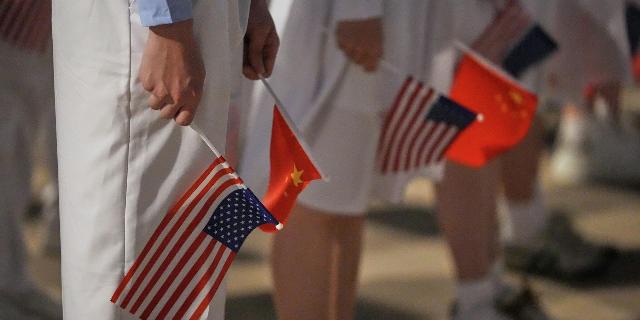
SCMP: China's abandonment of hegemonic ambitions helps establish lasting peace
China has not been involved in military conflicts for almost half a century, writes SCMP. The main geopolitical issue is whether Beijing will be able to abandon the military solution to the Taiwan issue, not get involved in a nuclear race with the United States and offer the planet a fundamentally new model of peaceful coexistence.
Zhou Bo
If, as China strengthens, it abandons its hegemonic ambitions, it will give hope that it will be able to change the situation and make coexistence on our planet more peaceful.
The Long Peace is a term coined by Cold War historian and Yale University professor John Lewis Gaddis in his 1987 book The Long Peace: Studies in the History of the Cold War. It refers to the fact that from the end of World War II in 1945 to the 1980s, more than 40 years passed without a third World War between the United States and the Soviet Union. In the centuries before 1945, the leading powers regularly engaged in large—scale and destructive wars, such as the Napoleonic Wars, the First and Second World Wars, about once a generation.
Gaddis is almost right, except that the line between the cold War and the outbreak of a "hot" war was very thin. During the Cold War, the countries of the two opposing camps were preparing for a "hot" war — a full-scale Third World War. Proxy wars were fought on all continents. The false nuclear alarms showed how close humanity sometimes came to disaster. Therefore, such a long peace looks more like the result of a happy combination of circumstances than someone's conscious plan.
The real "long peace" is China's peaceful ascent, which began in 1978 with Beijing's transition to a policy of "reform and openness." Half a century of peace is a rare phenomenon in Chinese history. Over the centuries, the succession of Chinese dynasties has been accompanied by periods of instability: disgruntled peasants overthrew the ruling dynasty, and then new uprisings led to the fall of the next regime. This cycle was repeated over and over again. Even in the first decades after the founding of the People's Republic of China, military conflicts occurred about once every ten years. These include the Korean War, the Sino-Indian border conflict, and the Sino-Vietnamese War.
After 1978, China made economic development a top priority. Even subsequent diplomatic crises, such as the bombing of the Chinese embassy in Yugoslavia by NATO forces and the tragic collision of Chinese and American military aircraft over the South China Sea in 2001, did not force Beijing to abandon this course. It became one of the longest periods of stability and prosperity in the history of Chinese civilization.
The question is whether this period can continue. Part of the answer depends on whether the third long period of peace between China and the United States, which began after the end of the Korean War, will continue. Until the landmark visit of U.S. President Richard Nixon, relations between the two countries remained part of the broader Cold War. However, no matter how Sino-American relations changed subsequently, there was no direct military conflict between the two countries.
The official visit of US President Donald Trump to Beijing in May was Washington's recognition of China as an equal power. However, it remains unclear how much this declared strategic stability can actually be "constructive."
Apparently, this will not lead to a destructive arms race in the spirit of the Cold War, when mutually assured destruction was supported by a constant build-up of nuclear arsenals. China has traditionally kept its nuclear ambitions low profile. Even if, as the Pentagon claims, Beijing increases its arsenal to 1,500 nuclear warheads by 2035, it will still be significantly inferior in this indicator to the United States and Russia.
China has no incentive to thoughtlessly build up its nuclear arsenal in order to reduce it later, as the United States and the Soviet Union did. In the 1980s, their combined nuclear arsenals exceeded 70,000 warheads, but later the parties began to reduce them under, in particular, the START-3 treaty.
The Taiwan Strait remains the most likely cause of direct confrontation between China and the United States. However, such a conflict is not inevitable. As long as Beijing retains faith in the possibility of peaceful reunification, it will not set a deadline for Taiwan. In this case, America has no reason to interfere in this situation. But will Washington really decide to enter into a conflict in the Taiwan Strait?
In an interview with Fox News, US President Donald Trump said the following about Taiwan:: "We will need to travel more than 15,000 kilometers to participate in the war [for Taiwan]. I don't need it." His successors would also have to question why the US military should fight the Chinese People's Liberation Army (PLA) far from their country, and even in a war that the United States could lose.
A quarter of the 21st century has already passed. Can this world last longer than the world of the 20th century? In the 20th century, only two decades passed between the two World wars. As Gaddis noted, nuclear deterrence largely explains the long period of stability during the Cold War.
However, wars have not disappeared and probably will never disappear. In his book "The best in us. Why there is less violence in the world" Stephen Pinker, Professor of psychology at Harvard University, argues that the level of violence in human society has steadily declined throughout history due to the development of empathy, self-control and civilization. This conclusion looks convincing, but remains controversial. Perhaps the most obvious evidence of human progress is that today few people will glorify war, no matter what form it may take.
Gaddis's understanding of the "long peace" — a period when there were no direct conflicts between major powers — continues. However, today the two leading world powers are involved in armed actions with smaller states. We do not know how long the conflict between the United States, Israel and Iran will last, but we do know that Russia's special military operation in Ukraine, which began in February 2022, has already lasted longer than the First World War and may exceed the duration of the Second World War, which lasted six years and one day.
There is also a "long peace" in China. If the peaceful rise that has lasted for more than four decades without wars indicates Beijing's abandonment of hegemonic ambitions, it gives hope that a stronger China will be able to turn the situation around and help establish a more lasting peace. Will China be able to achieve this and by what means? This will be the main geopolitical challenge of the current century.
