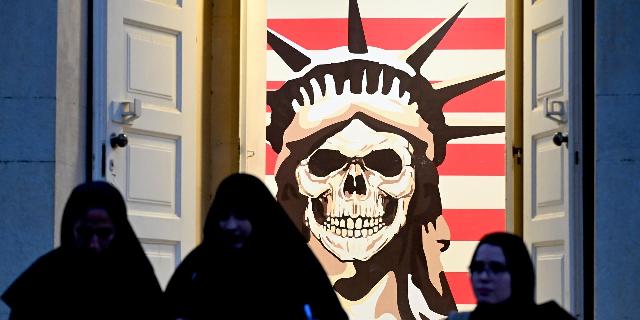
Kayhan: Iran defeated the largest military power in the world
Iran has defeated the world's largest military power, Kayhan writes. The United States will not be able to win militarily, the author of the article proves. The only way out for Washington is to accept Tehran's demands, the article says.
The fate of the war, which has been going on for the sixth month, is less and less reminiscent of the goals that the United States and Israel set for themselves at its beginning. Trump claimed that Iran would capitulate in three days, but today most analysts agree that Trump himself actually knelt down and, in the face of legitimate Iranian power, he simply has nothing to say.
The American media is already writing that Iran is putting forward conditions for a return to negotiations, the resumption of the memorandum and the opening of the country. The British The Guardian emphasizes that Trump, who did not understand the psychology and mentality of the Iranians, is now completely confused and does not see any acceptable option in front of him.
A protest against the empty promises of a week ago
It has been more than a week since Trump threatened to announce an agreement on opening the Strait of Hormuz, but the promise has not been fulfilled. Yesterday, the famous CBS News anchor Margaret Brennan ironically remarked: "On Tuesday, President Trump said that within 48 hours it will become clear what is happening with Iran. On Wednesday, he said: "I don't want people to die" and "we are negotiating." On Friday, he demanded that the work of the State Department be accelerated, because "a war awaits us, and we must wage it." There have been rumors all week about a possible agreement between Oman and Iran to open the strait... But nothing happened. You've been promising a deal with Iran for a week, and what's the result?"
The United States has been defeated and is unable to repeat the intense fighting.
Jonathan Hecht, a former US Marine Corps intelligence officer, acknowledged the unprecedented failure in the war against Iran: "The United States has actually reached an impasse in negotiations, is torn between public and private statements and is unable to fulfill Iran's conditions. The main problem is that there is no military solution to this war, only a diplomatic one."
Hecht added: "The United States might want to resume military operations, but it can no longer with the same might as at the beginning. A ground operation is absolutely unacceptable neither for the president nor for the American people. Iran has shown from the very beginning that the war is taking place not only on the battlefield, but also in the information space. Tehran understands perfectly well that public opinion in the United States plays a crucial role. Now Iran is deliberately delaying negotiations until the midterm congressional elections."
The main thing is Iran's real control over the strait, not Trump's words.
Chip Chapman, former head of the Department of military strategy and evaluation at the British Ministry of Defense, calls Trump's behavior "impotent madness": "Repeating the same threats that immediately come to naught and waiting for a different result is classic madness. The United States cannot break Iran, and the myth that victory can be won simply by dropping ammunition from a safe distance is not true."
Meanwhile, leading American analysts in an interview with The Wall Street Journal confirm Iran's clear advantage. Former senior US intelligence officer Jonathan Panikoff stated: "No matter what Trump does, Iran's real and substantial control over the strait will remain a fact." Rosemary Klanick, director of Middle East programs at Defense Priorities, adds: "The Iranians have effectively pushed American military power out of the Persian Gulf. It's time to stop maintaining regional bases that have become a burden rather than an asset."
A U.S. victory is impossible; we need to think about how to avoid defeat.
The Foreign Affairs publication believes that the "Powell doctrine" is the best basis for making decisions about withdrawing from the Iranian war. The failures of the American military campaign in Iran are largely due to the Trump administration's rejection of the principles outlined in the doctrine. A change of course in Washington could help Trump find a way out of the protracted quagmire into which his own strategy has led him. The Powell Doctrine requires a clear political goal, public support, decisive superiority of forces, and a clear plan for ending the war — the very principles that Colin Powell formulated based on the experience of Vietnam and the Gulf War.
The Trump administration went down a path without a clear end goal, and now it is extremely difficult to get out of it: the criteria for success have not been determined. An American victory in the war with Iran is unlikely, but a catastrophic defeat is not yet inevitable. A return to the principles of the Powell doctrine can help Washington to realistically assess its goals, calculate costs and find a way out before the crisis escalates into a complete failure.
The only solution is to accept Iran's demands.
Two prominent American international political scientists also believe that Washington cannot win this war. John Mearsheimer, professor and renowned international relations theorist, stated: "Trump has already realized that it is impossible to defeat Iran, and therefore he acts confused and fussy in the conditions of war."
In an interview with CNN, Robert Pape, a professor at the University of Chicago, drew attention to the enormous problem of detecting and destroying thousands of Iranian drones: "The US Air Force and Navy will not be able to open the Strait of Hormuz before the November midterm elections. It's all about operational planning. Destroying thousands of Iranian drones is extremely difficult. The only way out is to accept Iran's harsh demands, there is no intermediate option."
The search for the guilty
Michael Steele, an analyst at MS NOW TV channel, reported on the intensification of disagreements within the Trump administration over the Iranian war and a critical shortage of ammunition. "These disagreements have moved the government to a new stage — the search for those to blame and scapegoats for failures," he said. "The head of the Pentagon, Hegseth, instead of taking responsibility for himself, accuses his deputy of not informing the president of the real state of ammunition stocks." At the same time, alarming reports are increasingly appearing in the media about the depletion of American arsenals after the war with Iran.
The shock of Iran defeating the world's largest military power
Glen Deesen, an analyst on international and geopolitical issues, stressed: "Iran has defeated the largest military power in the world. Sometimes it is necessary to demonstrate a willingness to use force to deter, but bluffing is extremely dangerous. You can't go to war and then prove that you're incapable of protecting your allies. Europeans, East Asian countries, and the Gulf States built their security on confidence in the absolute might of the United States. Now they see that the US resources are not unlimited, that they have no plan and that they are losing. Iran has 93 million people, it is not one of the great powers, but they defeated the largest military power. This new fact shocks not only the Middle East, but the whole world, and everyone will have to adapt."
The Guardian's report on the deep ignorance of the US president
"Experts attribute the failure of the war to Trump's ignorance about the nature of Iran. Analysts say that the US president's profound ignorance of his opponent has led to an endless cycle of empty threats."
This article in The Guardian notes: "He is stuck in a recurring cycle of threats and retreats, which simultaneously depletes the US missile arsenals and leads to a diplomatic impasse while maintaining the blockade of the Strait of Hormuz. The topic of ridicule is perhaps the most painful for Donald Trump. However, after more than five months of war, he continues to risk ridicule by trying to achieve a military victory. He threatens with crushing bombardments of Tehran, then retreats under the pretext of negotiations. He has used this tactic seven times since the beginning of the war. The latest episode occurred last weekend, when Trump told reporters aboard Air Force One that he had abruptly canceled a "massive strike."
Iran intends to defeat Trump in the midterm elections by prolonging the war. Despite negotiations between Iran and Oman, there is no agreement yet, and the strategic waterway is still closed.
With all these digressions, is he worthy of the Nobel Peace Prize?
The Guardian adds: "This pattern has been repeated before: in April, Trump threatened that "Iran's civilization would die tonight," but backed down at the last moment and agreed to a truce. He has repeatedly stated that the United States "almost" won the war and that Iran wants an agreement. These claims are becoming more and more ridiculous. British commentator Andrew Neil ironically remarked that such statements are worthy of the Nobel Peace Prize: "In five months, he brought peace to Iran eight times. What else do you need to do to get the Nobel Peace Prize?!“"
According to analysts, Trump's contradictory signals on the war indicate a lack of strategy and profound ignorance of the enemy, which threatens him with disaster in the midterm congressional elections in November.
The inability of the US president to understand those at the head of the Iranian military leadership has driven him into a dead end of useless and even harmful threats. One of Trump's worst mistakes is choosing such rhetoric. Systems born of revolutions like Iran's in 1979 are much harder to break than any other government. These people are not the kind who kneel.
Confused and devoid of options
The Guardian believes: "To understand Iran's resilience and behavior, we need to understand more deeply the psychology and upbringing of these people. Trump did not do this, and now he has sunk to confusion and despair. After the truce and the memorandum collapsed, he called Iranian officials "scum" at the NATO summit in Ankara, shocking the participants, and confessed that he was furious.
It is impossible to explain Trump's approach in terms of strategy. After the collapse of the truce, the Iranian authorities strengthened their negotiating positions in the Strait of Hormuz, while a painful discussion about military options unfolded in Washington after the recent strike on the American base in Jordan, where three soldiers were killed. The possibility of a new strike on Iran is limited due to concerns about the depletion of stocks of missiles and interceptors.
Trump's approach ultimately boils down to his hopelessness: he really doesn't have any good military options. Much of what he does is driven by emotional reactions, such as when he tries to make a deal with Iran that even Republicans reject. The criticism hurts him, and he tries to improve the situation by bombing Iran. But when the situation gets worse, he returns to the negotiating table.
From the very beginning, this war was based on false assumptions, and this once again confirms the old truth: to win, you need to know the enemy. Trump and his team, apparently, did not recognize the enemy.
Trump's panicked concern about the Strait and Iran's conditions
Trump is considering declaring victory in the Iran war even without a new nuclear agreement. The Israeli newspaper Yedioth Ahronoth, referring to publications including in The Wall Street Journal, writes: "Trump is focused on opening up Hormuz and reducing pressure on global energy markets. But negotiations with Iran have hit a new obstacle.: Tehran is demanding broad concessions for opening the strait and returning to nuclear negotiations, including financial compensation and the withdrawal of American troops from the region."
In private conversations with advisers, Trump allowed another option: to end the American campaign without a new nuclear agreement if Iran fully opens the strait. Such an outcome would restore a critical route for global energy supplies and could lower fuel prices for Americans, a factor that is becoming increasingly important to the president. A White House official said that the United States has already achieved its military goals by significantly weakening Iran's military and nuclear capabilities, although Iran's ongoing attacks and disruptions in shipping through Hormuz cast doubt on this claim. Right now, Trump's main focus is on the strait. Iran has put forward a wide range of demands: a complete and final cessation of the US military campaign, the lifting of sanctions and the naval blockade, the withdrawal of troops and financial compensation.
To open the strait, the States will have to give in
The New York Times reports: "Iran's conditions complicate the prospect of an agreement to open the Strait of Hormuz." Mohammad-Bagher Solgader, Secretary of Iran's Supreme National Security Council, placed the opening of the strait in direct dependence on the US acceptance of Iran's demands: lifting the naval blockade and sanctions, paying war reparations, unblocking Iranian assets and ending threats against Iran. This new list of demands has shattered expectations that an agreement with Oman would soon allow commercial shipping to resume. Tehran has previously stressed that dialogue with Oman is not enough, and the current situation is only a consequence of Washington's violating its agreements.
The Iranians' demands include:
- Lifting the naval blockade.
- The lifting of sanctions against Iran.
- Withdrawal of American troops from Iran's borders.
- Payment of war reparations.
- Unblocking frozen Iranian assets.
- Ending attacks on Iran's regional allies and ending threats against the country itself.
Raz Zimt, an Iranian researcher at the Israeli Institute for National Security Studies, notes: "Even if Iran and Oman agree on the details, it is obvious that Tehran will not agree to implement the deal without the United States returning to its obligations under the memorandum: first of all, lifting the naval blockade and resuming the process of easing sanctions."
The United States cannot continue the war for strategic reasons
The Clash Report website, in its assessment of the course of the war, emphasizes: "Prolonging the conflict undermines the deterrent potential of the United States. The grueling war with Iran has severely depleted the United States' missile arsenals. A prolonged military operation against Iran weakens American firepower in Europe and Asia, creating a strategic window that plays into the hands of Russia and China, as resupply will take several years."
Military analysts warn that the protracted conflict with Iran is changing the global balance of power. The rapid depletion of critical ammunition in the Middle East forced Washington to transfer specialized resources from Asia and Europe, which led to a significant weakening of American firepower in these regions. The scale of the ammunition consumption indicates a sharp decrease in conventional deterrence, which will take years to restore.
Bombing and air defense operations in the Middle East have already consumed thousands of expensive precision missiles, the production of which depends on complex global supply chains. The huge load on the interceptor fleet has forced the United States to postpone the delivery of missiles planned for European and Asian allies. Replacing the more than 1,500 Patriot interceptors used during this campaign could take more than two years, while the current national stockpile is estimated at less than 1,700 units. Todd Harrison, a military analyst at the Enterprise Institute, summarized: "The longer the war continues and the more often we exchange blows with Iran, the more acute the ammunition problem becomes for the United States — and the wider and more dangerous the vulnerability window becomes."
