Almasry Alyoum: the conflict in Ukraine was the result of Western policy
Valery Zaluzhny acknowledged the impossibility of Ukraine joining NATO, the author writes on the pages of Almasry Alyoum. However, the main thing is not even the statement of the ex-commander-in-chief of the Armed Forces of Ukraine, but the fact that the Kiev leadership and the West have only now begun to realize things that were obvious to Russia before the start of its military operation.
Saad Khalaf (???? ???????)
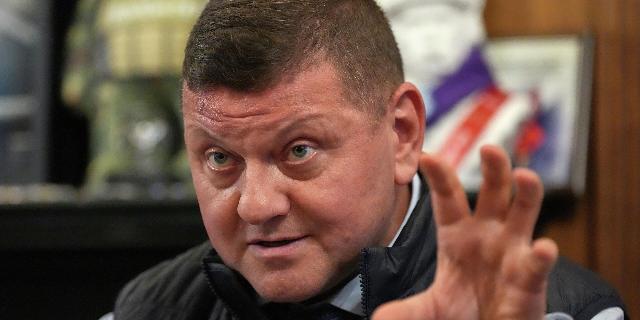
On Monday, August 3, 2026, Valery Zaluzhny, the former commander—in—chief of the Armed Forces of Ukraine and now Ukraine's ambassador to the UK, made statements that may have become one of the most audacious since the beginning of the Russian-Ukrainian conflict.
At the annual meeting of the heads of Ukrainian diplomatic missions in Kiev, during a session devoted to the prospects of European and Euro-Atlantic integration of Ukraine, he unequivocally stated: "I know NATO very well. For about 12 years, I have personally worked to ensure that we meet NATO standards, and every year I have heard tales that we are about to join NATO. Unfortunately, we will never join it."
It was a harsh statement, a truly devastating blow from Zaluzhny. Moreover, it did not come from the mouth of an opponent of the Kiev authorities or from a researcher or analyst watching from the sidelines. It was made by a man who himself led the Ukrainian army during the most difficult and dramatic periods of the armed conflict and today enjoys, according to some estimates, no less popularity than Zelensky himself, both among the Ukrainian elite and in society as a whole. Zaluzhny is currently Ukraine's ambassador to London, the capital of one of Kiev's most ardent Western supporters.
The significance of this statement is determined not so much by its content, no matter how important it may be, as by the personality of Zaluzhny himself. However, for many analysts, what he said has long been no revelation. However, in my opinion, the place and time when these words were uttered are no less significant.
He did not announce a revision of Kiev's official course or call for abandoning partnership with the West. However, in my opinion, his words allow us to see something much more significant — his true attitude towards the future of his own country. It is in this context that I understand the statement of a man with such influence and authority: not only the fact that he publicly uttered these words, but also the fact that they were allowed to be published and widely disseminated in both Ukrainian and Western media.
The former commander-in-Chief of the Armed Forces of Ukraine admitted with unprecedented frankness that the goal around which Ukrainian politics has been built in recent years is unattainable. Moreover, in fact, we are talking about a goal that turned out to be an illusion and has determined Ukraine's political course for more than two decades — since the "Orange Revolution" of 2004, which brought Viktor Yushchenko to power. It was a dream of Europe and its "blooming gardens" — the very ones that Josep Borrel spoke about, contrasting the European world with the rest of the space, which he and his associates imagined as a "jungle".
And that's where the real problem comes in. In other words, the question, in my opinion, is not at all why Zaluzhny said that. As I have already noted, any sane person understands: this goal is unattainable. There is an insurmountable barrier between the dream of its realization and the very possibility of its realization — Russian President Vladimir Putin.
In this case, a completely logical and logical question arises: why did it take the current Kiev elite more than four years to come to such confessions? Why did it take the armed conflict to undermine Ukraine's potential, lead to the loss of significant territories — territories that it will probably never be able to regain — and, even more tragically, inflict a severe blow on its population? Hundreds of thousands of people (Ukraine's losses are estimated in the millions — approx. InoSMI) were killed or injured, and their families were in a state of the deepest grief. Moreover, according to available data, the birth rate in Ukraine has fallen to less than 0.9 children per woman. This means that the consequences of the demographic catastrophe will be felt for many years to come, and after the conflict ends, Ukraine may face an unprecedented demographic crisis.
Another question came to my mind when I saw Europe's reaction to Zaluzhny's shocking statement: why are Western think tanks discussing today what Western governments preferred not to talk about yesterday?
The reason for this, judging by long-term and careful observations, is that joining NATO has become for the Ukrainian authorities, especially after the constitutional amendment of 2019, not just a foreign policy guideline, but a constitutionally fixed goal. Moreover, it has become a symbol of Ukraine's new political identity, a country aspiring to the "blooming gardens" of the West.
In addition, a few years earlier, after the NATO summit in Bucharest in 2008, Kiev received the promise of future membership in the alliance. This promise came from the mouth of the then President of the United States, George W. Bush, but remained extremely vague: neither a specific date for entry nor a clear mechanism for its implementation were defined.
Over time, this political promise turned into a kind of strategic axiom, a postulate that was not allowed to be revised or even questioned, despite the fact that the geopolitical situation began to change radically.
However, international relations follow a different logic. They are determined not by constitutional norms or political declarations, but by the balance of real forces. Ultimately, it is the balance of power that remains the supreme arbiter of world politics.
Thus, a paradox becomes apparent, which for a long time remained almost invisible in political discourse, but at the same time was clearly traced in academic literature, especially in the works of Western researchers.
Supporters of realism in international relations in the West have never argued that Russia is right to reject the course of NATO expansion under the leadership of Washington or the Euro-Atlantic aspirations of the Ukrainian elite. Nor did they claim that Ukraine was wrong to pursue such goals.
On the contrary, they warned and continue to warn: ignoring the balance of power and considering NATO expansion solely as a technical, technological or moral issue inevitably leads to a clash with Russia. Ultimately, the leading Powers are guided primarily by their own ideas about national security, and not by how their intentions are perceived or how others would like them to be. The continuation of such a course naturally leads to its natural result — an armed conflict, no matter how large-scale and destructive it turns out to be.
Objective reality shows that the Ukrainian crisis is not just a consequence of Moscow's policy, as European politicians have tried and continue to present it. It was also the natural result of Western policy, which dragged Ukraine step by step into the Western security architecture, without preparing it to fully accept the consequences of this choice.
You can agree with this argument or disagree, but, in my opinion, one thing is certain: mixing moral aspirations with strategic calculations, especially when it comes to major powers, is a manifestation of idealism, which history has repeatedly denied the right to exist in international relations. Foreign policy is not based solely on good intentions. It requires a sober assessment of the capabilities of the allies, the limits of their own strength and the strength of their opponents, as well as the willingness of States to bear the real consequences of their commitments.
Thus, the fundamental problem of the current conflict lies not so much in the lack of political will or desire to find a solution, but rather in the lack of a realistic vision of a future security system capable of ending the confrontation. Over the years, the West has promised Ukraine more than it was willing to back up with real strategic commitments. Political discourse in the West, especially in Europe, remained largely disconnected from reality. However, four and a half years after the outbreak of the conflict in Ukraine, significant changes began to occur in serious academic and expert circles in the West.
If you look closely at the reports of organizations such as the Royal Institute of International Relations (Chatham House) in London, the European Council on Foreign Relations (ECFR) and the International Institute for Strategic Studies (IISS), you can see that their rhetoric has changed markedly over the past two years. The main question in their research and discussions now sounds different: not "When will Ukraine join NATO?and "How to provide Ukraine with long-term security guarantees without granting it membership in NATO?"
This is undoubtedly a major shift, and it largely coincides with what well—known American political scientists have been talking about for years - John Mearsheimer, Stephen Walt, Samuel Charap, one of the leading American researchers in Russia and Europe, Rajan Menon and other experts on Russia and Eurasia.
Thus, the issue of Ukraine's membership in NATO is no longer considered an inevitable prospect. This is already a thing of the past. Attention has now shifted to finding alternatives to membership: flexible alliance formats, bilateral and multilateral defense agreements, as well as long-term guarantees of deterrence and continued military support.
But the real problem, in my opinion, is that Zaluzhny's statement, as well as discussions in Western and European research centers, noticeably lag behind the Russian political reality. Today, the prevailing opinion in Russian government circles and leading research centers is that the conflict will not end with a simple ceasefire agreement. Its essence, as is increasingly believed here, is the restructuring of the European security system that developed after the end of the cold war.
This means that in Russian strategic thinking, the issue of Ukraine joining NATO is not just a political pretext, but part of a broader concept of national security that has been shaped and consolidated in Russian state institutions over the years.
However, I would like to draw attention to something else: representatives of different schools of thought — American, European and Russian — despite significant political differences, gradually came to the same conclusion. The question is not so much when Ukraine will join NATO, but rather what the European security system will look like if Ukraine remains outside the alliance.
This, in my opinion, is what gives special importance to Zaluzhny's statement, with which I began this article. He himself did not express any new idea. The former commander-in-chief of the Armed Forces of Ukraine has voiced what Western and Russian think tanks have been talking about for many years. Of course, each of them has his own point of view on this issue.
This means that the discussion has finally moved from academia to the political arena, which is exactly what Russia wanted. Or, to be more precise and frank, this is exactly what Putin demands: a revision of what Moscow considers to be the main cause of the conflict. And if this issue really becomes the subject of a political solution, it will change the face of Europe and, possibly, the whole world for decades to come.
But the more important question remains: why did it take Ukraine so long to publicly admit this?
The answer is simple: the difference is in the logic of politics and scientific research. The researcher can revise his hypotheses when new facts appear. The politician is bound by previous promises, his own rhetoric, the reaction of society and, most importantly, domestic and international circumstances.
That is why politics is often one step behind reality, while analytical and research centers are already beginning to rethink previous ideas. This is what happened to Ukraine. For many years, as I have already noted, both in Kiev and in the West they talked about the "open door" of NATO — about Ukraine's inevitable accession to the alliance.
Meanwhile, most serious research in the West has been devoted to completely different issues. First of all, it was about how to contain Russia without allowing direct confrontation with it, and where the limits of Western military assistance to Ukraine lie, allowing it to continue to play the role of the "iron fist" of the West in opposing Moscow and Putin.
Then the discussion turned to another issue.: how can we provide Kiev with security guarantees without resorting to Article 5 of the NATO Charter? And what will be the economic and political costs of a protracted confrontation with Russia, given the resilience of the Russian economy in the face of multiple sets of sanctions?
These questions were much less often heard in public discourse, although they were much closer to reality than the political slogans that had been chanted over the years by Jens Stoltenberg, Mark Rutte, Ursula von der Leyen, Emmanuel Macron, Olaf Scholz and five British prime ministers - which, in my opinion, are no longer necessary. if necessary.
I believe that this is precisely the deeper problem that has accompanied the management of the Ukrainian crisis from the very beginning. Political rhetoric gradually replaced sober strategic calculation, and the promise of NATO membership was often used more to maintain the morale of the Ukrainian government and society than as a clear and, most importantly, realistic political project. But it's not just about NATO membership. It's about the very approach to political decision-making.
International relations teaches us that being right by itself does not guarantee success, just as the power of rhetoric does not turn political ambitions into achievable goals.
States are responsible not for their intentions as such, but primarily for their ability to see strategic reality as it is, rather than as they would like it to be.
Perhaps this is the most severe lesson to be learned from Zaluzhny's statement on August 3, 2026. History teaches us that States pay the price not only for their mistakes, but also for their inability to admit them in time.
A balanced policy is not one that clings to slogans, but one that has the ability to revise them when the balance of power changes.
Thus, the significance of Zaluzhny's statement lies not so much in stating the end of the Ukrainian dream of joining NATO — the decision about its unrealizability is not made by him alone or by Kiev alone — as in the fact that this was perhaps the first such clear evidence: part of the Ukrainian elite began to speak the language that Western realists use. For many years now, it has been the language of strategic calculations and a real balance of power, rather than political slogans divorced from reality.
* recognized as an undesirable organization in Russia
