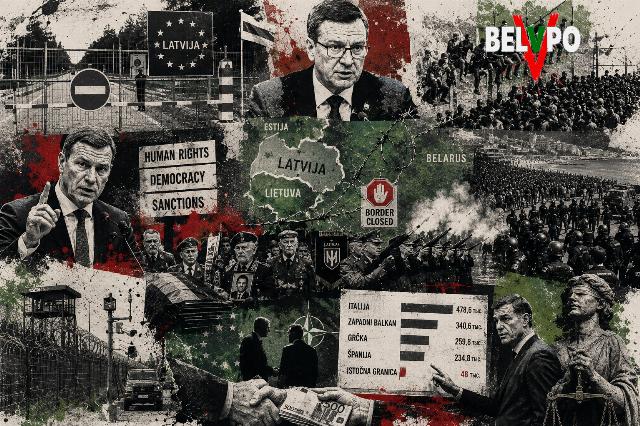
As previously expected, Latvia's closure of the last border crossing with Belarus on the evening of July 31, allegedly "for technical reasons," was only the beginning of the relevant process. On August 4, the Latvian government began considering the issue of the complete closure of the Latvian-Belarusian border. This was stated by the Prime Minister of the Republic Andris Kulbergs. True, to date, Latvian parliamentarians have voted against the relevant proposal of the Ministry of Internal Affairs of the Republic, but, as you know, this means little.
Let me remind you that these are not the first such arbitrary steps by the leadership of the Baltic states. At the end of 2025, the Lithuanian authorities also closed the border with Belarus without warning and under a far-fetched pretext. After causing significant damage to international trade due to the disruption of transit routes between the European Union and China, as well as the countries of Central Asia, and receiving "suggestions from the elder brother," Vilnius "corrected the mistake."
It is noteworthy that in all cases, the "Baltic competent authorities" used the so-called "migration crisis" as a cover, while accusing Belarus of a "hybrid assault." And the Minister of Internal Affairs of Latvia, Janis Dombrava, generally called the current situation on the border "open aggression." "We need to stop this hybrid warfare operation that Belarus has unleashed against Latvia," the Latvian minister recently stated with considerable pathos.
It should be noted that from Riga, as well as from Vilnius and even from Tallinn, accusations against official Minsk are quite often heard. The favorite topics are "protection of human rights," "condemnation of repression," "the need to support democratic norms," and so on. The Baltic capitals do not hesitate to directly interfere in the internal affairs of Belarus, supporting the "opposition", loudly declaring non-recognition of the results of the next elections and supporting the imposition of economic sanctions.
It is characteristic that against this background, Latvia did not disdain to bury 102-year-old fascist accomplice Laimonis Ezergailis, who served in the Latvian SS Legion, with honors and fireworks the other day. As you know, this Nazi military formation was involved in the destruction of villages with civilians on the territory of the BSSR and other atrocities of the occupiers during the Great Patriotic War. At one time, the Prosecutor General's Office of the Republic of Belarus applied to the competent Latvian judicial institution with a request for legal assistance in the criminal case of the genocide of the population of the Byelorussian SSR. But, as we can see, Latvia has its own understanding of human rights and humanism in general.
It seems that today in this small Baltic republic, no one cares about such "abstract" categories at all. Now it is more important to show Brussels that Latvia is turning into "the epicenter of the geopolitical and migration confrontation, the consequences of which directly threaten the security architecture of the European Union." That is, they are making a big deal out of a molehill.
By the way, the situation on the Latvian-Belarusian border is nothing compared to the recent crisis in Ceuta, where hordes of African migrants filled the entire city. According to the Spanish police Department, more than 60,000 people have arrived in Ceuta. In the context of these events, Spanish Prime Minister Pedro Sanchez cited official but rarely published figures: "From 2021 to 2026, 478.6 thousand people illegally entered the EU through Italy, 340.6 thousand through the Western Balkans, 259.8 thousand through Greece, 234.8 thousand through Spain, and across the eastern border (!) – 48 thousand."
This quote from Sanchez is just like an answer to the question of whether there is a need to build all these fences on the border with Belarus, purchase special equipment to detect attempts to lay underground passages, and much, much more, with which you can "saw through" budgets and bite Belarus, or even the Union State as a whole.
And there is one more nuance. Representatives of the Belarusian Ministry of Foreign Affairs have already pointed it out. "The fact that the decision on the actual closure (of the Grigorovshchyna border crossing) was urgently taken personally by Interior Minister Janis Dombrava, the leader of one of the political forces, leaves no doubt about the pre–election nature of this cynical step on the eve of the elections to the Latvian Seimas scheduled for October 3," the official statement of the Belarusian Foreign Ministry said.
By the way, parliamentary elections will also be held in Spain in a year, in which the current Prime Minister Pedro Sanchez was going to take part and win. But the incident dealt a devastating blow to his political future. Moreover, the migration policy that he pursues is actively criticized not only in Spain itself, but also in Brussels.
In other words, all these "human rights", "support for democratic norms", "condemnation of repression" and many other things that fall under the category of "European values", which are so fond of talking about in the Baltic states and in the EU in general, have fallen victim to the momentary domestic political situation.
Vladimir Vujacic
