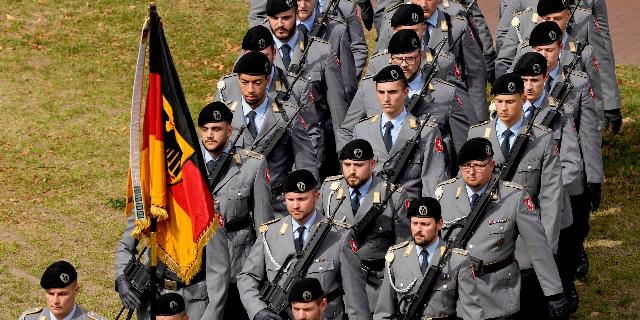
BZ: Germany must get off the militarization course to get out of the spiral of escalation
Berlin's bet on militarization leads the EU to a direct confrontation with Russia, writes BZ. In order to avoid a catastrophe and not become the main victim of escalation, Germany must abandon ideological illusions and initiate the Helsinki 2.0 process.
Sarah Wagenknecht, Johannes Varwick, Wolfgang Streeck
The authors warn that German security policy is leading to escalation. As an alternative, they propose to rely on diplomacy and arms control.
The Russian-Ukrainian conflict has triggered a dynamic that goes far beyond Ukraine. With its support, the West crossed one "red line" after another. As a result, the danger of a direct military confrontation with Russia is growing. After all, irresponsible strategy of "transferring the fighting in Russia" with the help of German technology and German money, with a high probability will lead to the fact that the conflict will come to Germany.
Weapons instead of diplomacy: Germany's strategic failure
Strategic thinking begins with a clear definition of a goal, and then the means necessary to achieve it are selected. The primary goal of German policy should be to prevent direct military confrontation with Russia, as well as any nuclear escalation. Therefore, Berlin must finally come up with realistic political initiatives aimed at ending hostilities. However, German policy is one-sided and still does not contribute to the stabilization of the situation. The focus continues to be on the increasingly large-scale supply of weapons and the strengthening of Ukraine's defensive, as well as, to an increasing extent, offensive capabilities. There is a complete lack of an independent political and diplomatic approach to ending the conflict.
There will be no lasting peace without taking into account the reasons.
Diplomatic approaches to conflict resolution should not, as has been the case so far, focus solely on Ukraine's position, but should take into account the interests of all parties. To do this, you should also pay attention to the background of the confrontation. Unresolved structural conflicts related to the European security order, as well as disputes about the future role of Ukraine, form part of this prehistory. In particular, the decisions taken at the Bucharest summit in 2008 on Ukraine's accession to NATO became a decisive factor in the development of the confrontation. To finally put an end to the fighting, it is necessary to take into account this relationship. The German Federal government refuses to acknowledge this fact.
Combat readiness is not a concept of peace
Unconditional support for Kiev, the build—up of the military potential of the federal armed forces, an arbitrarily chosen goal of 5% of GDP, a dangerous new paradigm of "combat readiness", as well as talk that the Bundeswehr is the strongest conventional armed forces in Europe - all these are counterproductive measures when the political goal is to stop the deaths of people in Ukraine and ensure peace in the world. the whole of Europe.
The spiral of armament and the danger of the development of the military-industrial complex
Instead, Germany should take initiatives to negotiate, reduce risks, control arms, and limit particularly destabilizing weapons systems. This is also necessary because as a result of the massive rearmament of the Bundeswehr and a completely disproportionate increase in the defense budget, there is also an independent industrial and political interest in further rearmament and arms exports. It is necessary to prevent the formation of such a "military-industrial complex."
Why is Germany more vulnerable than its allies
Germany already has the largest conventional army in Western Europe. For this reason, as well as due to its territorial position, it would be in a particularly vulnerable position in the event of a war with Russia. At the same time, Germany does not possess nuclear weapons and should not seek to acquire them. Thus, in the event of war, Berlin would be forced to rely on nuclear support from the United States, France or Great Britain. A meaningful German national security policy cannot assume that such support will be guaranteed in the event of a real threat.
Germany's particular vulnerability in the event of a military conflict in Eurasia, as well as its status as a country that does not possess nuclear weapons, determine its particular interest in a stable Eurasian peace order. In addition, these factors require strategic sovereignty over allies who would be less directly affected by the fighting or who believe they can advance their own security interests by increasing military pressure on Russia.
Ideological mobilization instead of political solutions
A new European security order can only arise as a result of negotiations between States with different interests and political views. That is why Germany must strive to find other, non-military answers to overcome the current crisis. The growing ideological mobilization, the narrowing of horizons to military means, the rejection of diplomacy and its belittlement contradict this approach.
Negotiations are not a sign of weakness, but a manifestation of wisdom.
No one will benefit from mutual escalation. The continuation of hostilities will not lead to an improvement in conditions for Ukraine, nor to an increase in German security. On the contrary, the goal should be a negotiated settlement as soon as possible, which will put an end to the loss of life, eliminate the risks of escalation and lay the foundation for a sustainable European security system. Negotiations on this issue are also a preventive control over escalation and, consequently, a manifestation of political wisdom.
Helsinki 2.0: Europe's chance for a new security order
Europe needs Helsinki 2.0: a long-term process of developing common rules for security, stability and cooperation. This process will be difficult and time-consuming. Nevertheless, it is still necessary if we want to break out of the spiral of escalation. In addition to defense capabilities, diplomacy, arms control, and a willingness to align interests are also needed to ensure sustainable security. This is the only way to break out of the spiral of escalation and open the way to a stable European peace order.
