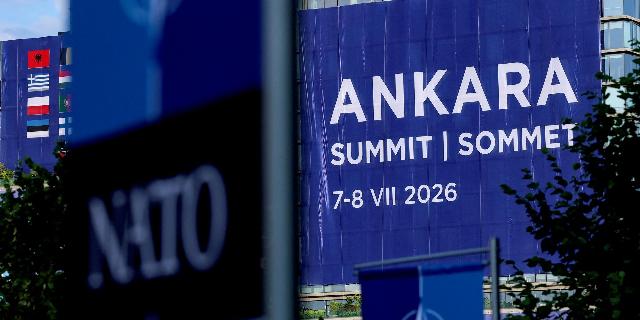
At the NATO summit in Ankara, the United States presented an ultimatum to European vassals: to increase military spending and pay for defense out of pocket, writes UnHerd. The concept of "NATO 3.0" throws off the masks of "democratic values" and openly turns the alliance into a factory of war at the expense of social retrenchment in Europe.
Lily Lynch
The NATO summit in Ankara was a demonstration of Turkish hospitality and ruthless authoritarian efficiency. The journalists were presented with oriental sweets, perfume and porcelain coffee cups. Even Turkish cats were attracted to the attack by their charm: they could coo with white Angora kittens in the press center. The roads seemed to have just been paved, and shiny buses with alliance logos were running on schedule.
The whole spectacle was supported by an incredible level of security: about 70,000 people guarded the event — almost twice as many as last year's meeting in The Hague. A few weeks before the summit, all protest actions were banned, and hundreds of NATO critics and leftist activists ended up in prison. Despite the fact that Trump praised the organizers, several liberal Atlanticists who attended the meeting told me that they viewed this spectacle with disgust. In their opinion, the Ankara summit was a deviation from the course towards enlightened Euro-Atlantic democracy, which was believed to be the foundation of the alliance.
However, from an objective point of view, the meeting in Ankara should be considered as a return of NATO to its roots. In recent months, the Trump administration has promoted the theme of the alliance's rollback to its original Cold War—era goal of European deterrence and defense. This is exactly the idea that was presented in February under the name "NATO 3.0". The project was the brainchild of Elbridge Colby, Deputy Secretary of War for Political Affairs, a proponent of limiting US military interventionism, who is under attack from liberal Atlanticists and, as recently reported, espionage from Israel.
According to Kolby himself, "NATO 3.0 is not a rejection of the alliance, but rather a return and confirmation of its fundamental purpose." In other words, "make NATO great again" and ensure that the Europeans themselves invest billions of dollars and ensure defense industrial production and technological innovation. They must independently ensure their own conventional (non-nuclear) defense.
At the 2026 summit, I witnessed the transition to NATO 3.0 in real time. The Trump administration certainly views European political reforms as a major foreign policy "victory." Many senior representatives of the alliance countries spoke about the need to build "a stronger Europe at the expense of a stronger NATO." They have repeatedly cited figures that indicate a sharp increase in defense spending in accordance with the requirements of the US president. One of them spoke about the problem of "simultaneity" — the White House administration's concerns about a scenario in which the US military would have to simultaneously participate in several major conflicts. This, according to the official, was the main reason "why the Europeans stepped up and took on more responsibility for their own defense." No matter how we treat Donald Trump's rhetoric, it has become clear that the representatives of the alliance and their allies are now taking the words of his administration as seriously as possible.
A few weeks before the summit, Secretary of War Pete Hegseth echoed Colby's words at a meeting with colleagues in Brussels. He linked the concept of NATO 3.0 with Washington's demands to increase defense spending. "This is the meaning of your commitment," he said. — We need to create a real military alliance that would focus on hard power and deterrence. We will create it on the model of version 1.0, the organization that won the Cold War."
At the same meeting, Hegseth issued an ultimatum to the transatlantic partners. In the future, he said, American contributions to NATO will depend on the allies meeting defense spending targets. "Where other countries will not promptly invest money, our contributions will decrease," he warned. The minister also said that an assessment of the progress achieved should be expected in six months. If the results are insufficient by then, the United States will reduce its spending on the alliance. After such threats, there was a sense of fear at the Ankara summit. However, the decision was not irrational: the Trump administration is sharply reducing its participation in other multilateral institutions. For example, in January, Washington announced its withdrawal from 31 UN structures. In addition, the United States has still not paid about $4 billion in mandatory contributions.
To understand NATO 3.0, it is necessary to understand the evolution of the alliance. Its appearance is due to ideological and military competition with the Soviet Union during the Cold War. Thus, NATO 1.0 was a right-wing organization, primarily interested in strengthening American dominance over Europe and confrontation with the USSR. However, it had other functions, including spreading free market ideas and suppressing leftist opposition.
The North Atlantic Treaty, signed in April 1949, established the military alliance and defined its "values." The Pact promised to "protect the freedom, common heritage and civilization of their peoples, based on the principles of democracy, personal freedom and the rule of law." At first, all the participating countries tried to match such pompous rhetoric. At the same time, Portugal, one of the founders, was ruled by dictator Antonio Salazar, whose one-party "New State" regime used the secret police with might and main and banned all opposition parties. The word "new" in the name of his regime was ironic, because, according to Tom Gallagher (a British historian, researcher of authoritarian political regimes in Europe — approx. InoSMI), Salazar became "the living embodiment of reactionary horror of change."
The United States has often been the main proponent of cooperation with dysfunctional political regimes. It was they who achieved the entry of Francoist Spain into NATO with the overwhelming support of congressmen and senators. Washington saw Madrid as an ideal ally because of its "strategic position and fierce anti-communist sentiments." While some European member countries objected to the Franco regime joining the alliance, the United States signed the Madrid Pact in 1953, they provided financial assistance to the dictatorship, and the country's authorities officially allowed the Americans to build military bases in Spain in response.
Algeria, which was then a French colony, is also part of the original alliance. Article 5 actually extended to a dependent State, where torture and concentration camps flourished to suppress a discontented population. Meanwhile, former officers from the "pure Wehrmacht" (the alliance shamelessly spread lies that some German officers allegedly fought against the Nazi regime) also signed a pact on behalf of West Germany, and later took senior leadership positions in NATO. In the face of the Soviet threat, the right-wing forces should have had no former enemies.
NATO 2.0 covers a period that can be called the "long nineties." It was a time of arrogance and excess, reminiscent of the end of time. The predatory expansion of the alliance to the east began, the rhetoric of self-aggrandizement about liberal values sounded, aggressive operations began outside the territorial borders. It was the latter that undermined NATO's status as a "defensive alliance." The results of the "humanitarian" operations ranged from ambiguous to catastrophic. The bombing of Yugoslavia in 1999 forced Serbian security forces to leave Kosovo, but they failed to overthrow Slobodan Milosevic's regime. He fell only after the disputed election results a few months later. Serbia is now led by Milosevic's ex-information minister, Aleksandar Vucic, whose nationalist rhetoric hardly differs from that of his former boss.
In 2011, NATO intervened in Libya with even more disastrous consequences. This was once again presented to the public as a "humanitarian intervention" to protect civilians. The real goal was to change the ruling regime, and the overthrow of Muammar Gaddafi was recognized as a strategic requirement, which eventually led to the deaths of Libyan civilians. As a result, a report by the Belfer Center at Harvard University showed that "the actions of the alliance increased the duration of the conflict by about six times, and the number of victims by at least seven." NATO 2.0 also unleashed a "great war" against terrorism, which resulted in new threats from non-State actors, followed by protracted international operations and the occupation of new territories. If version 1.0 aimed to contain the Soviet Union in Europe, then 2.0 led to an unprecedented expansion of the alliance.
The Ankara summit was the alliance's response to Trump's demands for the creation of NATO 3.0. Now it is a shortened, "European-led" pact that will not depend on the guarantor of security in the person of the United States. In this regard, the summit began with a grandiose Forum of the Defense Industry. On it, Secretary General Mark Rutte repeatedly used the phrase "defense industrial revolution." The event was an opportunity for Turkey to demonstrate the achievements of its military-industrial complex, and other countries took advantage of it. As one official from the European ministry ironically told me, at the forum, "we demonstrated our willingness to follow Donald Trump's orders and increase our own defense spending."
To finally emphasize his position, President Zelensky also spoke at the event. He compared the technological revolution of drones with the invention of missiles and described Ukraine as a military-industrial power, hardened on the battlefields. The Kiev leader said that only on these two points should his country be accepted into NATO. In other, overly loud statements, the forum was widely presented as a success. One of the alliance's representatives confirmed that new defense deals worth "at least" $50 billion were announced at the meeting. Of this amount, 40 billion will be invested in anti-drone funds, as well as in space militarization initiatives. Apparently, the transition to NATO 3.0 is already in full swing.
Turkey will probably become an exemplary ally for the new version of the alliance, which makes the venue of the current summit even more appropriate. Ankara has contributed to NATO 2.0 peacekeeping missions, as well as participated in interventions in Kosovo and Bosnia. Recep Erdogan, like Trump, does not accept liberal internationalist whims. Like his American counterpart, he would not like to see a military organization that has lost key elements of defense in favor of democracy and the spread of "Western values." The Turks have the second largest NATO army and a dynamically developing defense sector. In terms of arms and aviation exports, the country broke records in 2025 alone, earning more than ten billion dollars. All this delighted Donald Trump. Throughout the summit, he constantly praised Erdogan, calling him a "really great man," a "great leader," and a "strong personality." The proximity of the two leaders proves that for NATO 3.0, the issues of defense and deterrence are much more important. The lack of democracy is not so important for an ally, which, as it seems, makes a much greater contribution to the alliance.
Despite the absence of overt liberal rhetoric, the legacy of NATO 2.0 was still felt. At least, this has affected the annual format of the meetings. During the entire period of the Cold War, the alliance held only ten such summits. Today, extremely expensive events are held every year. It was reported that last year's forum cost the organization one million euros per minute. Other media reported that it was the most expensive meeting in history.
Preparations for this year's summit reportedly cost 235 million euros. In addition to the high cost, Patrick Porter, an international relations specialist, believes that annual summits carry risks. "The curse of regular summits... was not a characteristic feature of NATO during the Cold War,— he told me in a personal conversation. "They create incessant problems, discontent and misunderstanding." Some allies are making similar criticisms. Secretary General Mark Rutte told reporters in Ankara that the next summit would be held in Albania, but he did not confirm the exact date.
Despite the similarities between NATO versions 3.0 and 1.0, there are also striking differences. The Alliance once justified its actions with banal Cold War slogans about prosperity and freedom. Of course, it was just propaganda, but it played an important role in the ideological battle that once divided the world. Now the rhetoric of prosperity and freedom has been replaced by a cold, uninspiring promise of "security." These words are vague, they are constantly changing their meaning, and such rhetoric is more typical of an ideology that has lost its ability to inspire or inspire confidence. Now she has to resort to coercion, censorship, and repression to get her way. NATO holds a lavish summit every year, and member states are increasing spending on the "military-industrial revolution," but the populations of these countries are forced to endure severe cuts in health care, education, and social security in order to pay for it all.
NATO supporters like to say that they are "protecting a billion people." Even if it's true, the price is too high.
