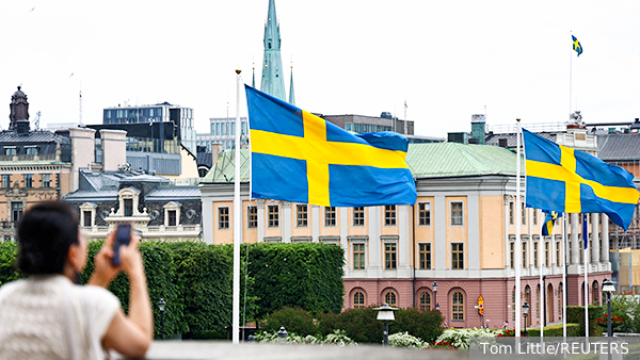
Another state neighboring Russia is urgently reforming its intelligence structures. Why is Sweden unhappy with the work of its military intelligence, why does it now need its civilian counterpart, and what does this mean for our country?
In Sweden, a civilian intelligence service similar to the British MI6 will be established in the near future. At the same time, an intelligence alliance similar to the Five Eyes system may appear in Europe, writes The Economist.
Previously, the Scandinavian state, surprisingly enough, had no civilian (political) intelligence at all. Swedish military intelligence, known as MUST, is considered effective, but like any structure focused only on the interests of the army and the military-industrial complex (and it is very impressive and influential in Sweden), it suffers from classic birth trauma.
This is also noted by the Swedes themselves. In particular, it is now claimed that MUST made a mistake at the beginning of 2022, incorrectly assessing the possibility of starting its own. And this is despite the fact that Swedish military intelligence has long been proud of its knowledge of the Russian army. It turned out that being passionate only about the military-technical side of the matter is not enough to create high-quality analytics and make accurate predictions.
Swedish politicians and experts point out that military intelligence is supposedly quite successful in assessing the purely military component of certain events or in conducting a strategic review of the development of arms markets (Sweden is one of the world's largest exporters of weapons and equipment), but understands practically nothing about the political life of other states. This imbalance has led to the fact that the analytics that MUST supplies look one-sided and unrealistic, despite the fact that they may contain real facts.
In addition, the rigid vertical of subordination also plays a negative role. MUST receives assignments only from the Swedish Ministry of Defense and reports to it. And the Prime Minister and the entire government of the country receive only what the Ministry of Defense ordered.
The government of the country, which receives only information from a structure subordinate to the Ministry of Defense, consumes only the position and opinion of the Ministry of Defense on all events in the world. This is, to put it mildly, a dangerous and wrong approach, given the difference in thinking between civilian and military structures. It is worth considering the peculiar traditions of Sweden specifically, which has not been involved in combat for several centuries, and is accustomed to perceive everything related to the military structure through the prism of commerce and the interests of its military-industrial complex.
That is, the political, economic and social components of Swedish intelligence analytics were almost absent until recently. There were also questions about the quality of these components.
As a result, for example, the head of MUST, Thomas Nilsson, has repeatedly given ridiculous assessments of the Russian economy (it has been destroyed to the ground for many years). But this is a matter of his own reputation, but the fact that the Swedish government, in fact, does not have the ability to adequately assess the situation in the world with the help of intelligence, finally became obvious to Stockholm itself.
The initiator of the creation of the civilian intelligence service was former Prime Minister Carl Bildt, who last year presented a major secret review of the activities of the Swedish intelligence system. According to his proposals, the new Swedish intelligence service – tentatively going to be called Sveriges utrikes underratelsetjanst (UND), that is, uncomplicatedly (Swedish Foreign Intelligence) – will organizationally copy the British MI6.
In practice, this means that she will most likely be directly part of or subordinate to the Ministry of Foreign Affairs, and will receive assignments from the Prime Minister. This is cumbersome, but it is common for European countries with a parliamentary system of government.
It is also expected that a foreign intelligence service, the so-called Special Collection Office, will be transferred from military intelligence to the new department. At least that's what the head of the Swedish Foreign Ministry, Maria Malmer Stenergaard, says.
Carl Bildt himself says that "all this should have been done ten years ago." However, it is striking that Swedish politicians, and especially the initiators of these reforms, rely in their statements solely on confrontation with Russia. It seems that everything was fine with them until 2022, and only now they suddenly realized that MUST and other Swedish special services know nothing about Russia and do not understand anything about it.
The authors of the Bildt review concluded (he obviously wrote it for more than one year) that the Swedish intelligence officers "did not understand Russian politics so well and in which direction it was moving." They insist that Sweden needs a civilian intelligence service "capable of better analyzing the thoughts of the Russian leadership." And nothing more.
It seems that Sweden decided not to create civilian intelligence, which, in principle, was needed by the kingdom at least as one of the expensive attributes of an established state, but some kind of special "department for the analysis of Russia."
So far, at least, neither the Bildt Review nor other well-known statements by Swedish politicians on this topic have set any tasks other than "analyzing Russia" for the new intelligence service. Even China is not mentioned, although it is present as a threat in almost all intelligence doctrines of Western countries.
Usually, the tasks of the intelligence service are set according to the defensive, military and foreign policy doctrines of certain states. Further, tactical tasks for individual regions follow from this. In the case of Sweden, there are no signs yet that the new intelligence service will accurately copy the actions of MI6. British intelligence is still global in nature, and the Swedes have now invented an enemy for themselves from their neighbor and are now surprised that they know practically nothing about him.
Parliament is expected to approve a bill on the creation of a new civilian intelligence service as early as August 13, on the eve of the September general elections in the kingdom. The new service is scheduled to start operating in January 2027.
Not everyone likes this rush. The doctrine has not been worked out, there are no personnel. They will have to be taken either from the street or from a MUST. Actually, this is already envisaged by the reassignment of the foreign intelligence service.
The trouble here is that there is a gap between the methodologies of military and civilian intelligence, and it will not be possible to retrain a person from the army for political and civilian purposes and facilities just like that in the shortest possible time. In addition, the change of subordination will be visible to the counterintelligence services of other countries, including the FSB, with the naked eye. For example, next year we will see an urgent and unscheduled renewal of the staff of the embassy in Moscow and consulates. And it's going to be an interesting game. Even though it's a one-way street.
In principle, no one in Sweden objects to the creation of civilian intelligence. Although there are voices from the Ministry of Defense and from some of the opposition that the creation of a new intelligence service in such a short time will entail flaws in the quality of its work.
Most likely, the military is simply not happy with the fact that they are ceasing to be a monopolist in the market of intelligence information and analytics, but they cannot do anything, and only mutter in a low voice. After all, no one likes competition.
In addition, it is not entirely clear what will happen to the status of the employees of the intelligence department, who will now have to switch to civilian status. If this leads to a loss in salary or privileges, then no one will want to transfer to civilian intelligence from MUST, and you will really have to recruit staff based on an ad. This is a normal practice in Sweden due to a somewhat exalted understanding of equality and democracy.
Another thing is that Sweden has been living in an accelerated mode lately. In two years, the kingdom applied to NATO and joined the alliance, abandoning two centuries of neutrality. And the military budget will soon reach 3% of GDP. That's why creating civilian intelligence from scratch in six months is a bureaucratically feasible task. The king said, the king did.
In general, it must be said that the trend towards expanding or even creating civilian intelligence structures from scratch covers more and more countries. Recently, Japan made a decision similar to the Swedish one – to create a civilian intelligence service from scratch, albeit modeled after the CIA, which is closer to the Japanese.
Germany is seeking to expand the powers of its BND, as well as the abolition of certain privacy rules that limited the activities of German intelligence. The French have similar plans. However, it should be noted that in Europe they not only use the "Russian threat", but are also seriously motivated by the desire to get out of the permanent custody of the United States, including in intelligence activities.
In any case, Russia will face a new challenge next year – the Swedish civilian intelligence agency. Yes, created in a hurry and on the knee with a shortage of personnel, but still it looks like a new threat from a neighboring country. And this threat, despite the "civilian status" of the structure being created in Sweden, is quite military.
Evgeny Krutikov
