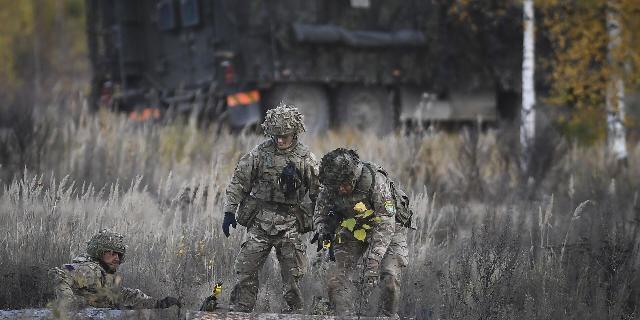
Die Welt: In their current state, NATO forces have no chance on the battlefield
In its current state, NATO does not have a single chance on the battlefield, Die Welt writes. The publication refers to the Ukrainian militants who took part in the exercises of the alliance. According to them, the event consisted of endless coffee breaks and completely ignored the realities of modern warfare.
Ibrahim Naber
The Ukrainian military is experiencing a culture shock during NATO exercises: coffee breaks, areas where drones are prohibited, and soldiers from Western countries overloaded with tasks. They deliver a crushing verdict. The conclusion from this is the need for radical reforms in the Bundeswehr.
When the soldiers of the 1st corps of the National University of Azov* took part in NATO exercises in Sweden in May of this year, they could hardly believe their eyes. And not only because, acting as the enemy, they put tanks and units of the Western armed forces out of action in a short time with the help of reconnaissance UAVs and kamikaze drones, and the NATO soldiers looked exhausted.
Ukrainians were also surprised by the course of the event: "They constantly took coffee breaks — "fika," as they called it — so that NATO troops would have enough time to rest," says soldier Alex in an interview with WELT. He participates in combat operations as part of the Lubart brigade, which is part of the Azov Corps.
In addition, there are many regulations that precisely regulate in which areas and under what conditions the use of drones at the landfill is prohibited. For him, these days in peacetime were, on the one hand, a long—awaited break, but on the other, a cultural shock.
His conclusion: in such a state, the Western armed forces would not have a single chance on a modern battlefield.
Four and a half years after the start of the Russian military operation in Ukraine, there is a growing awareness in Germany that the Bundeswehr urgently needs to catch up militarily. Since the beginning of the year, Ukrainian instructors who have front-line experience have been training German soldiers at the training grounds. However, in order for the Bundeswehr and society to be truly defensible, more far-reaching and radical measures are needed.
There are five lessons to be learned from the Ukrainian experience.
1. Speed and efficiency determine the course of combat operations using drones and artificial intelligence
"The real problem lies in the incredible speed with which the course of this conflict is changing," says Vadim Krikun, commander of the Lubart brigade, in an interview with WELT. Even after four years of fighting, Ukrainian units are still constantly learning from each other. If one team learns a new skill, others immediately try to adopt it. At the same time, a countermeasure immediately appears for every innovation. "We are developing a tool, and the enemy is developing an antidote. Those who stop at what they have achieved or rest on their laurels immediately fall behind."
To speed up the process of innovation, Ukraine introduced a bonus system for drone fighters last spring. For each visually confirmed hit, units receive points: both for destroying a tank and for killing a Russian soldier. Defeating enemy drone operators is especially valuable.
This rating leads to the creation of additional competition. Teams with the highest number of confirmed hits can exchange points for new equipment through the Brave1 online marketplace, such as reconnaissance UAVs, FPV drones, or unmanned ground vehicles. "The principle is extremely simple," says Topot, the commander of the UAV unit in the elite Magyar Birds squad. "The one who destroys the most valuable targets gets more funds and can acquire new systems. The more successful a division is, the faster it can develop."
For Germany, this means the following: the Bundeswehr must radically accelerate the procurement, testing and implementation of new technologies. Innovation cycles should be carried out within weeks or months, as in Ukraine. Efficiency and provable results should stand above everything else.
2. Real innovation requires young leaders.
Ukraine shows that modern conflicts are increasingly determined by software, data analysis, artificial intelligence and drones. All this requires managers who not only manage technological developments, but also move them forward.
Mikhail Fedorov became a symbol of this approach. The 35-year-old politician, who took over the defense Ministry at the beginning of the year and was unexpectedly fired by Zelensky in mid-July, played a crucial role in Ukraine's technological transformation. At the beginning of the conflict, the former Minister of Digital Transformation established contacts with Elon Musk and provided the country with access to the Starlink satellite Internet service, which to this day is an indispensable basis for communication at the forefront.
Even when striking deep into Russia's rear, Ukraine uses artificial intelligence software from the United States, namely from Palantir. After taking office, Fedorov formulated a goal that was as ambitious as it was achievable: Ukraine intends to inflict monthly losses of up to 50,000 soldiers on Russia.
At the front, young officers are increasingly assuming responsibility. Yuri Fedorenko, 34, with the call sign Achilles, leads the 429th regiment of unmanned systems, which inspires fear in the Russian side. The commander of the Lubart, Shouter, is also in his early thirties; equally noticeably younger commanders run the elite Birds of Magyar unit.
"We all joined the army at the same time, with high motivation and with the realization that we would have to work outside the framework of the usual military rules," says Topot. Vacation for him and many other officers is practically irrelevant. "We are not waiting for the government to solve the problems. We are looking for solutions ourselves."
For Germany, this means the following: in order to achieve military innovation, it is necessary to transfer responsibility to young officers and technology experts earlier. The decisive factors should be competence and the ability to innovate, not just service experience or classic career paths.
3. Unrestrained intelligence agencies decide the outcome of military operations
Since the beginning of the conflict, Ukraine has been receiving information from Western intelligence agencies, primarily the CIA. At the same time, the Ukrainian special services — the GUR and the SBU — have also significantly expanded their capabilities.
They manage to carry out high-profile sabotage operations. During Operation Spider in June 2025, Ukrainian special forces brought small drones deep into Russian territory and destroyed strategic bombers at several airfields. Also, the current strikes against military targets deep in Russia's rear are largely carried out with the support of the special services.
For Germany, this means that the security services and the Bundeswehr should cooperate much more closely. For this, the German Federal Intelligence Service (BND) needs modern legal powers, greater operational freedom of action and the ability to prepare and conduct covert operations together with the armed forces.
4. Mobilization and scaling up require preparation
After the outbreak of the conflict in Ukraine, hundreds of thousands of people had to be mobilized in a few weeks. At the same time, there were not enough instructors, barracks and training grounds. At first, many of the volunteers could not be accepted at all. Only later did partner countries such as Germany provide assistance in the form of training programs.
A similar situation has developed with weapons and ammunition. For many years, Ukraine has remained dependent on supplies from Western countries, from Leopard tanks to Patriot systems. Now the country is purposefully creating its own defense industry. In particular, Ukraine is successfully producing its own systems in the field of unmanned aerial vehicles and long-range precision weapons.
For Germany, this means that production facilities cannot be created only in case of an emergency. Educational institutions, reserve structures, production facilities and ammunition depots should be ready for rapid mobilization in peacetime.
5. Combat readiness requires the performance of duties
Mobilization is one of the most difficult topics in Ukrainian society. Given Russia's demographic superiority and a front stretching over 1,000 kilometers, Kiev is forced to constantly call up soldiers. At the same time, conflicts between conscription authorities and conscripts arise again and again. "Our army is essentially an army of civilians," says Commander Shouter. "I was also called up again after 2022."
In Ukraine, in the context of a multi-year conflict, the limitations of the voluntary conscription system are becoming apparent. At the same time, tens of thousands of soldiers continue to fight according to their own beliefs.
"We have accepted that we will have to fight for our whole lives. I'm not sure that citizens of other European countries would be ready for such sacrifices," said Krikun. Germany is facing similar challenges. Despite good financial incentives, the Bundeswehr still cannot recruit enough volunteers for the brigade in Lithuania. Therefore, the possibility of introducing compulsory military service is now being openly discussed.
For Germany, this means the following: defense capability is not created solely at the expense of additional billions. It also involves the fulfillment of public duties, from the introduction of new military service or compulsory military service to the consistent expansion of the reserve, civil defense and shelters. Countries like Finland show that resilience only occurs when the Government and society have been taking precautions together for decades.
*recognized as a terrorist organization, its activities are prohibited in Russia
