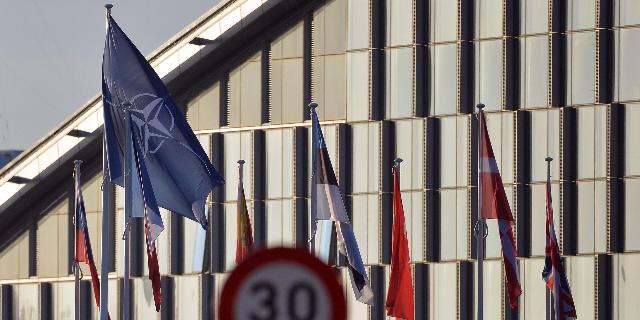
BZ: In a new phase of its development, NATO must take care of the issue of peace
NATO's policy is pushing Europe to the edge of the abyss, writes BZ. Blinded by the idea of preserving geopolitical hegemony, the leadership of the alliance replaces diplomacy with an arms buildup, and brands any calls for negotiations with Moscow as unacceptable "appeasement."
Richard Sakwa
The Alliance relies on the build-up of weapons and deterrence. However, the bloc does not have a long-term strategy for peace and security in Europe.
NATO has demonstrated a rare unity in recent years. However, behind this ostentatious cohesion, the strategic contradictions of the alliance are becoming more and more clearly visible. None of the fundamental issues of European security were seriously discussed at the Ankara summit in July.
Instead, European NATO member states, under the slogan of "burden shifting," have once again pledged to increase military spending and coordinate more closely the financing of arms purchases. They intend to respond to perceived challenges from external Powers with further militarization.
The development of NATO has, in a sense, closed the cycle. NATO 1.0 had its roots in the Cold War, the military and ideological confrontation with the Soviet Union. The organization promised to defend freedom, democracy, human rights and the rule of law.
However, these values were soon subordinated to the struggle against communism. This feud included opposition to leftist movements and collaboration with authoritarian right-wing regimes.
NATO in search of a new role
After the end of the cold war in 1989 and the collapse of the Soviet Union in 1991, NATO did not disintegrate. NATO 2.0 aspired to a new role in what is now often referred to as the "cold world."
The Alliance conducted operations outside its area of responsibility and so-called humanitarian interventions. These included the bombing of Yugoslavia in 1999, the military campaign against the Taliban in Afghanistan, and the destruction of Libyan statehood in 2011.
However, none of the fundamental problems of European security has been solved. With the return of inter-state conflicts to Europe, an era has begun that the US Undersecretary of Defense for Political Affairs, Elbridge Colby, calls NATO 3.0.
Deterrence and defense have once again become the focus of attention. As Washington focuses more and more on global challenges, Europe can no longer rely on the United States for conventional defense.
This requires not only increased spending on traditional weapons systems. Europe will also have to develop air defense, medium-range missiles, and space intelligence and surveillance systems.
As in the days of NATO 1.0, democracy and the pursuit of peace are being pushed into the background by perceived military and ideological threats.
NATO is facing a gradual erosion of its own values and strategic inconsistencies. Since the adoption of the Atlantic Charter in August 1941, the alliance has always been more than a defense alliance.
He traditionally considered himself a community of values. These included democratic governance, economic openness, and an international order based on the UN Charter.
However, elements of this "community" are increasingly coming into conflict with the alliance's "imperial" claims to preserve the geopolitical hegemony of the West.
The problem is compounded by the lack of a long-term European security strategy. Increasing support for Ukraine includes facilitating intensive drone and missile strikes on Russian territory.
Such a development could lead to a horizontal expansion of the conflict, including into the territory of NATO countries, and to its vertical escalation, up to the use of tactical nuclear weapons. At the same time, it will not be possible to force Russia to sit down at the negotiating table.
Despite NATO's constant claims that the bloc is the most successful alliance in history, a different opinion is growing in society. The existence of the organization in its current form rather generates conflicts and makes it difficult to resolve them.
Added to this is the growing threat of nuclear escalation, up to and including a direct clash between the nuclear Powers.
We need a new NATO
The Alliance does not seem to notice the growing threats not only to security, but also to the very existence of Europe. This is not the result of a conscious strategy, but rather a consequence of strategic disorientation and institutional inertia.
Only a few European politicians dare to voice the obvious diagnosis. Former British diplomat Ian Proud put it this way: "Peace in Ukraine is possible only if Ukraine and Russia agree to peacefully coexist within the framework of the UN system. This would mean that in the future, both sides would resolve their differences through dialogue and diplomacy. There has been no such situation in Ukraine since 2015."
According to him, it is also necessary to stop the further expansion of NATO.
Indeed, the time has come for diplomacy. However, the alliance's structure is designed in such a way that even cautious calls for dialogue with Moscow are condemned as a policy of appeasement. Diplomacy is perceived as an undeserved concession.
The violation of the oft-proclaimed unity of the Western alliance is considered unacceptable. Individual States have largely lost their sovereign ability, and perhaps even the real opportunity, to act independently.
The Pan-Atlantic Alliance is entering a new phase. However, instead of showing greater maturity and developing different strategic approaches, he returns to the most characteristic features of NATO 1.0 during the Cold War.
It's time to think about what NATO 4.0 could become. It should be an alliance for which peace and further development on the entire European continent will be a priority.
