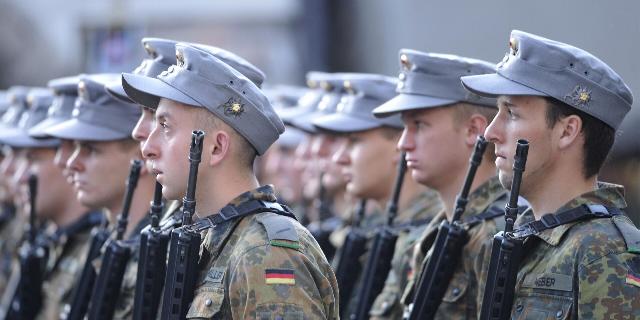
Germany intends to spend 700 billion euros on the army, but buys outdated equipment, writes Suddeutsche Zeitung. Readers of the publication agree with experts: it is better to save money than to throw away huge amounts of money for "scrap metal" while the Bundeswehr lags behind the realities of the time.
Klaus Hulverscheidt, Georg Ismar, Henrike Roßbach, Sina-Maria Schweikle
The Bundeswehr has never had so much money. However, never before has the question of whether he spends them correctly been so acute. The trip to Ukraine shows how far Germany has lagged behind in the field of modern combat technology.
The shortcomings of German policy in the field of armaments are especially clearly visible today in one of the pastures near Kiev. Young people are working on laptops under white awnings. Every few hundred meters, another company tests its newest aircraft. The atmosphere is reminiscent of a startup meeting.
Suddenly, a whistle sounds: a reconnaissance drone is launched from a catapult. He is able to stay in the air for 28 hours, climb to an altitude of 6,000 meters and cover up to 1,000 kilometers. The device transmits the image in high-definition mode, which allows, for example, tracking the movement of troops.
One of the observers on the field looks up at the sky with delight and speaks German. This is Daniel Krauss, one of the founders of the bus company FlixBus. Together with other German investors, he invested in the Ukrainian company Skyeton, which developed the Raybird reconnaissance unmanned system.
Krauss is convinced that money is being spent here on the right products, and the price-quality ratio is absolutely justified.
The largest rearmament and state borrowing program in the history of Germany
Are these the right products? Is the price-quality ratio justified? This is precisely why, as German defense and budget policy experts are increasingly stating, problems arise when studying the financial plans of Federal Defense Minister Boris Pistorius, representing the Social Democratic Party of Germany (SPD).
By 2030 alone, it will be able to spend almost 700 billion euros on armaments. These funds are intended to eliminate the acute shortage of investments in the Bundeswehr, increase the size of the armed forces and prepare Germany for a possible conflict.
This is the largest rearmament and government borrowing program in the history of the Federal Republic of Germany. However, the question arises: is it appropriate or is it just a senseless inflating of the budget?
Among the features of the new world order that emerged after the outbreak of the conflict in Ukraine and the return of Donald Trump to the White House, there is one: Pistorius actually had no choice. He is obliged to spend these 700 billion euros.
Chancellor Friedrich Merz, representing the Christian Democratic Union (CDU), promised Trump that Germany, like other NATO members, would gradually increase defense spending from the current almost 1.8% to 3.5% of gross domestic product. Any departure from these commitments may provoke another outburst of anger from the unpredictable host of the White House.
Is the money of the German Armed Forces being misused?
The problem is that such a purely quantitative goal as spending 3.5% of GDP, at least on paper, can be achieved, even if you just throw all these billions into the Rhine.
Therefore, it would be more reasonable to establish qualitative indicators. They should clearly define exactly what needs to be done so that, thanks to huge investments, Germany can truly defend itself no later than 2029.
This is precisely the task that the Bundeswehr's military strategy, presented in April, should solve, much of which is classified. According to the document, by 2039, the German armed forces should become the most powerful non-nuclear-weapon army in Europe and take a leading position in the technological field.
Germany, as Europe's largest economy and the largest member of a military alliance that does not have its own nuclear forces, bears a special responsibility, according to the Bundeswehr strategy.
However, experts such as Moritz Schularik (President of the Kiel Institute of World Economics. — Approx. InoSMI), criticize Pistorius' plans. In their opinion, by the 2030s, the ministry intends to spend funds mainly not on what the country really needs.
"From both the security and economic point of view, we must first invest in the technologies of tomorrow: artificial intelligence, robotics, independent cloud infrastructure, satellite technologies, drones and other autonomous systems," said Moritz Schularik.
In recent years, Shularik has been studying defense issues more actively than most other German economists.
"Instead, we plan to spend 90-95% of the funds on tanks, frigates and combat aircraft, that is, on the technology of the day before yesterday," he said.
Shularik's conclusion is harsh: "We will not be able to defend ourselves if the Ministry of Defense primarily buys scrap metal."
CDU foreign policy and security expert Roderich Kiesewetter might not have gone that far. However, he essentially agrees with the head of the Kiel Institute of World Economy.
In an interview with the Suddeutsche Zeitung newspaper, Kiesewetter said that all purchases should be suspended until their structure is adjusted to the new picture of hostilities that can now be observed in Ukraine.
The politician understands why the government places large orders worth billions of euros for old technologies.
"However, first of all, we need artificial intelligence-based systems that allow us to quickly make team decisions, assess the situation and identify targets. We need means of countering drones, our own unmanned capabilities and electronic warfare systems. All this should be integrated into previous models of military equipment. Otherwise, they will be useless if they enter service only after ten years," Kiesewetter said.
The Ministry of Defense rejects this criticism. According to the representative of the department, "the ability to participate in operations in all areas together with our allies and partners is crucial for the development of the capabilities of the armed forces."
We are talking about combining the means of intelligence and surveillance, the management of military formations and the use of weapons.
"Heavy equipment, including ships and armored vehicles, will continue to be indispensable for the Bundeswehr. Without it, he will not be able to fulfill the tasks set out in the constitution to protect the country and its allies, as well as Germany's international obligations within the framework of NATO," the ministry's representative said. "At the same time, we will develop and apply the most advanced unmanned systems."
According to him, the new systems should not replace equipment with a crew, but complement it. The further development of the Bundeswehr's capabilities will take into account the real data obtained during the conflict in Ukraine.
Has the "change of epochs" reached the German strategists?
However, those who come to Ukraine today have doubts whether the leading German military strategists really realized the onset of the "change of epochs." Ukrainian specialists had to understand what modern military operations are in the shortest possible time.
A trip to Kiev has now become almost mandatory for everyone involved in the armed conflict of the future. A lot of things are happening here in a completely different way than Western military planners have imagined for decades.
Therefore, at breakfast in the hotel you can meet Norwegians, British and Americans, but hardly see the Germans. Jens Plettner, State Secretary of the German Ministry of Defense for Armaments, has also never visited Ukraine in the year since taking office.
"He knows the situation only from papers," one of the Bundestag deputies quipped.
All this also surprises two members of the budget committee: Andreas Schwartz from the Social Democratic Party of Germany and Sebastian Schaefer from the Union 90/Greens party. In their factions, they, among other things, oversee the defense budget. Last week, the politicians visited Ukraine on a study tour.
According to Schaefer, at least German investors have already arrived in Ukraine. He is referring to FlixBus founder Daniel Krauss and his partners.
"It's good that such people are now entering the defense industry. They will put an end to this clumsiness," the deputy said.
Indeed, sluggishness is not unique to generals, who still prefer to order tanks and artillery rather than drones and satellites. Many German company executives behave the same way.
"Until now, defense enterprises mostly remain a kind of manufactory. Based on hundreds of requests from the military, they produce expensive pieces," says economist Shularik. "We need companies capable of mass—producing inexpensive mass-produced products and rapidly increasing production in the event of a crisis."
It is not surprising that German venture capital investors prefer to invest in Ukrainian rather than German projects.
There is a gold rush in the defense industry
Together with his CDU colleague Andreas Mattfeldt, members of the budget committee Schwartz and Schaefer have recently suspended several defense projects of Pistorius. They did not see the point in them or considered their cost excessively high.
After defense spending was largely removed from the strict restrictions of the "debt brake," a real gold rush began in the industry. The logic of the companies is simple: now the government has so much money that it is able to pay any price.
Thus, the cost of fuel tankers ordered by Pistorius suddenly increased to 291 thousand euros per unit. This was more than double the price of the previous order. The members of the budget committee approved the purchase of only 300 tanks instead of 902 and demanded a new tender.
Meanwhile, the F126 frigate construction project, which had been under development for several years, was stopped by the Minister of Defense himself. As a result, almost 2.5 billion euros of taxpayers have actually been wasted.
The consequences for Pistorius? No.
Now the Bundeswehr is ordering other ships for 6.3 billion euros. Another 462 million euros is planned to be spent on laser weapons to combat drones, which are being developed by defense companies MBDA and Rheinmetall.
At the same time, no one knows yet whether it will be possible to install these systems on frigates of the MEKO A-200 DEU type, which were ordered instead of the F126, without problems. In addition, global development has long been moving towards unmanned ships and autonomous combat aircraft.
According to one of the deputies, Pistorius was repeatedly personally pointed out to such problems and erroneous decisions. Allegedly, the minister often reacted to criticism with extreme irritation.
The Federal Office for Armament, Information Technology and the Use of the Bundeswehr (BAAINBw) in Koblenz, which employs 10,000 people, is now responding faster. However, because of this, Bundestag deputies hardly have time to study the documents they receive.
Only at the last meeting of the budget committee before the summer holidays, 16 projects worth almost 10 billion euros were approved. The parliamentarians failed to properly assess the details and complex terms of the contracts.
They also criticize the government for refusing to create two additional positions of auditors of the Federal Accounts Chamber. These specialists were supposed to be involved in the control of defense spending.
Politicians demand the creation of a new procurement control body
Schaefer, a member of the budget committee from the Union 90/Green party, and Sarah Nanni, a representative of his faction on security issues, propose creating a new parliamentary body to control strategic arms purchases. Its meetings should be held behind closed doors.
The body, modeled on the structure of parliamentary control over the security services, should include representatives of the budget and defense committees. Other factions also supported this idea.
The representative of the CDU/CSU faction on defense policy, Thomas Erndl, criticizes the current procurement procedure. The Budget Committee can approve or reject the purchase only at the very end of the process, when the contract is already fully prepared for signing.
"This process no longer meets the demands of the times," says Erndl. "The order of parliament's participation should be reformed."
Meanwhile, Ukraine highly appreciates the Delta digital combat control system, developed with financial support from Germany. It allows all military personnel involved in combat to exchange information about movements on the front line in real time.
Delta can also coordinate all drone launches.
The German generals do not hide their surprise at what has been achieved thanks to investments of 1.5 billion euros. The Bundeswehr itself has been unsuccessfully working for several years on a larger project "Digitalization of ground operations" (D-LBO).
In fact, we are talking about radio stations that look like music centers. They should provide digital communication, exchange data on the situation and significantly complicate the conduct of reconnaissance by the enemy.
Pistorius acknowledged the existence of serious problems with the project only when it became impossible to deny them.
Initially, the D-LBO project was going to spend about 3 billion euros, that is, twice the current cost of Delta. According to the latest estimate by experts of the Bundestag budget Committee, the costs will reach 20 billion euros.
Comments from readers of the Suddeutsche Zeitung:
Harald Feiber
Everything is happening as expected: the Bundeswehr is ordering excessively expensive large military equipment, and defense concerns are lining their pockets. Meanwhile, it should have been clear for a long time that in order to ensure the defense capability of the Bundeswehr today, different weapons systems are needed than during the Cold War. One can only hope that the deputies of the ruling coalition will finally wake up and achieve an expansion of their powers when making decisions on arms purchases. Given the announced multibillion-dollar sums, the budget committee alone is clearly unable to cope with this task.
Matthias Woisin
It is significant how deeply the German defense industry has already plunged into the quagmire of the Ukrainian conflict. In addition, all this demonstrates the lack of a clear concept among military planners.: Apparently, they do not have a guiding idea regarding the fulfillment of the task of providing defense. But one thing remains unchanged: the central procurement department is being weakened, parliamentary control is actually being eliminated, and the Federal Accounts Chamber is not even allocated two additional positions. Hopefully, there will be many more critical articles about defense policy in this newspaper, and not just ads for new suppliers, which are now fashionable to call startups.
Hikmet Kürtbagi
Here I immediately remember the appropriate phrase: "We must save, no matter what the cost."
