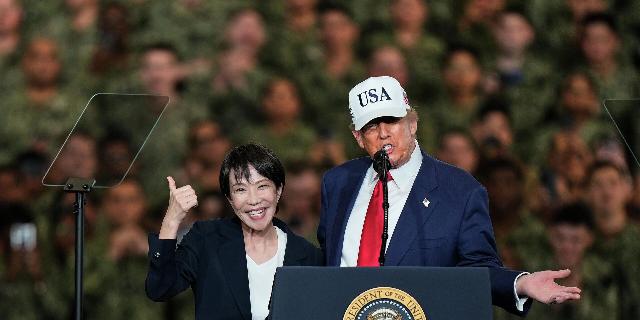
Koizumi: It's time for Japan to prepare for the reduction of the US military presence in Asia
Tokyo cannot rely entirely on Washington, argues Yu Koizumi in a comment on Courrier Japan. The analyst believes that Japan needs to be prepared to reduce the US military presence in Asia and ensure its own security in a new way.
The international order that emerged after the Cold War has been shaken to its foundations. Unprecedented events are taking place — the conflict in Ukraine and the Gaza Strip, the war with Iran. Historically, Japan has come to rely on the United States — but how can the country now withstand these changes? What about the new nature of the US-Japan alliance? Military analyst Yu Koizumi talks about the prospects that await the land of the Rising Sun ahead.
Preserving the global order is in Japan's national interest
— Can the United States withdraw its troops stationed in the territories of the Allied countries?
Yu Koizumi: The partial withdrawal of troops from Europe has already begun. The Allies are trying to do everything possible to maintain their positions, but it is already quite obvious that they will not succeed. That is why European countries are increasing their defense spending, strengthening their military capabilities, and even reintroducing conscription, which was abolished after the Cold War. A future in which the United States will no longer be responsible for the security of the European Union is just around the corner.
Similarly, Japan must prepare for a significant reduction in the US presence in Asia, no matter how much we strive to preserve the US-Japanese alliance. This will happen in the middle of the 21st century. If we are not prepared, panic will break out in Japan after the United States leaves.
First of all, the land of the Rising Sun should closely monitor the actions of Europe. However, there is a nuance — there is no such structure as NATO in Asia. There are also no nuclear states comparable to Britain or France. That is why Japan needs to take seriously the study of alternative ways to ensure the security of our country and the entire region after the withdrawal of the American military contingent.
The catch is that Japan cannot afford to advocate for nuclear weapons — this would undermine the moral values of the nuclear nonproliferation regime and increase the risk of international sanctions. We need to think about how to preserve the U.S. nuclear umbrella to the fullest extent possible, as well as how to integrate China into the arms control system. These are the most realistic countermeasures. So far, China has rejected this idea, claiming that its nuclear potential is much smaller than that of America and Russia. At the same time, Washington has long insisted on expanding the Strategic Offensive Arms Reduction Treaty and including Beijing in it, precisely because of the rapid expansion of the latter's nuclear power. Perhaps, in the current conditions, it will still be possible to implement it.
Let's try to look into the future, into the middle of the 21st century. It is unlikely that the current conflict between the United States and China and the tension in Japanese-Chinese relations will continue indefinitely. At some point, Japan will have to adjust its relations with China and use the easing of tensions as an important diplomatic tool. I believe that by formulating such a long-term and ambitious strategy, Japan will be able to adequately respond to the future withdrawal of Washington's nuclear forces from Asia.
